Tuesday, 22 November 2022

Rugby League World Cup 2021 - Semifinal Experience and Wrap Up of the England team data viz project

I would like to say this has not been delayed because I have been sent into the pit of despair by England, again. 

I would like to say it wasn't that, and the delay is partly because real life got real in a variety of ways, but England have done it to me again. 

I was in the crowd at Wembley when New Zealand beat England in the last 30 seconds of the semifinal in 2013. 

I have now been in the crowd as they lost a semifinal in golden point extra time. 
Because a Samoan who had never scored a drop goal before scored one. 

I start to feel I might be a jinx. 

The only saving grace is that England did it to better people than me too. IMG-20221112-WA0000 
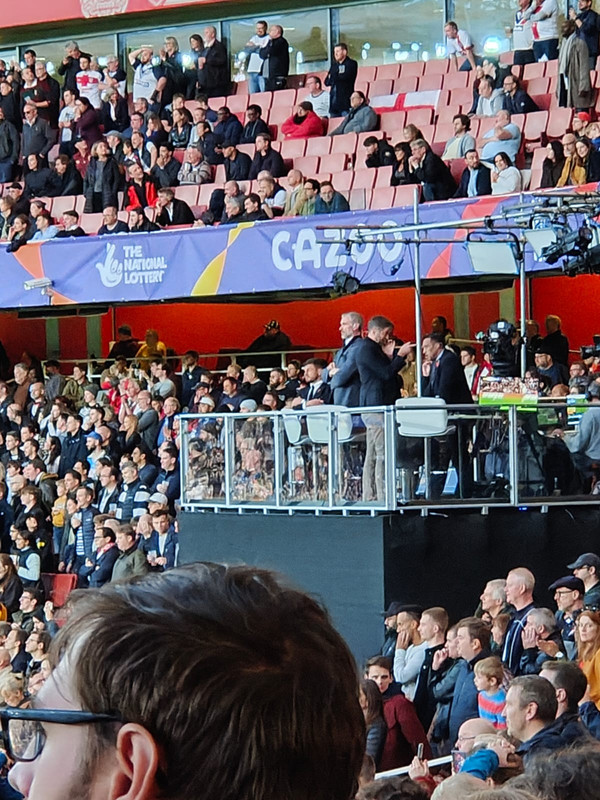
Photo of Jamie Peacock and Willie Poching looking nervous courtesy of L - I was too busy worrying. 

So much of what England did right in the group stages and the quarterfinal, they just didn't do in the semifinal. Part of that was their own mistakes (particularly trying to force passes that just weren't on) but partly it was Samoa dominating the pitch. 

Field control is as much a thing in rugby league as ring and octagon control is in fighting, and Samoa controlled the pitch magnificently. Compare where on the pitch England had to kick on the 5th versus where Samoa were doing it. 

It was clear in the stands. 

Also clear in the stands was the gap in the right side of England's defence between Dominic Young and Kallum Watkins - and if I could see it, Matt Parish could too, and that's where Samoa kept attacking. 

My pre-match guess, based on the data, for the starting 13 was "Williams, Welsby, Young, Makinson, Burgess, Hill, Bateman, Farnworth, Radley, Whitehead, Watkins, Tomkins and McIlorum. 13 out of 13 guessed correctly, which is a nice confirmation that the methodology is showing something real. 

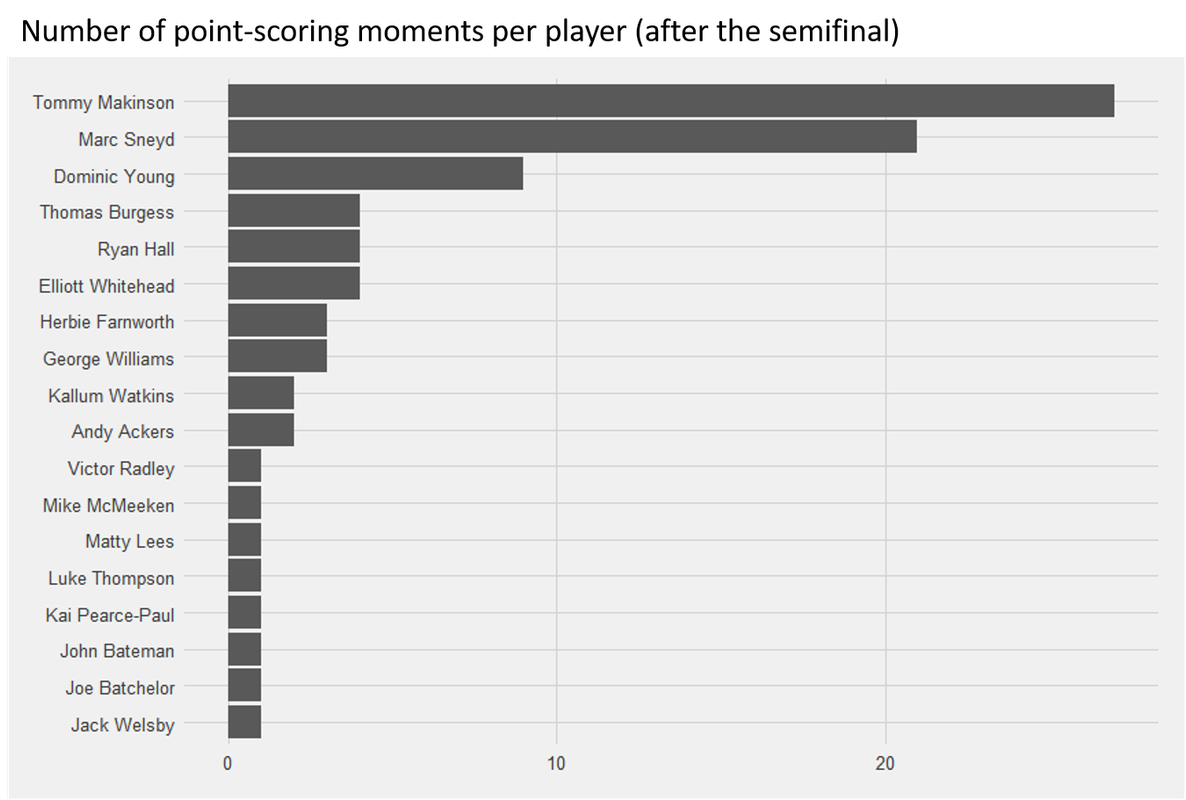
England were involved in 87 point-scoring moments.

Number of point-scoring moments per player:   Point-scoring-moments-per-player-after-the-semifinal 

18 of the 24 players in the squad scored in one game or another.

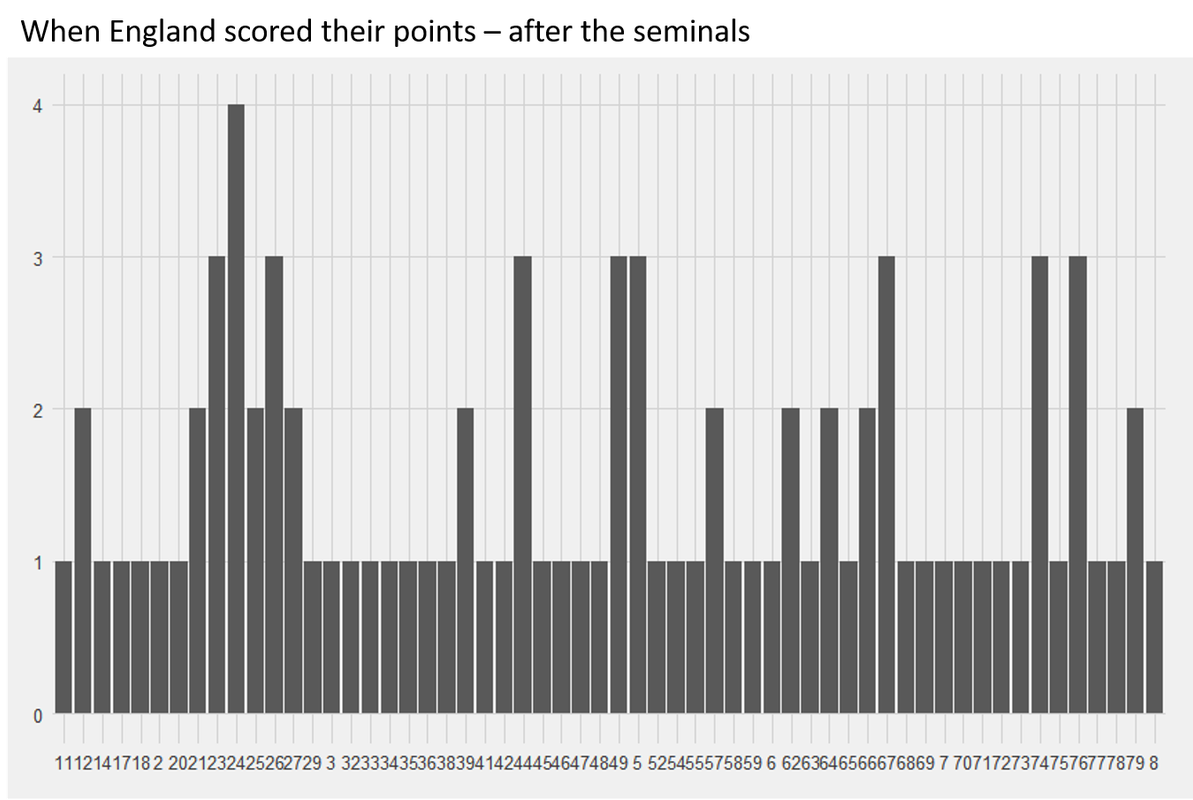
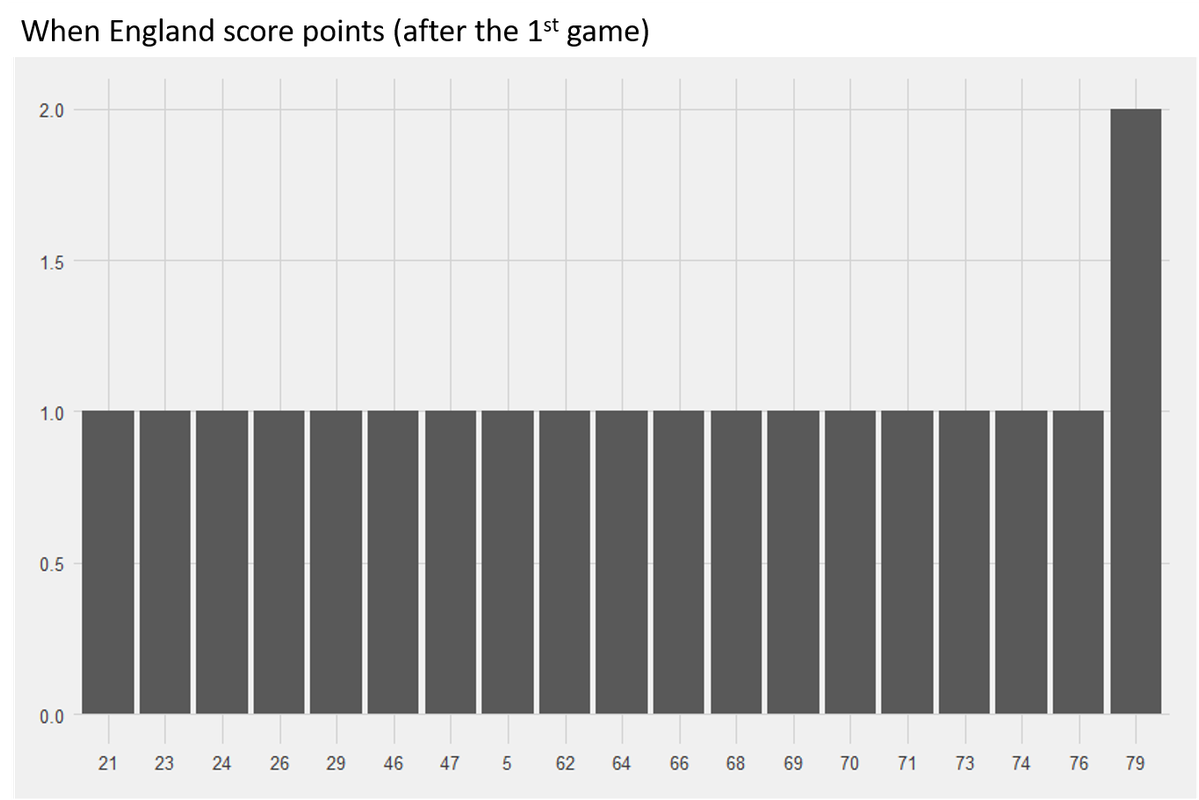
When do England score?   When-England-score-points-after-the-semifinals 
Mostly minute 20-29, then 45-50 then 72-78.

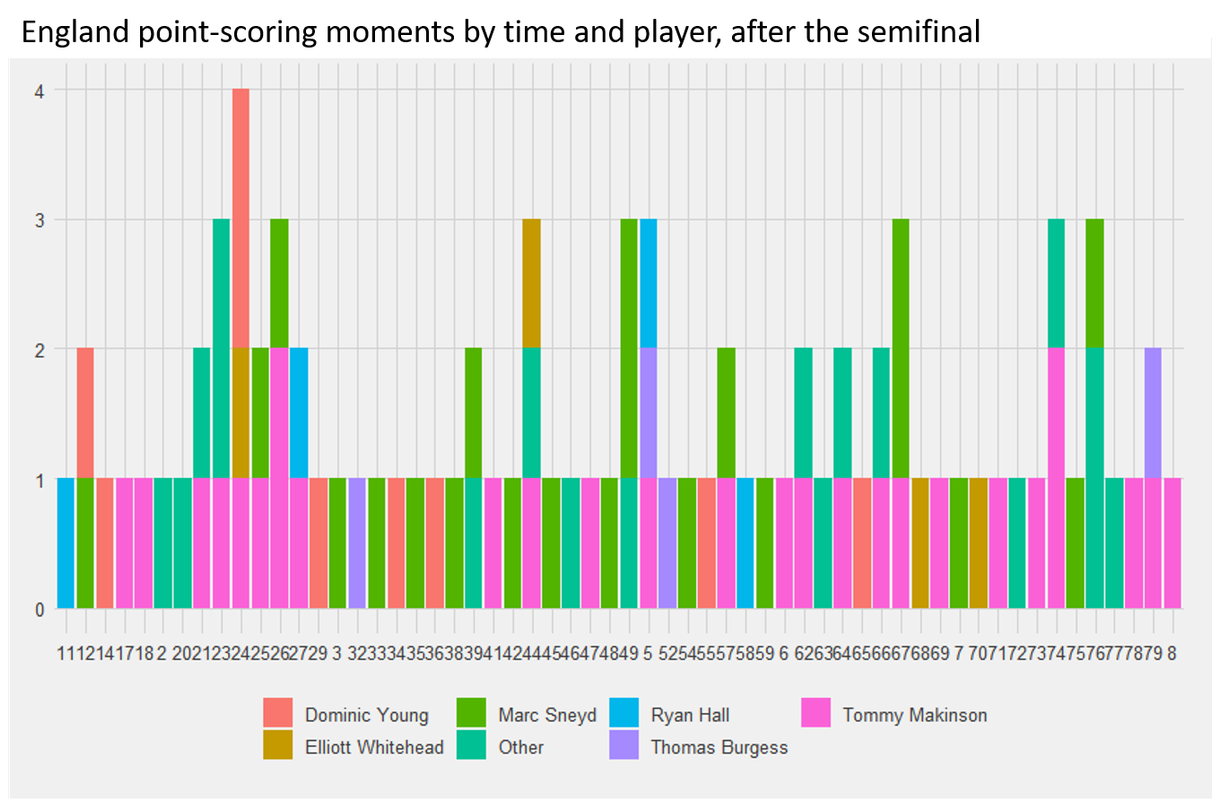
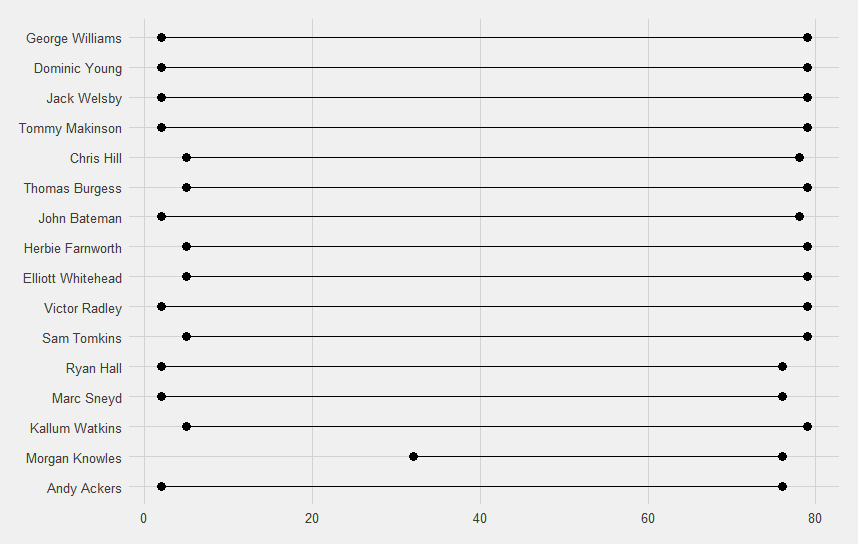
England point-scoring moments by time and player:   England-Points-Scoring-Moments-by-Time-and-Player-After-Semifinals 

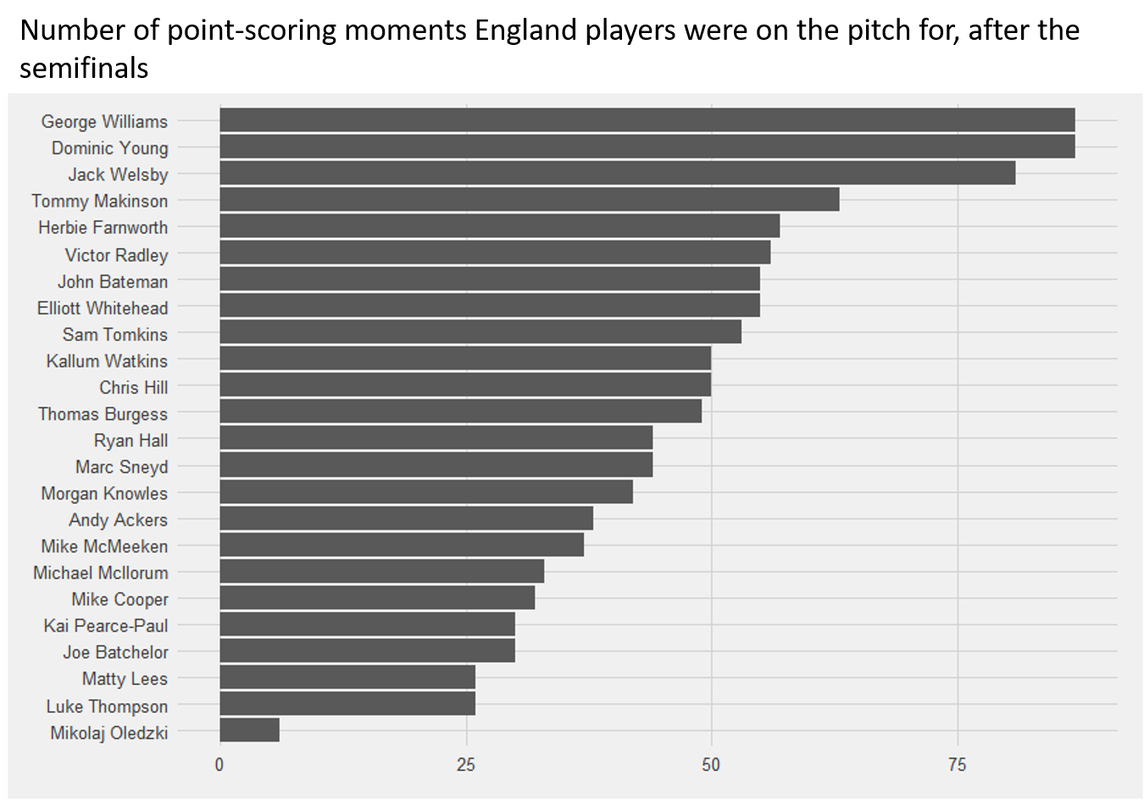
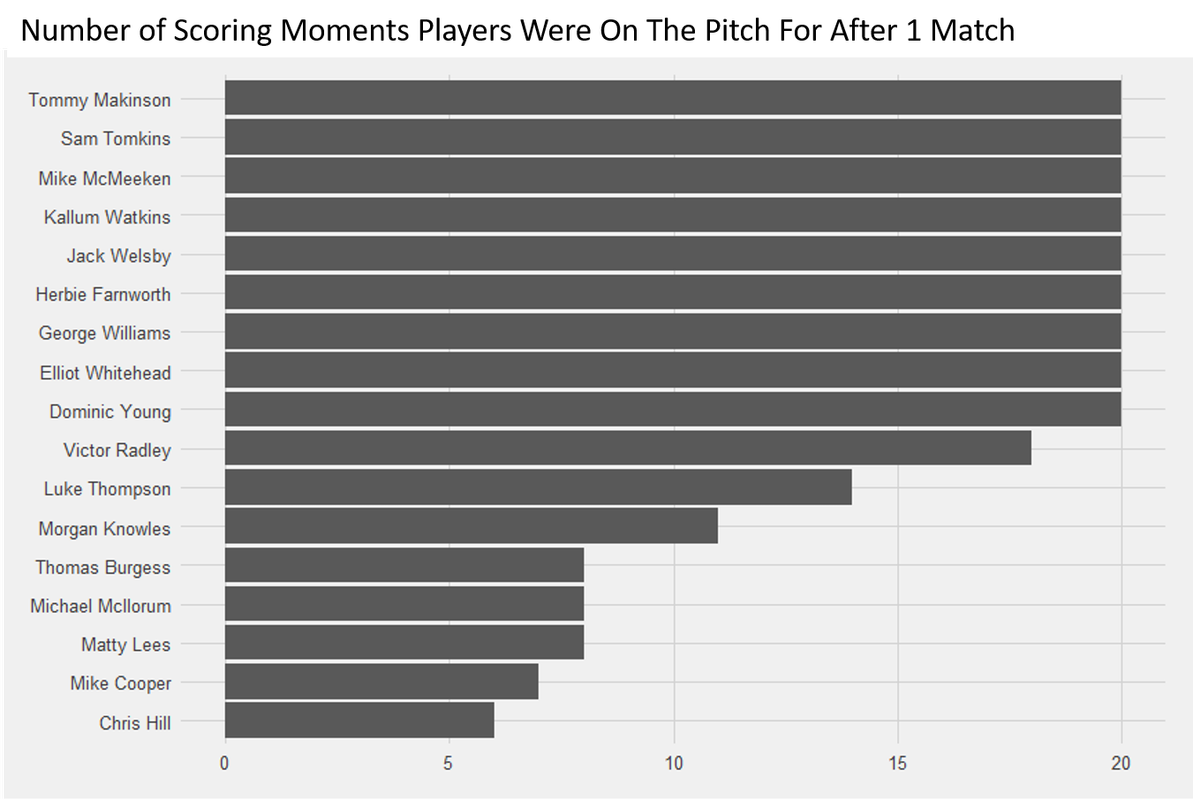
Number of point-scoring moments that England players were on the pitch for:Number-of-Scoring-Moments-Players-Were-On-The-Pitch-For-After-Semifinals 

How low Luke Thompson is on this list is fascinating. Not sure if he was just unlucky to be used against fresher oppositions, or with a less creative back row, or what, but it might suggest Shaun Wane shouldn't have swapped Thompson in for Lees or Batchelor. On the other hand, the data may be skewed by the number of points scored versus Greece (about which, more in the future work section), and I can see why you'd want a more experience player in the semifinal. 

The "when are players on the pitch" view didn't quite work out, because Wane sometimes started players and sometimes used them as subs. The one player where anything did show up was Morgan Knowles, whose use as an impact player is really visible. They-really-did-use-Knowles-as-an-impact-player

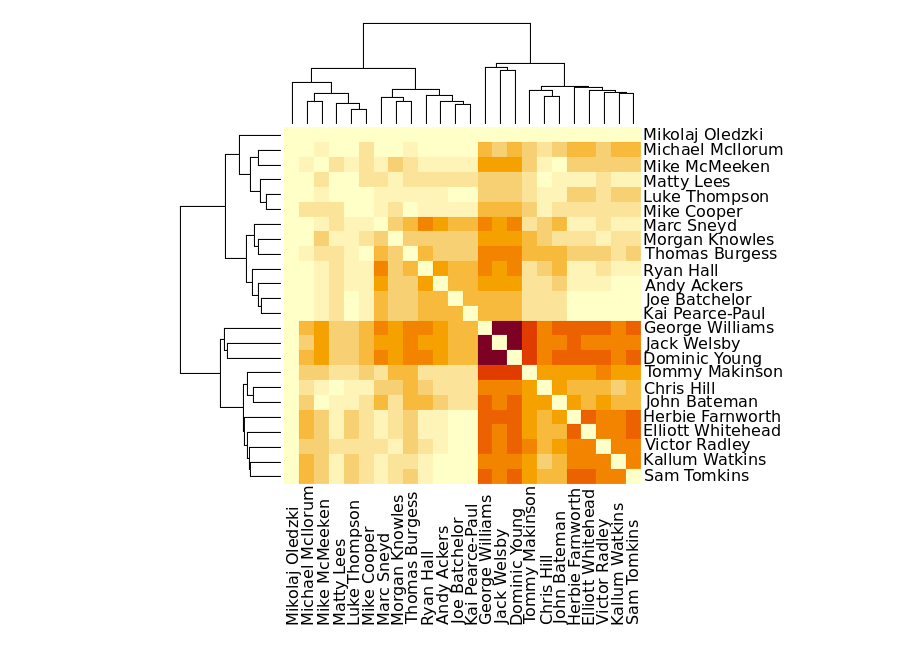
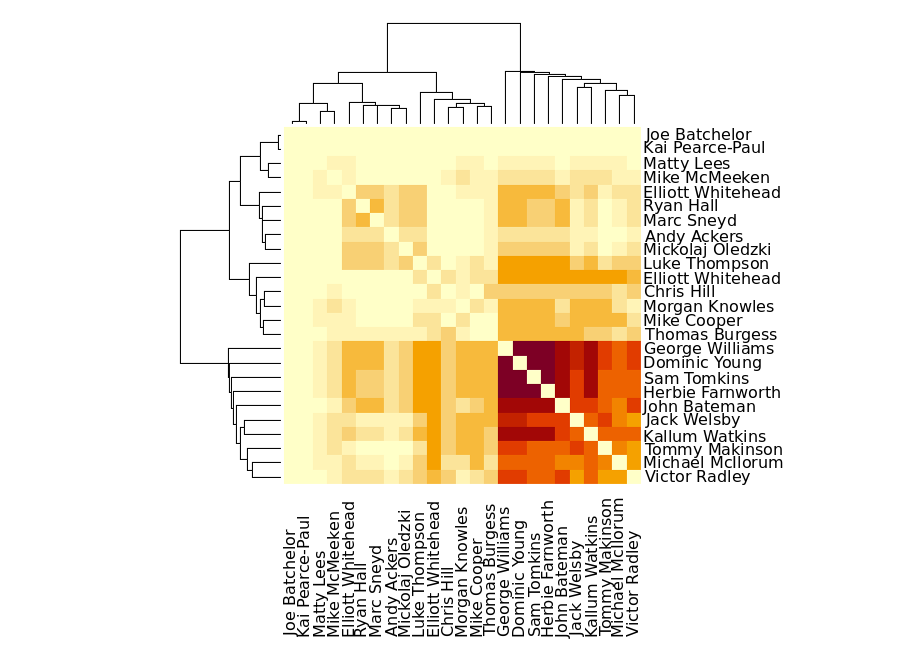
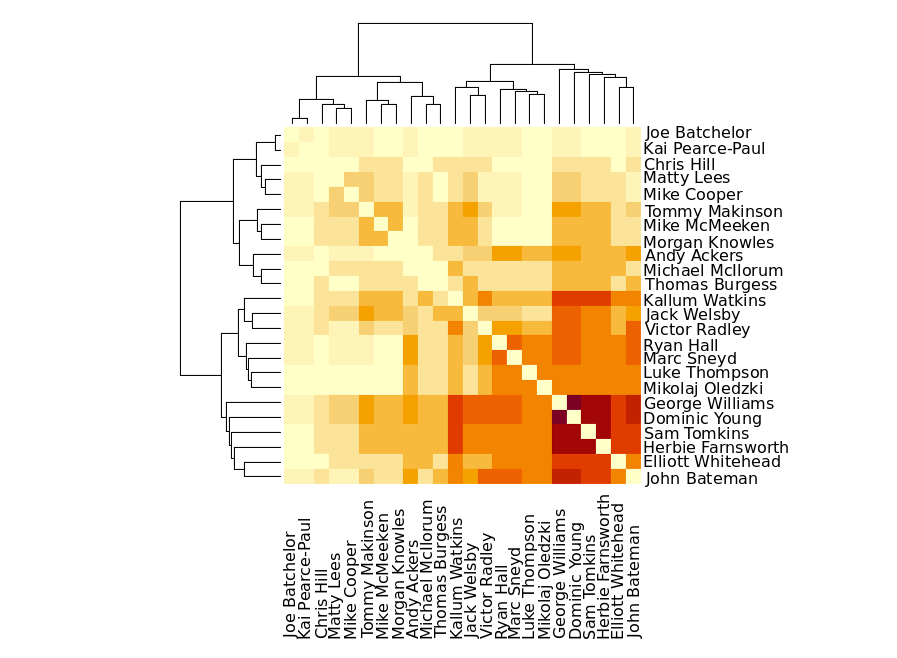
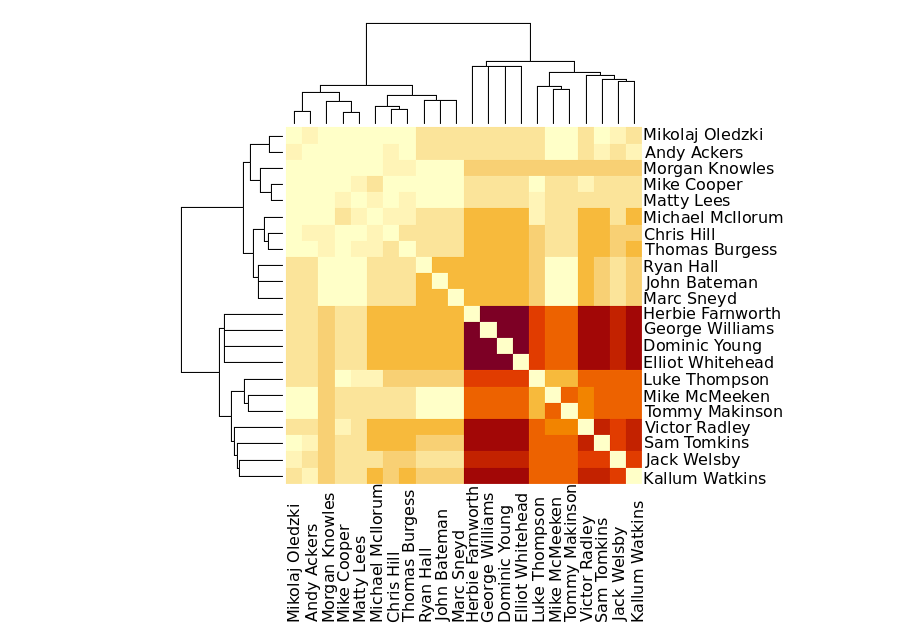
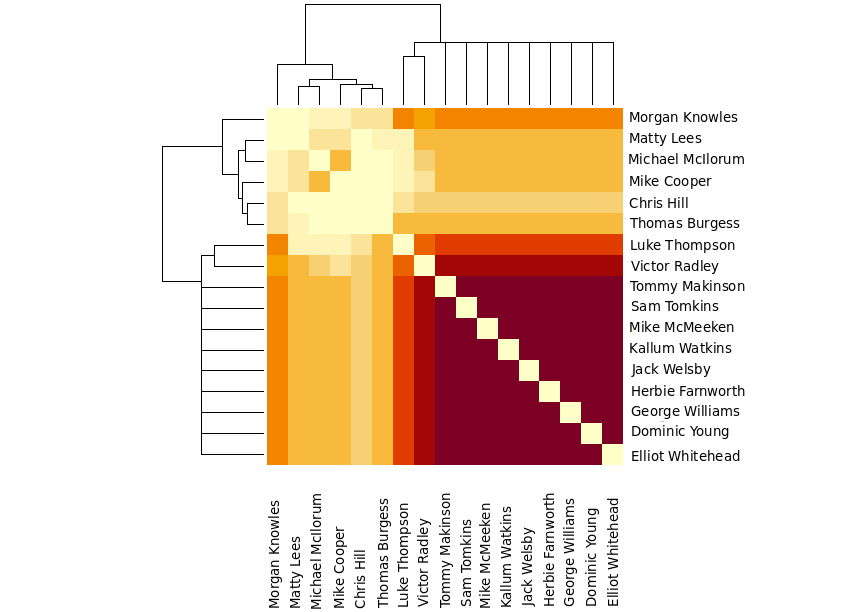
The matrix now looks like this:
Matrix-after-semifinal
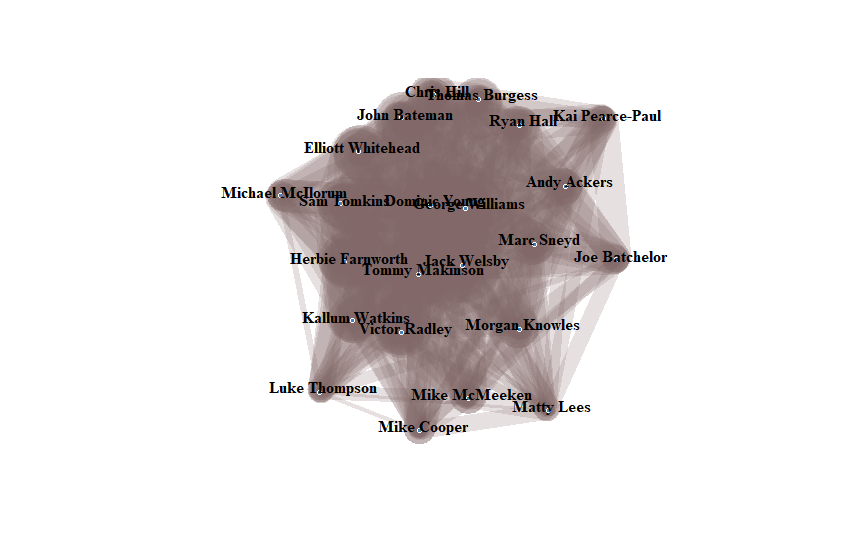
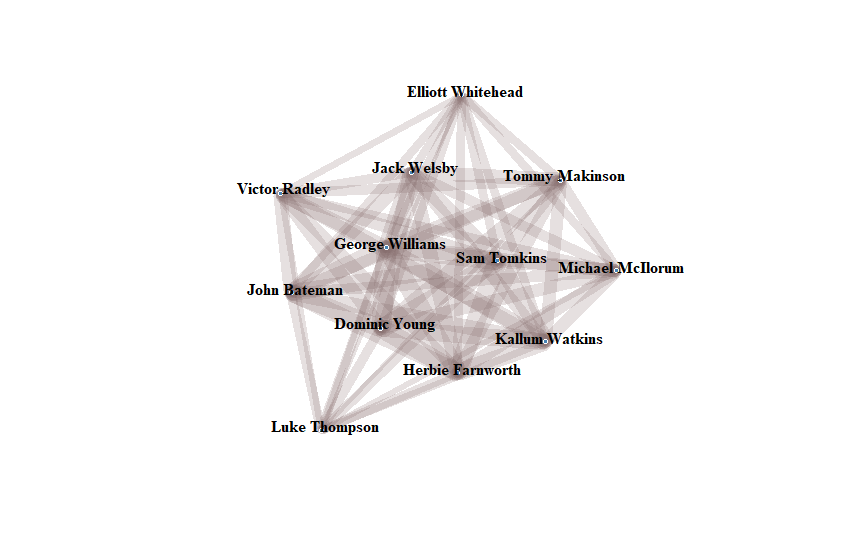
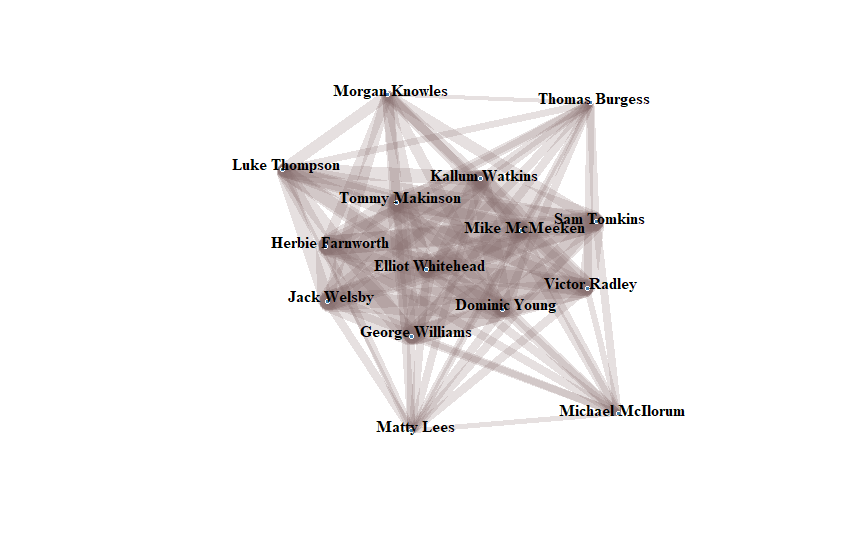
The network diagram looks like this:
Network-Diagram-after-semi 
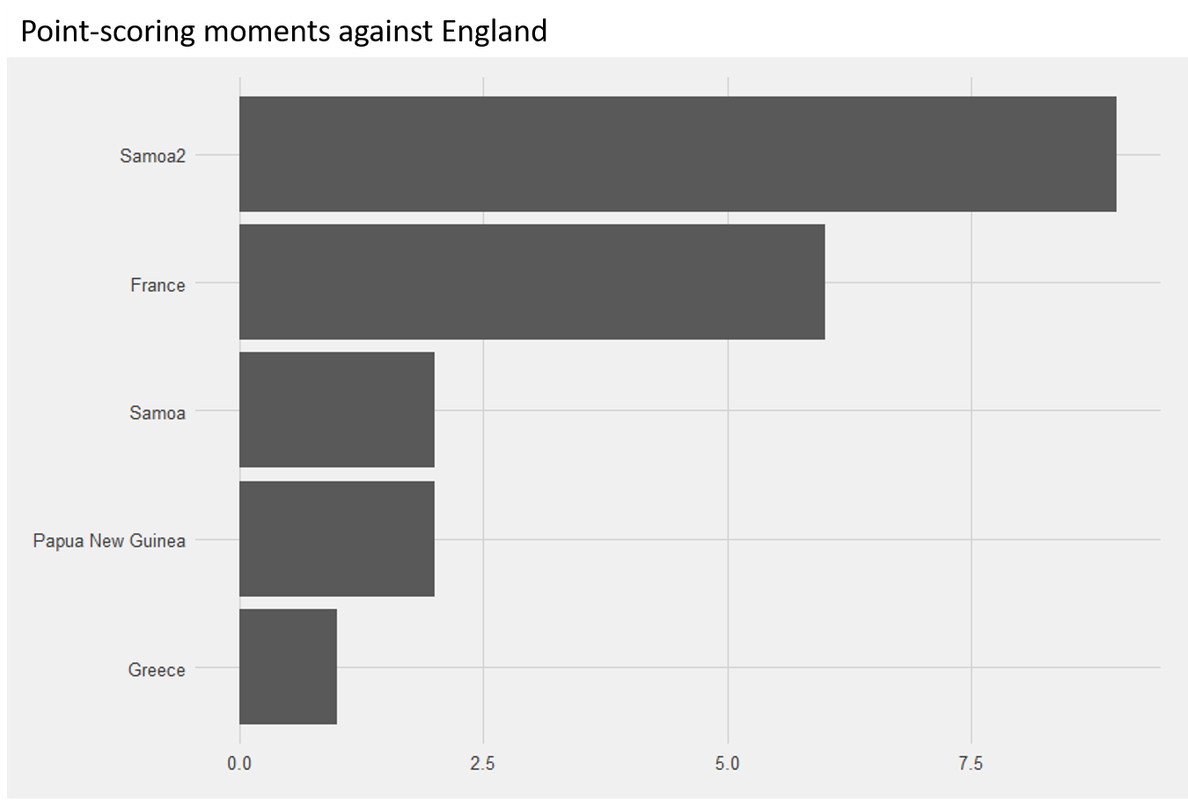
England conceded in 20 point-scoring moments. Unfortunately mostly in the second match versus Samoa. There being a second match against Samoa caused a small amount of difficult in this set of  visualisations - I have gone with calling the team in the semifinal "Samoa2".

Points-scoring moments conceded by England:
  Points-scoring-moments-against-England-after-semifinal Samoa's improvement, possibly an advert for warm-up games.

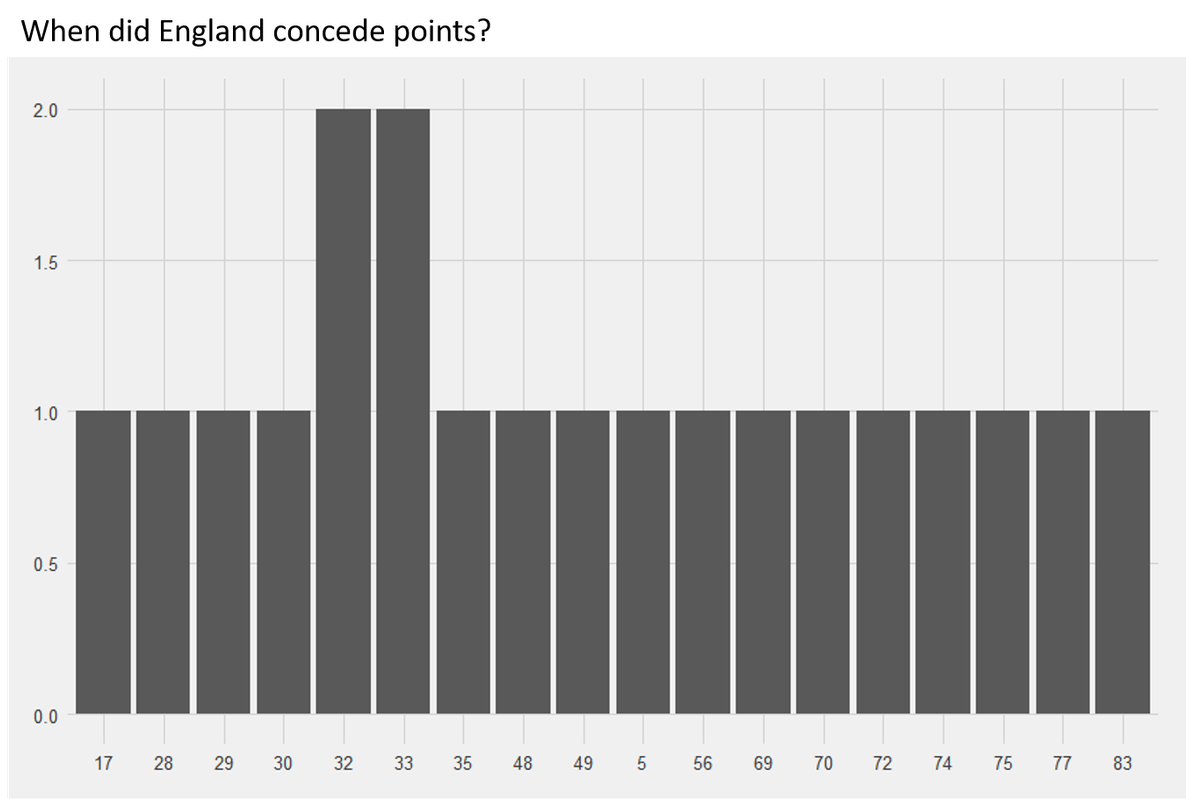
When do England concede points?   When-did-England-concede-after-the-semifinal 

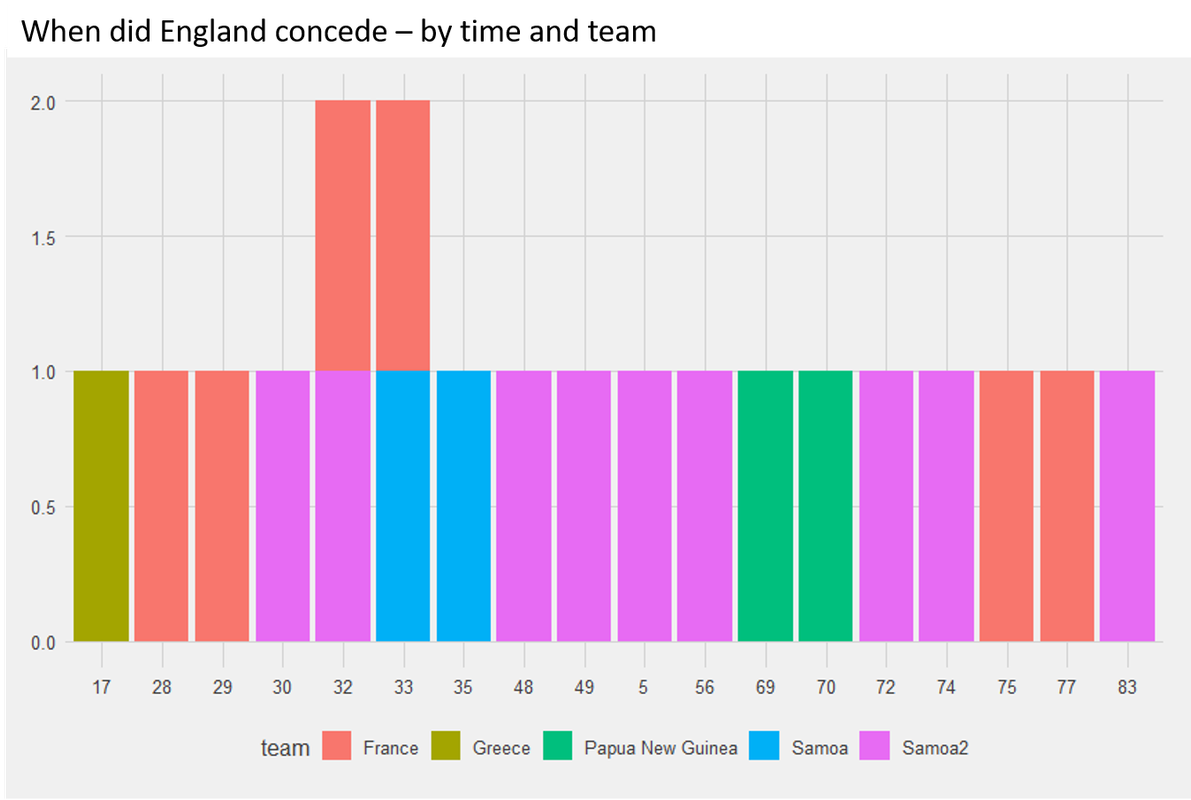
That 83rd minute point score is Stephen Crichton, breaking English hearts. I have no idea how he didn't win man of the match even before that, but it definitely showed why awarding MOTM before full time is a nonsense. (Also, he's only 22. If Samoa can keep most of that team together!!! Next time!!!)

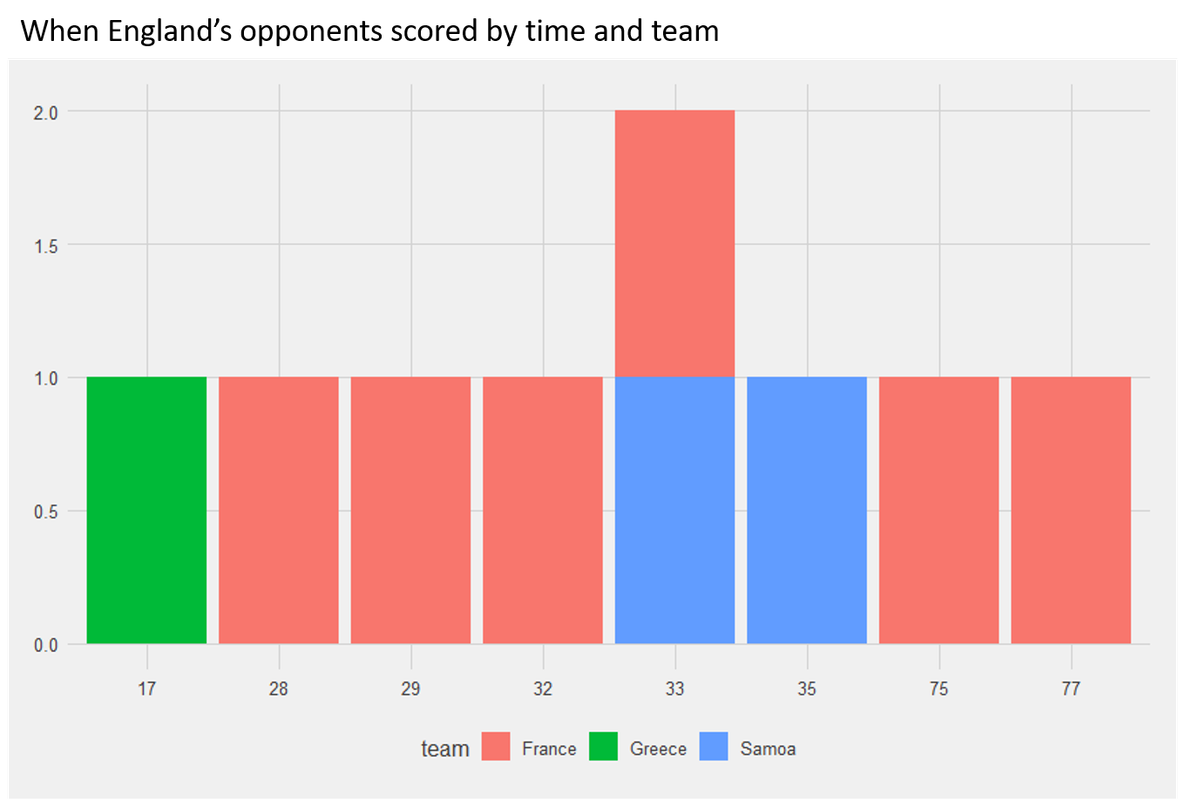
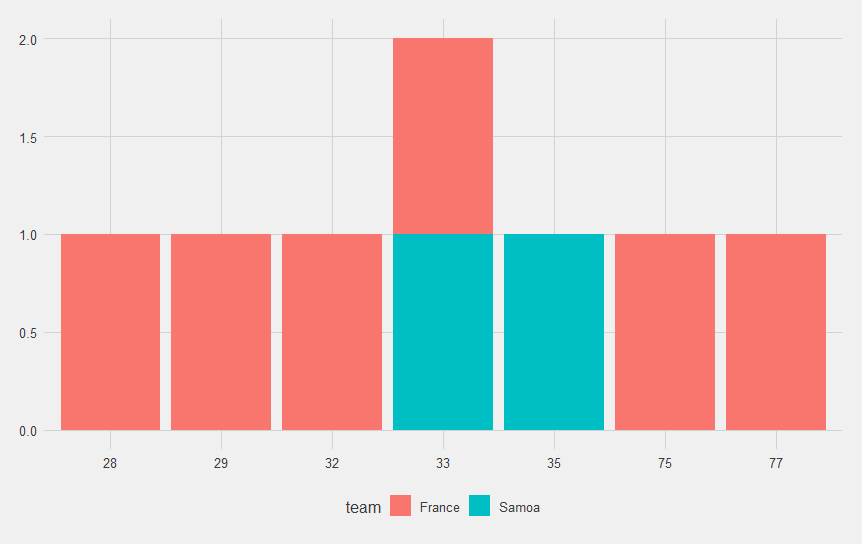
Point-scoring moments against England by time and team:
   Opponents-Score-Time-and-Team-After-Semifinal

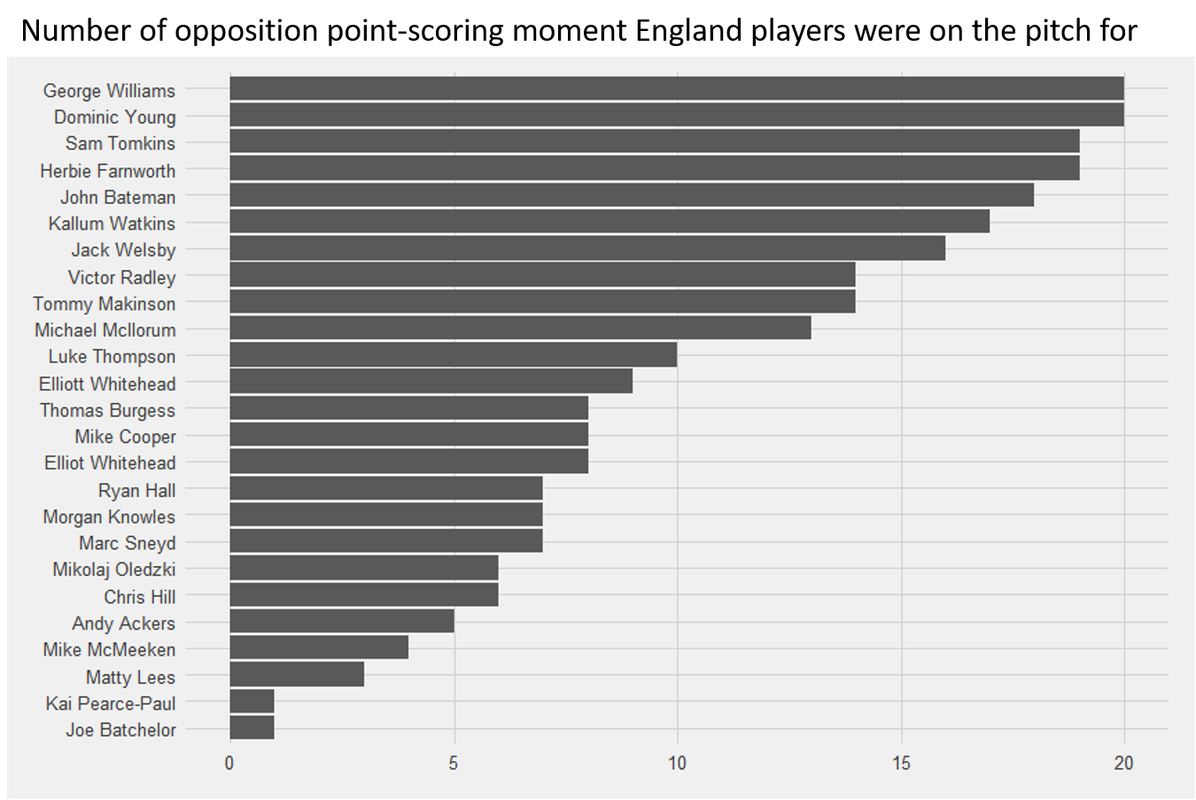
Number of opposition point-scoring moments England players were on the pitch for:
Opposition-point-scoring-moments-England-players-were-on-the-pitch-for 

Not normalised for number of games played, or minutes played, but Chris Hill is remarkably low in the list. He's probably my surprise of the tournament - I'm used to him being on Warrington teams that didn't quite win things or Leeds teams that didn't quite win things, but in this World Cup he's been a remarkable solidifying point. It's noticeable that him and Radley were both on when England picked up in the last 20 minutes of the semifinal. This is also seen in the equivalent matrix.  Concede-Matrix-Semi The relatively low points scored against means that, I think, the network diagram is unfair. Concede-Network-Diagram-Smi Discussion/Future Work: This did what it was intended to - from the data, I was able to predict Wane's starting 13 (okay, data and knowing that there's no way Wane wouldn't pick McIlorum). I think the rolling subs do make it easier than the "once you're subbed off, you're off" rules of rugby union. Because I included tries and conversions (because I had to include penalties for the rugby union) I probably overweighted the games where there were lots of points (e.g. 94-4 vs Greece) so in future, I might just cover tries and drop goals.)

Wednesday, 9 November 2022

Rugby League World Cup 2021 - Men's Semifinal Network Visualisation

I may have to apologise to my downstairs neighbour after the shrieking I did during the New Zealand vs Fiji game. 

I wasn't much better during Samoa vs Tonga. 

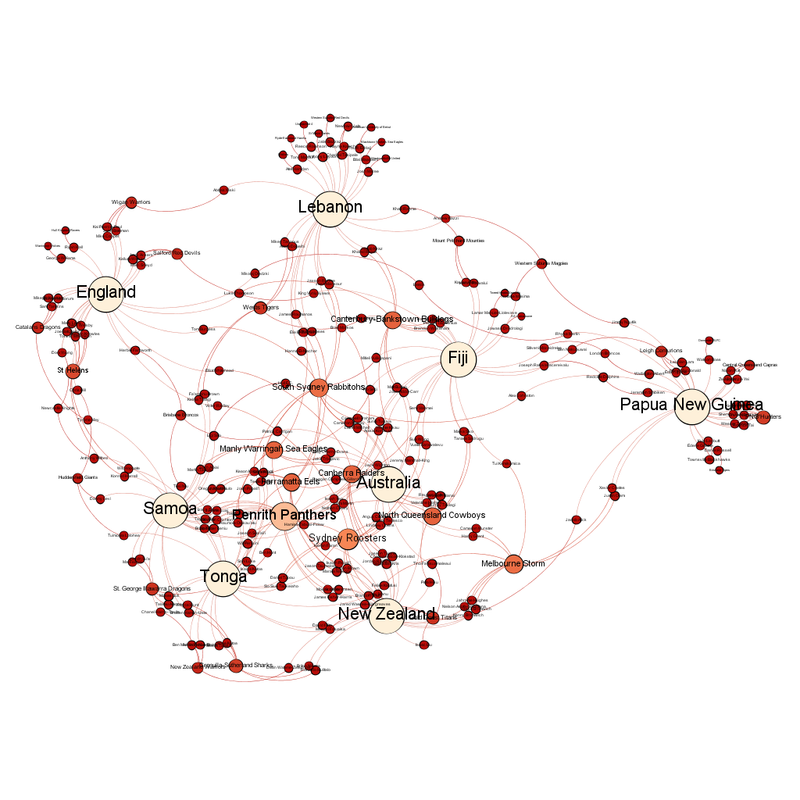
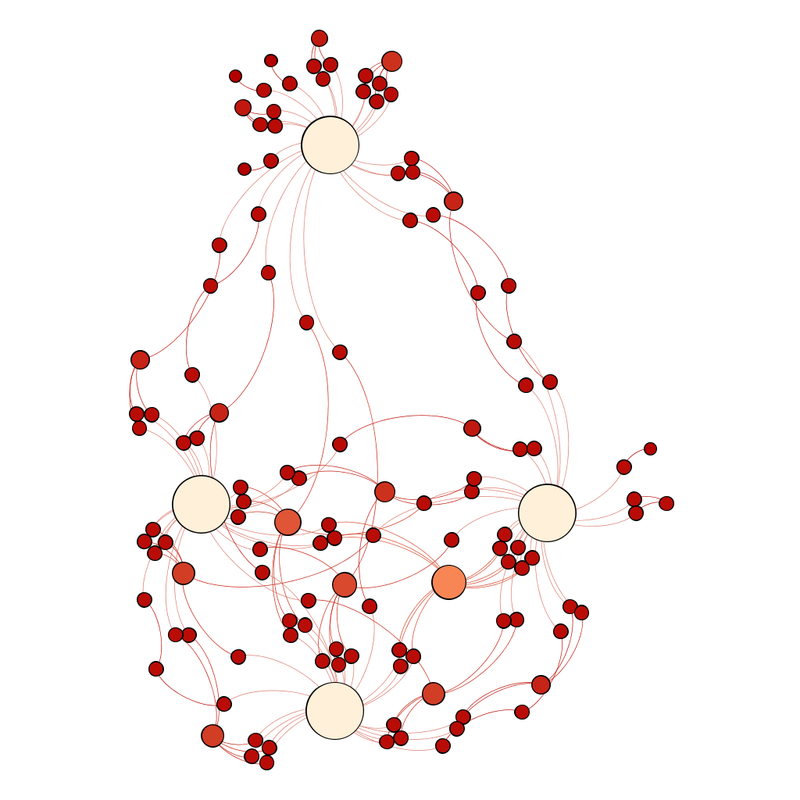
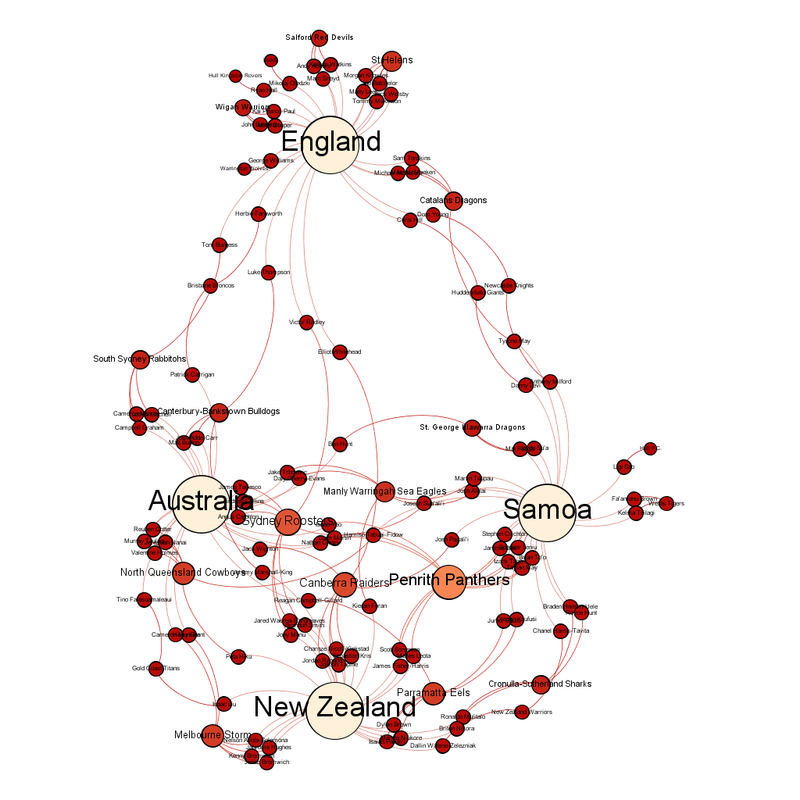
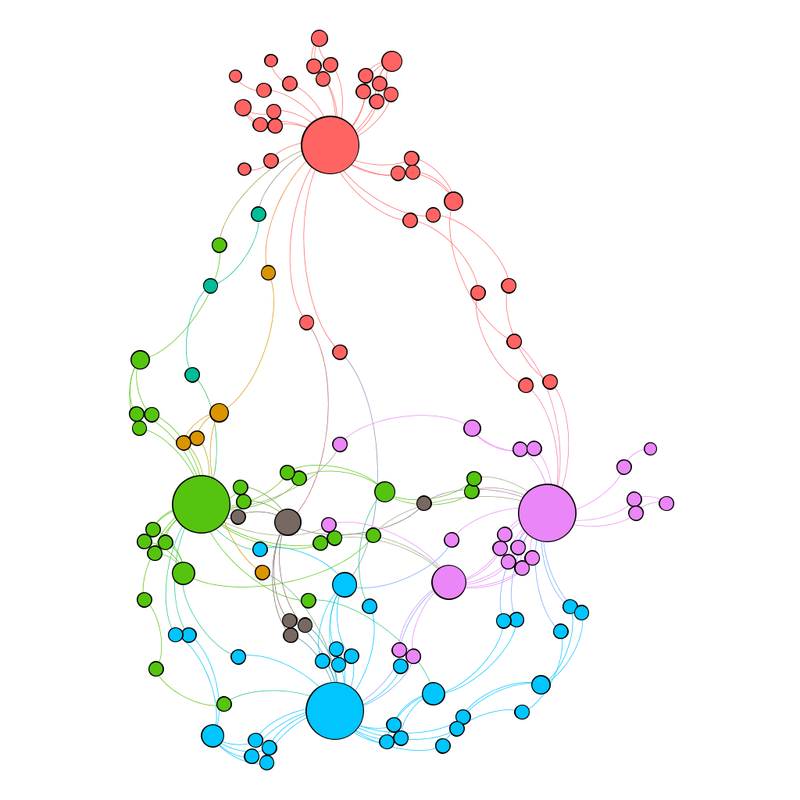
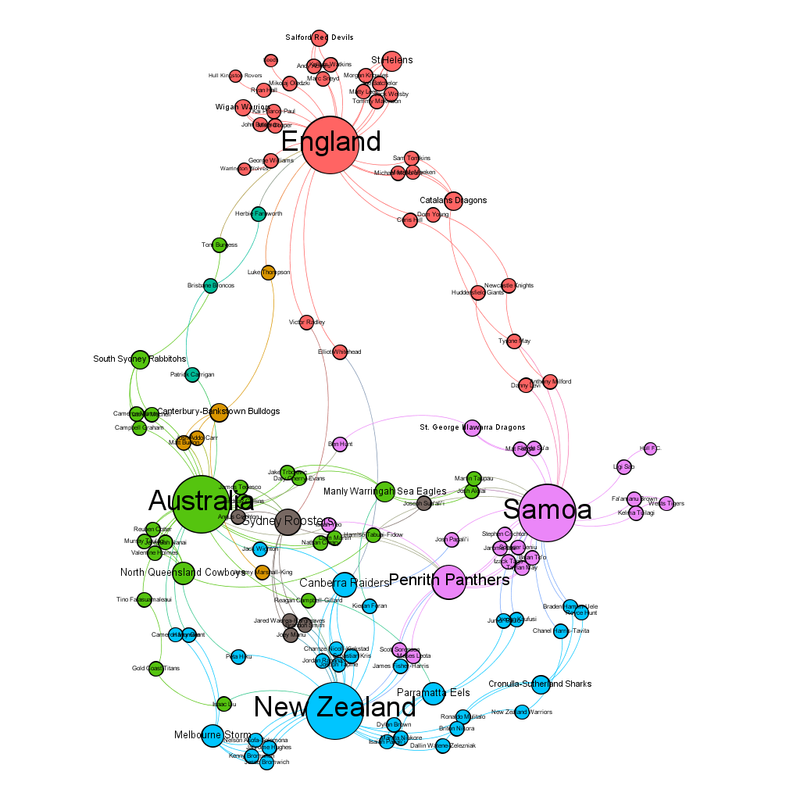
Tonga's defeat means that none of my beloved group D are left in the competition, and leaves the network diagram looking like this: Men-s-Semifinals Men-s-Semifinals-labelled 
The club teams with the most representatives left are the Penrith Panthers with 12 players, followed by 8 for the Sydney Roosters and 7 for Canberra Raiders. 

The club team closest to the centre of the diagram is St George Illawarra. 

The national team closest to the centre are Samoa, just about, although no team is really all that close to the centre because three of the teams (Australia, New Zealand and Samoa) are close together, while England stick out. 

That makes sense because the money in rugby league is centred around the NRL in Australia. 24 out of 24 Australia and New Zealand players and 22 out of 24 Samoa players play in the NRL, as do 6 of the England team. 

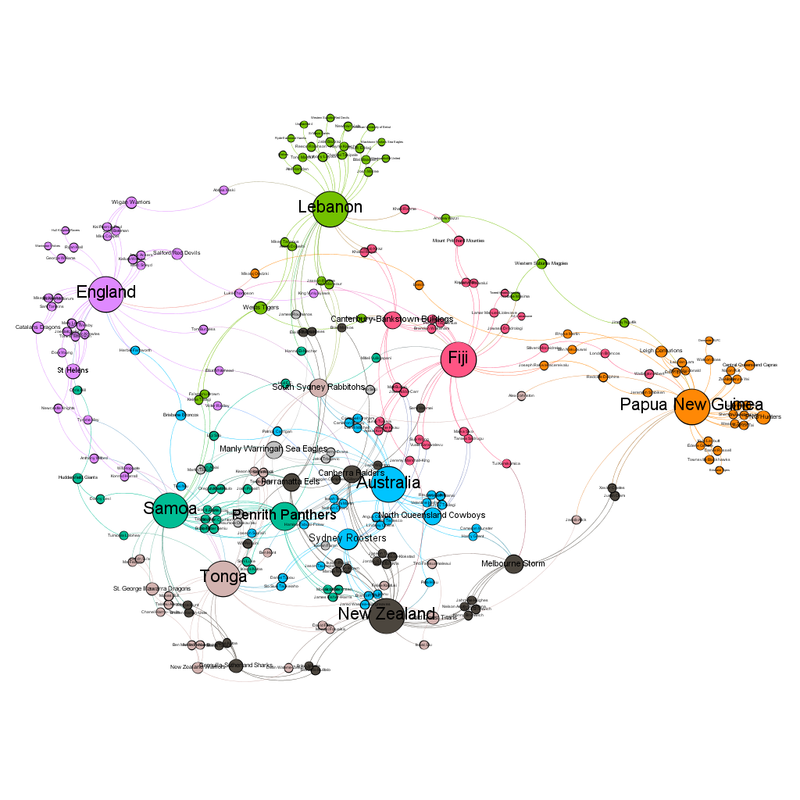
The community view now looks like this: Men-s-Semifinals-Communities Men-s-Semifinals-Communities-labelled 
Interestingly, although there are only 4 teams left, there are 7 communities in this view, one for each team left, then one for Canterbury-Bankstown Bulldogs, the Brisbane Broncos and one for the Sydney Roosters. 

The first semifinal is England versus Samoa which was also the opening match, but this Samoa team does not feel like the same Samoan team that lost quite so badly. There's a general theory that the lack of warm up games was behind Samoa's awful performance in that game, which could be true, they've improved in every game since. 

But it's not like England have wilted since so this could be a really good match. (If you hear really high pitched shrieking in the stadium, it may well be me because I'm lucky enough to have tickets) 

The other semifinal is New Zealand's chance to finally come good. But I have the fear that Australia are going to do that thing that Australia do so well and just steam-roller New Zealand. In the match versus Fiji, there were huge gaps in the centre of New Zealand's defence, gaps just the right size for Cameron Munster or James Tedesco to run through. 

But hopefully, there will be two very good games of rugby league to go alongside the wheelchair rugby semifinals.

Monday, 7 November 2022

Rugby League World Cup Data Visualisation Project - England point-scoring moments after 4 games

In the previous post, I made a data-driven prediction of who England's quarterfinal team would be. I went with Ackers, Bateman, Burgess, Hall, Radley, Knowles, Pearce-Paul, Sneyd, Tomkins, Welsby, Whitehead, Williams and Young. 

I got 8/13 right - I'd forgotten how fond Shaun Wane is of Michael McIlorum, hadn't expected him to choose Tommy Makinson over Sneyd and Hall and I completely forgot about Herbie Farnsworth - my apologies to Farnsworth. 

I will update my prediction, following an extra match's data, later.

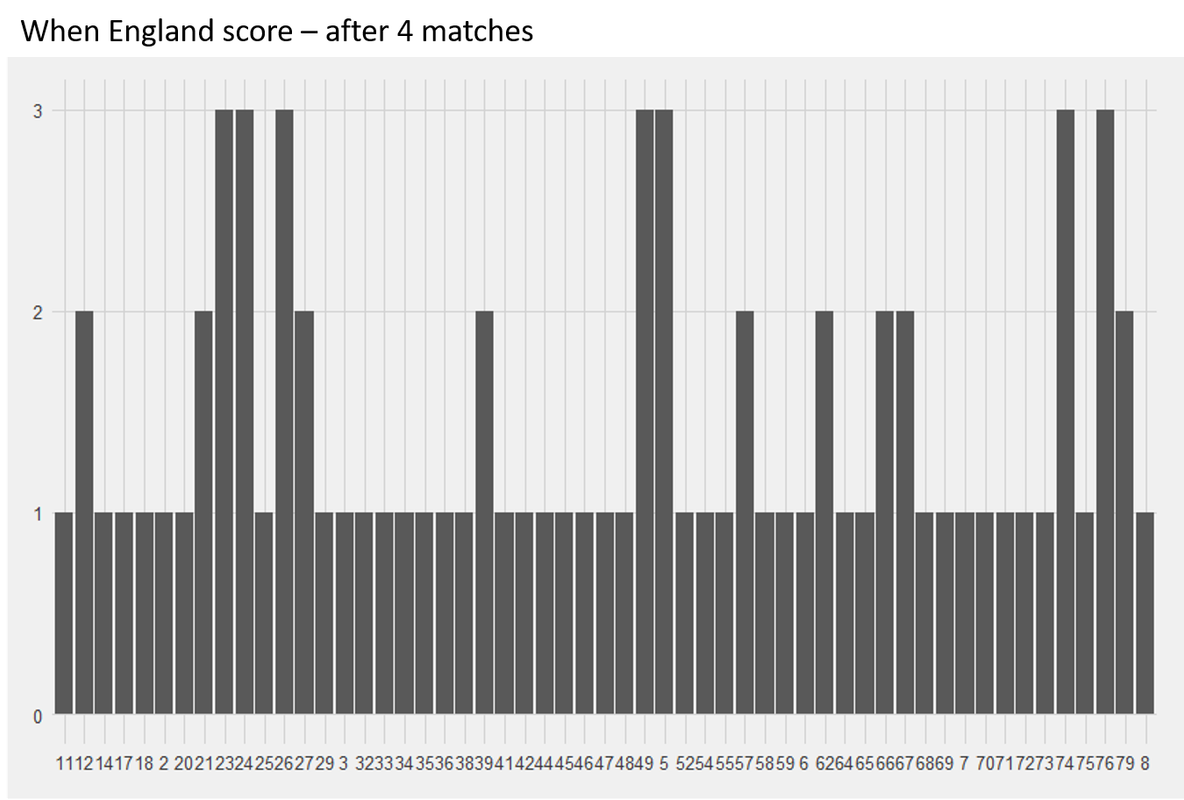
When do England score?
   When-England-score-points-after-the-4th-game 

It's more when don't they score? 

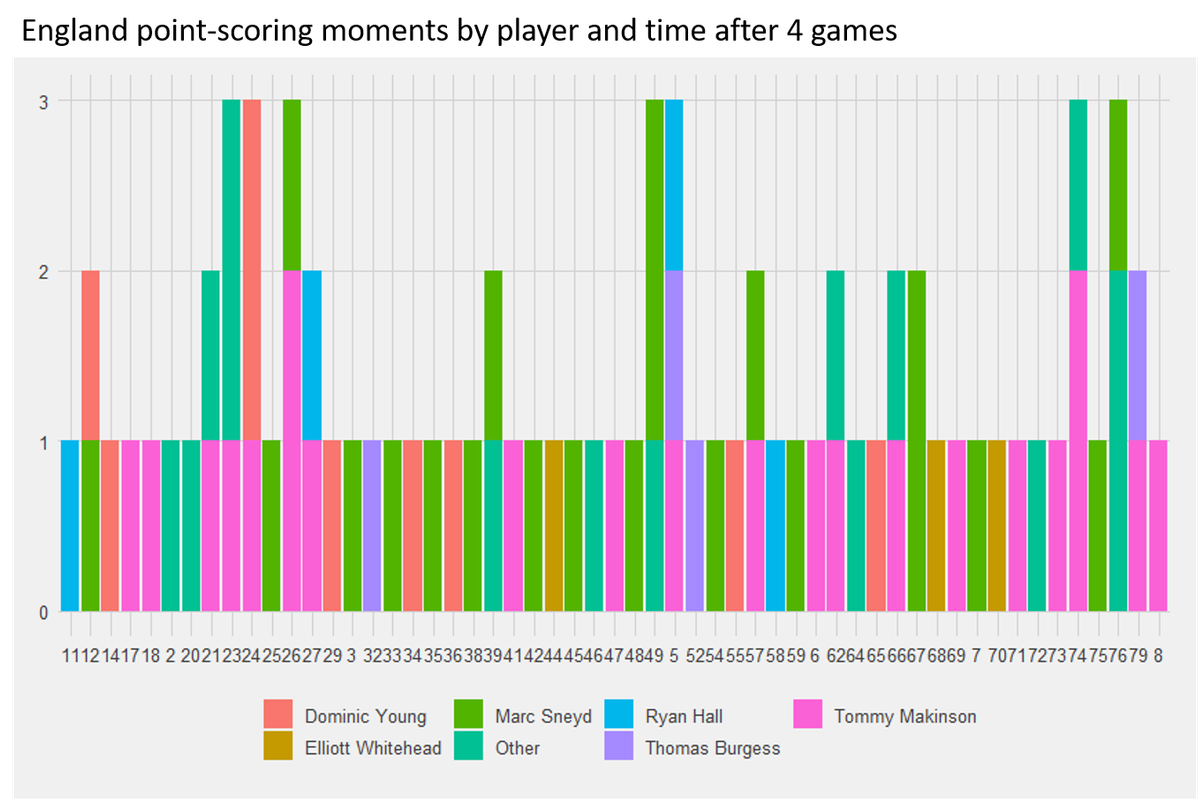
There's a concentration of point-scoring moments 21-27 minutes, 48-49 minutes and then 75-79 minutes.

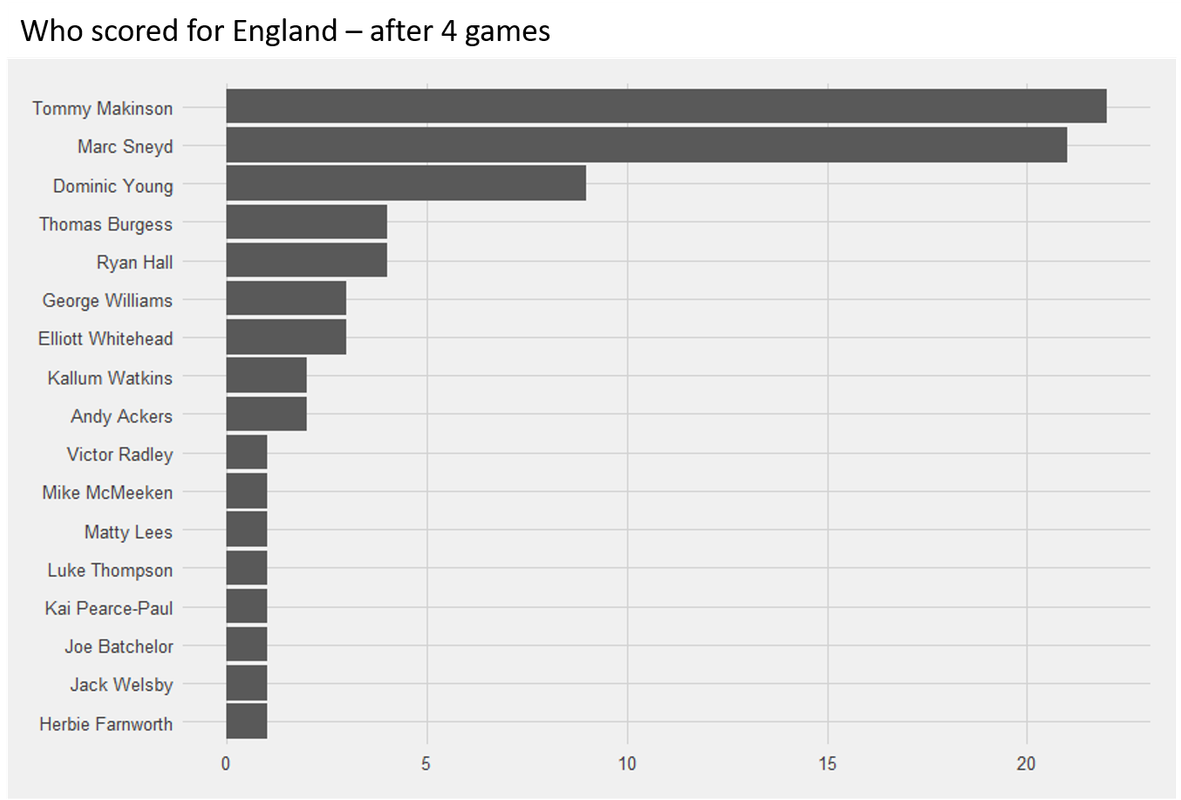
Who scores for England?
  Who-scored-for-England-after-4 

No new players are on that list, but that's still 17 out of a squad of 24 scoring.

Below is the England point-scoring moments by player and time   England-Points-Scoring-Moments-by-Time-and-Player-After-4-matches

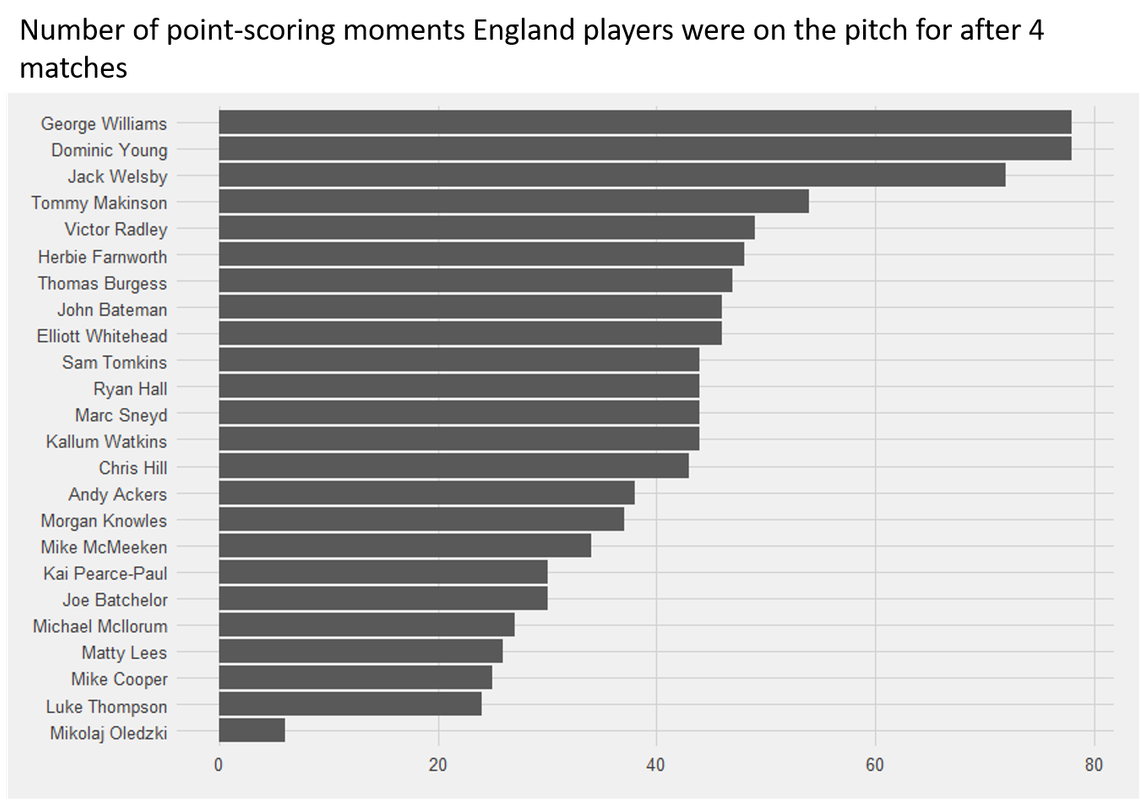
How many point-scoring moments were different players on the pitch for? 

Number-of-Scoring-Moments-Players-Were-On-The-Pitch-For-After-4-Matches

The network diagram now looks like this: Network-diagram-after-4 And this is the matrix now: Matrix-after-4 There's been a major shift, and I think it's because a lot of the team that scored so many against Greece weren't in the quarterfinal match. 

From how the figure looks now, there's still that central trio of Williams, Welsby and Young, then a second grouping of Makinson, Burgess, Hill, Bateman, Farnworth, Radley, Whitehead, Watkins and Tomkins. 

Which is 12 players. 

The 13th player is the hooker and it's clear that Wane will pick McIlorum, even though the data suggests to go with Ackers. 

The other interesting point, from watching the game, and it's interesting how watching and analysing at the same time changes the way you watch the game, but from that rather than anything that shows up in the data visualisations - England are so much better when Radley and Hill are on. 

Which wasn't a sentence I was expecting to write. It's not just scoring that dropped off without them, there was also an increase in handling errors. 

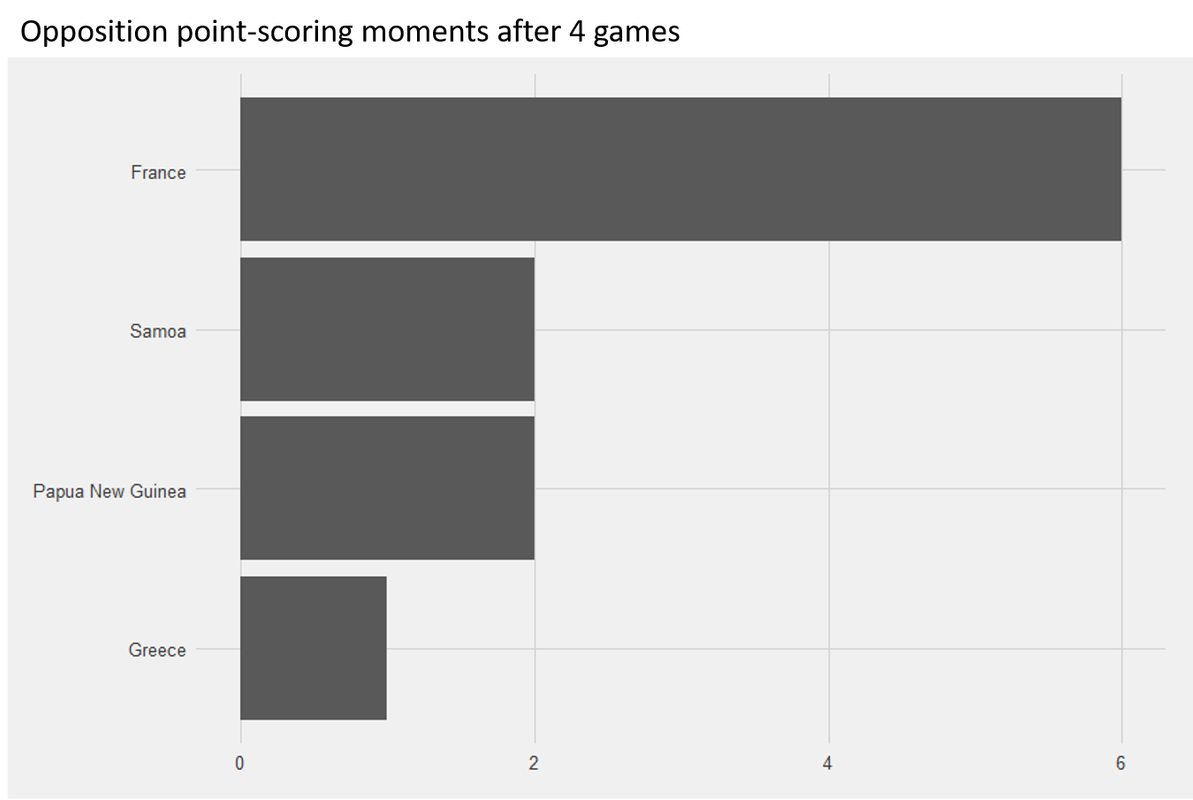
Looking at when England concede: 

Scoring-moments-for-other-teams-after-4-games
 
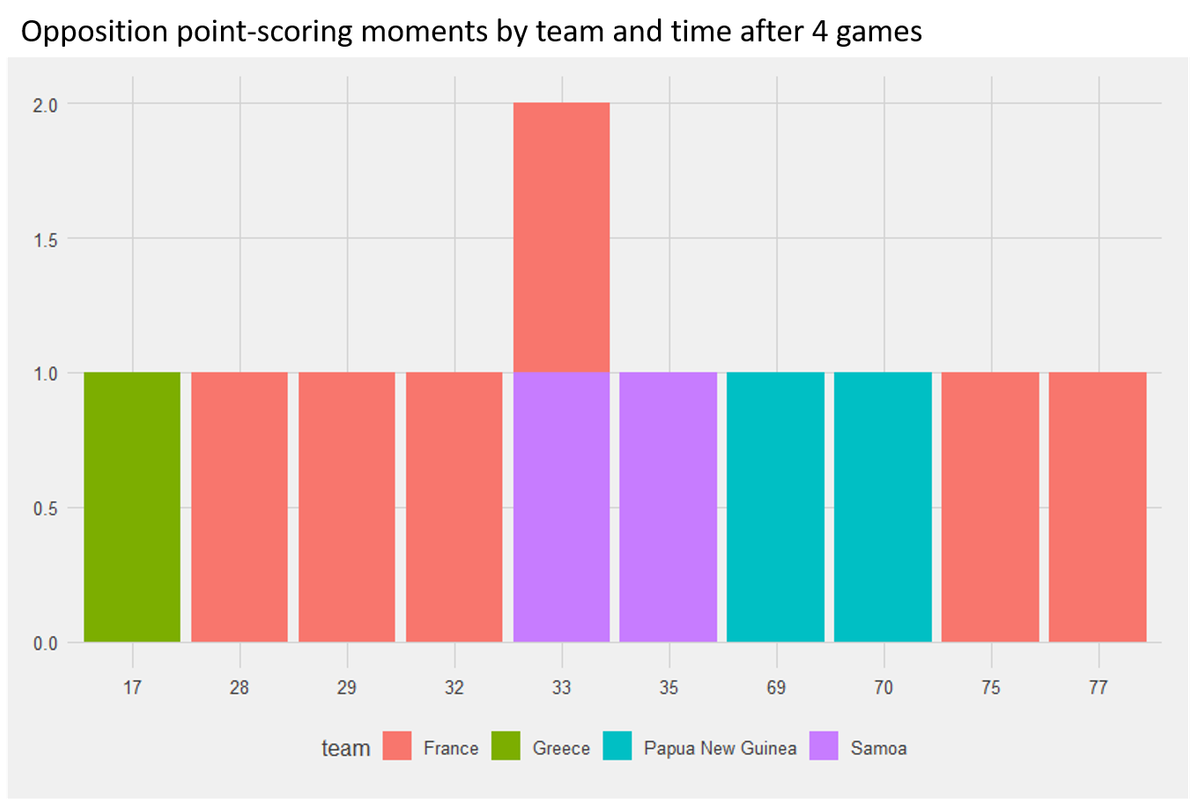
I am still not sure how to cope with France being the opponent that scored the most points against England when they've played Samoa and Papua New Guinea.Opponents-scores-by-time-and-team-after-4-games 

It does seem to be the second half of the halves when opposition scores.

Number of opposition point-scoring moments players were on the pitch for

  Opposition-scores-that-players-were-on-for-after-4-games

This is really skewed by the low number of points scored versus number of games, as is the matrix view of who is on the pitch at the same time when the opposition score. Concession-matrix-after-4 Tom Burgess and Michael McIlorum are probably lighter on the figure than expected, and it's possibly that defensive ability that is the reason why McIlorum is being picked over Ackers. 

The equivalent post for the semifinals will be delayed because yours truly will be at the Emirates watching it.  

The only positive to Tonga losing is that it means I can now wholeheartedly cheer for England (I find it difficult to cheer against a team with Kristian Woolf and Konrad Hurrell).

L will be acting as crowd control. 

Wednesday, 2 November 2022

Rugby League World Cup 2021 - That was the men's group stage that was

That's the group stage finished. 

It wasn't perfect. There were too many one-sided matches and International Rugby League really needs to do more to support the smaller nations. 

But there was so much to enjoy. 

Wales! 
Wales, with part-timers in their team, nearly beating a Cook Islands team who have players in the NRL. 

The Cook Islands anthem - https://twitter.com/RLWC2021/status/1586727371876581376 
The Cook Islands Pe’e Haka - https://twitter.com/RLWC2021/status/1584830810107957248 

The first female referee to take charge of a men's WC match, Kasey Badger reffing Tonga v Wales - https://twitter.com/RLWC2021/status/1584615952330928128 (Followed by Belinda Sharpe reffing England vs Greece 5 days later) 

Papua New Guinea nearly beating Tonga. Tonga in full flow, against Cook Islands. 

Cook Islands being the best, and performing a haka for the New Zealand Physical Disability team, because game recognises game - https://twitter.com/RLWC2021/status/1585032360663601152 

The editorial team have contacted me and pointed out that there were three other groups that were not group D, but you'd be hard-pressed to find more joy per inch than group D. 

In group A, you had Samoa taking two games to warm up, leading to an England 60-6 Samoa result that I saw live on TV and still don't believe. 
England, lead by the flying Dominic Young (https://twitter.com/RLWC2021/status/1583875608685473792), winning all three of their matches, France closing the gap and Greece, Greece who had to play qualifying matches past midnight to avoid being arrested for playing rugby league (https://www.rlwc2021.com/article/527/greece-captain-meads-to-honour-grandparents-), playing with heart and spirit and determination (and some flying last-ditch tackles - https://twitter.com/RLWC2021/status/1584830803208392704). 

Group B featured an incredibly young Australia (13 out of a squad of 24 will receive their first cap when they play). 
I'm used to all-conquering, swaggering Australia and I don't know what to do with this bunch of lovely young men I want to make cups of tea for. 

It featured Fiji, and I'm sorry but they're Kevin Naiqama's team and I love them - https://twitter.com/RLWC2021/status/1583815381478932480 

Italy, coming along nicely, with one player born and bred in Italy, representing a country that has a nine-team league. Italy winning a match and not being nilled, not even against Australia. 

Scotland, the brave, who got better as the tournament went on, and scored against all their opponents except Australia. 

Group C, featured a New Zealand team whose kicking is not quite working right (much to the suffering of Robbie Hunter-Paul on commentary who copped it from all his co-commentators), and their play is disjoined, but will hopefully improve, Ireland, who also improved as the tournament went on, and Lebanon who were determined to reach the quarters (and feature in this ditty - https://twitter.com/RLWC2021/status/1584113995744776193). 

Group C also featured Jamaica, who were a delight. There was a beautiful piece on BBC where Ashton Golding explained how much it meant to him to represent Jamaica as someone of Jamaican descent. There's many words I could say about how rugby league seems to be the only sport that understands that people can be from more than one place and love both and should be given the opportunity to play for both. 

It's not just Golding, it's Jordan Meads talking about how much him representing Greece means to his Yiayia and Pappou (https://neoskosmos.com/en/2021/10/07/sport/the-great-warrior-mindset-qa-with-greeces-rugby-league-skipper-jordan-meads/), it's James Tedesco, Australia's captain, who is on his third world cup, but only his first for Australia, because he's made his Dad proud for two and now it's his mother's turn. It's Dom Young, England try scorer, watching Jamaica play Ireland, because his big brother is playing for them and his grandmother is so proud of the two of them - https://twitter.com/RLWC2021/status/1581679550114631680 

Jamaica were not just their to make up the numbers, they didn't get niled in any of their matches, and Ben Jones Bishop scored their first ever World Cup try (https://twitter.com/RLWC2021/status/1584830805570113538) and why yes, that is the NZ captain joining in the guard of honour Jamaica formed for Jones Bishop at the end of the match - https://twitter.com/RLWC2021/status/1584069688559947776.

And Jamaica are not satisfied, they're building for the next World Cup - https://twitter.com/RLWC2021/status/1583949748708737025 

That spirit of togetherness, France wearing a 7 on their shirt for Rob Burrow (https://twitter.com/RLWC2021/status/1583729910710865920), Greece watching the PDRL matches (https://twitter.com/TheRFL/status/1584941387530653707) and Wales and Tongan fans happily singing together after their match (https://twitter.com/WalesRugbyL/status/1584658651322908672), that's rugby league as much as whoever wins the tournament. 

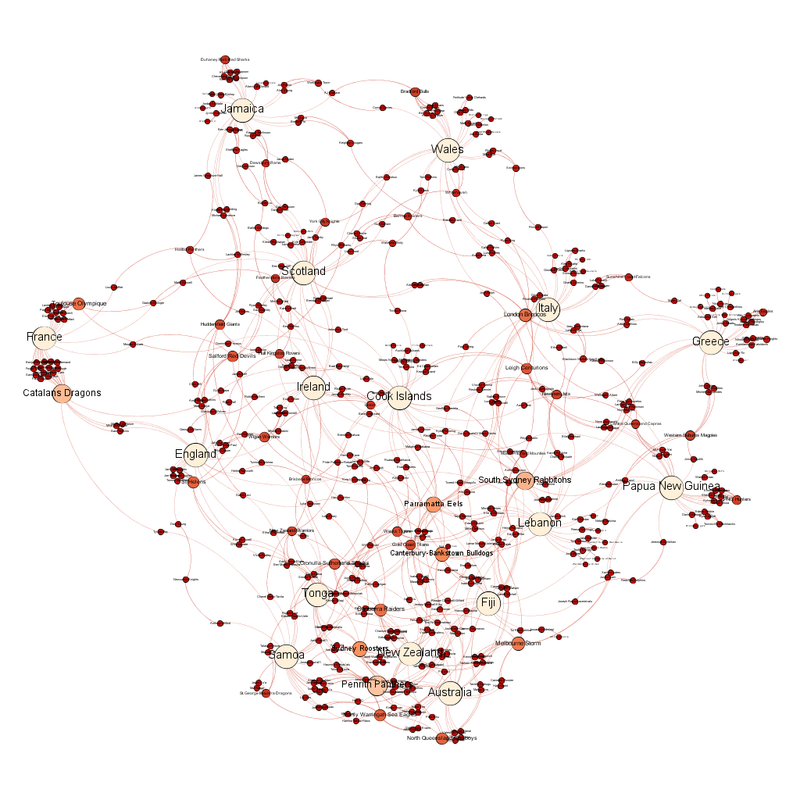
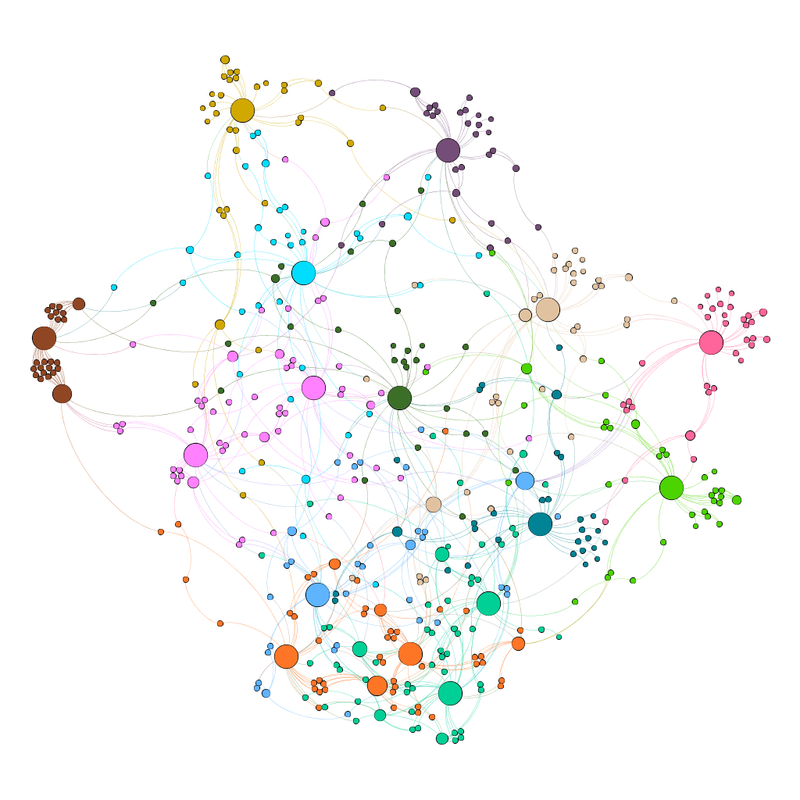
Back to the tournament, the network diagrams now look like this:    Men-s-Quarterfinals Men-s-Quarterfinals-labelled The national team now closest to the centre are Fiji, and South Sydney Rabbitohs are the club side nearest the centre. 
In terms of number of players left, Penrith Panthers still have the most players represented with 18. They are now followed by the Sydney Roosters with 12 and South Sydney Rabbitohs and Melbourne Storm with 10. The number of Catalan Dragons players dropped dramatically when France went out.

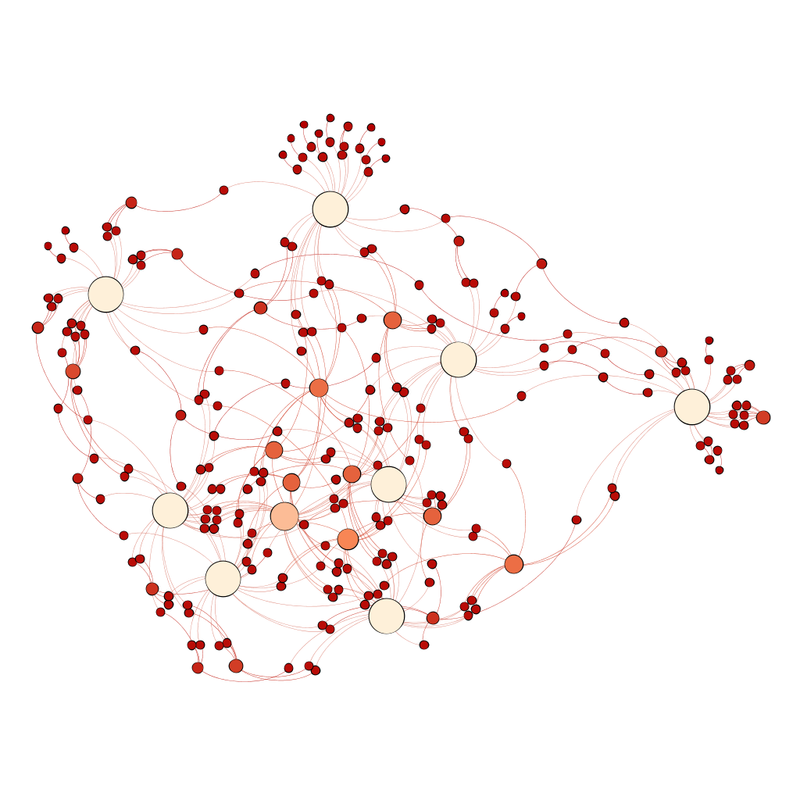
The community view looks like this now:    Men-s-Quarterfinals-Communities Men-s-Quarterfinals-Communities-labelled There are 8 sides left in, and 8 communities. 
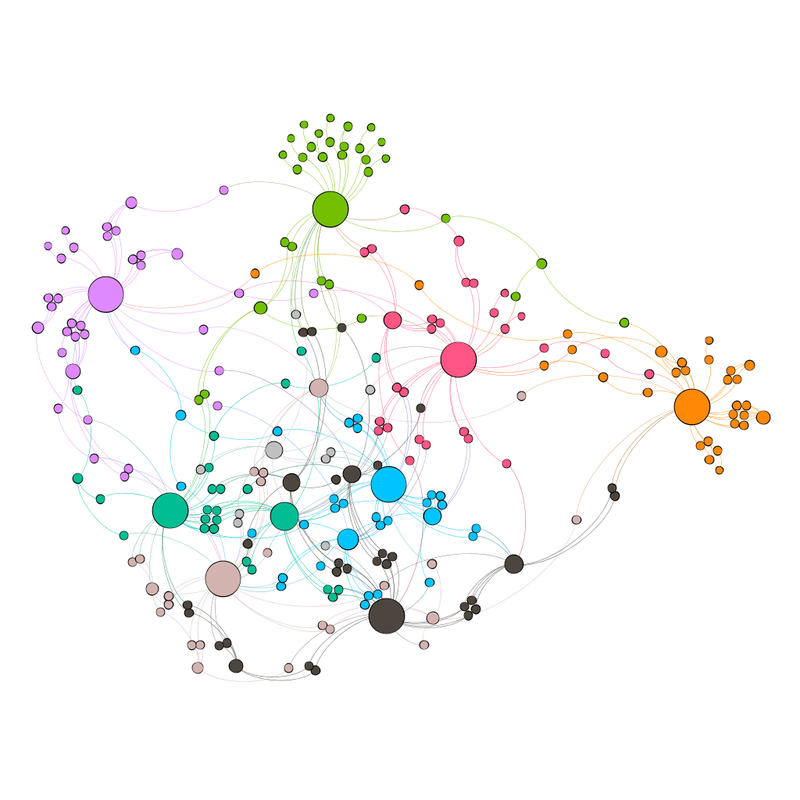
Probably the most interesting feature of the communities view is that Penrith Panthers are grouped with Tonga, not with Australia. 

Looking at the quarterfinals, there looks to be some cracking matches to come: 

Australia vs Lebanon - Australia are strong favourites here but Lebanon might be able to make it interesting. 

New Zealand vs Fiji - or New Zealand's chance for revenge after the last World Cup. This NZ team have some weaknesses, particularly in the kicking, but this Fijian team aren't as strong as last time. Could be very interesting. 

England vs Papua New Guinea - Ooooh. Oooooh. Given the Samoan capitulation in the first match, this is England's toughest challenge so far. On the other hand, PNG have moments of not-good mixed in with their moments of brilliance. 

Tonga vs Samoa - Even ooooohier noises. I mean, talk about mouth-watering match ups. A Tonga that have woken up and are starting to play beautiful, destructive powerful rugby vs Samoa that finally seem to be gelling and are fired up to make up for that opening defeat and to play their big rivals. Oh this could be epic!
Monday, 31 October 2022

Rugby League World Cup Data Visualisation Project - England point-scoring moments and point-conceding moments after 3 games

Once again, I'd like to that nrl.com for having the data in a really easy-to-read format. For this game, the link is here - https://www.nrl.com/draw/rugby-league-world-cup/2022/round-3/england-v-greece/

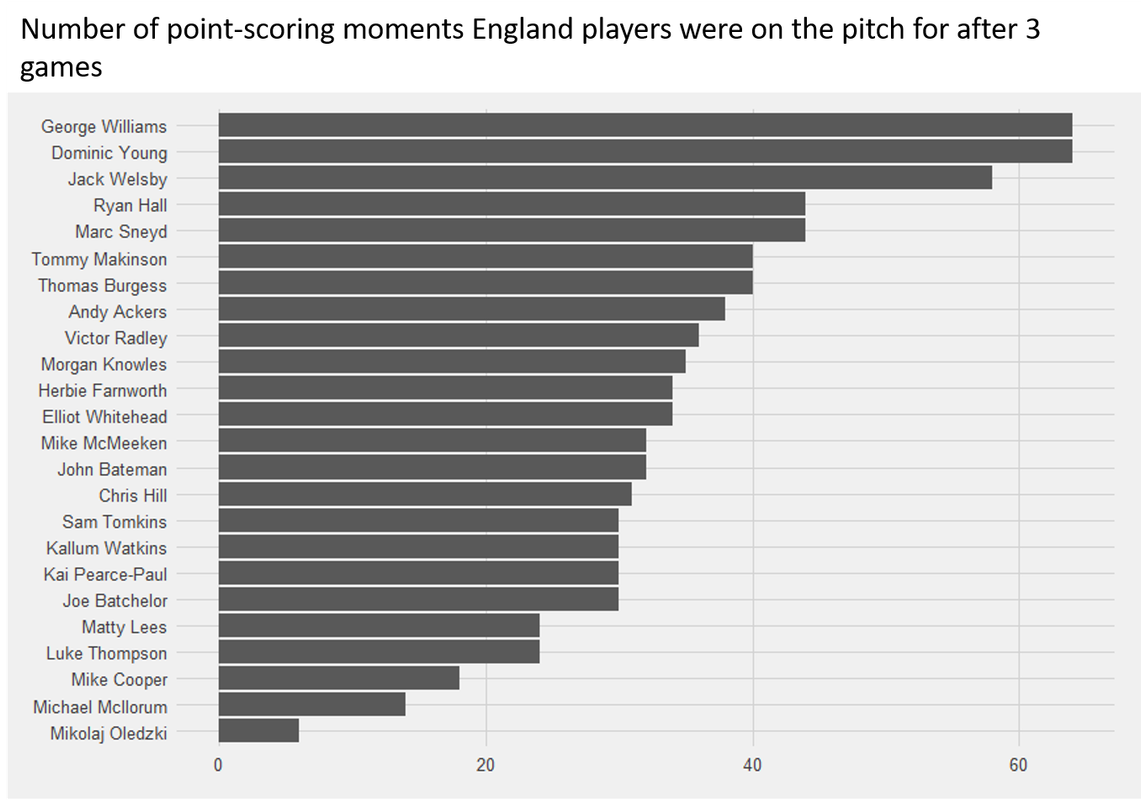
There were 64 scoring moments for England.

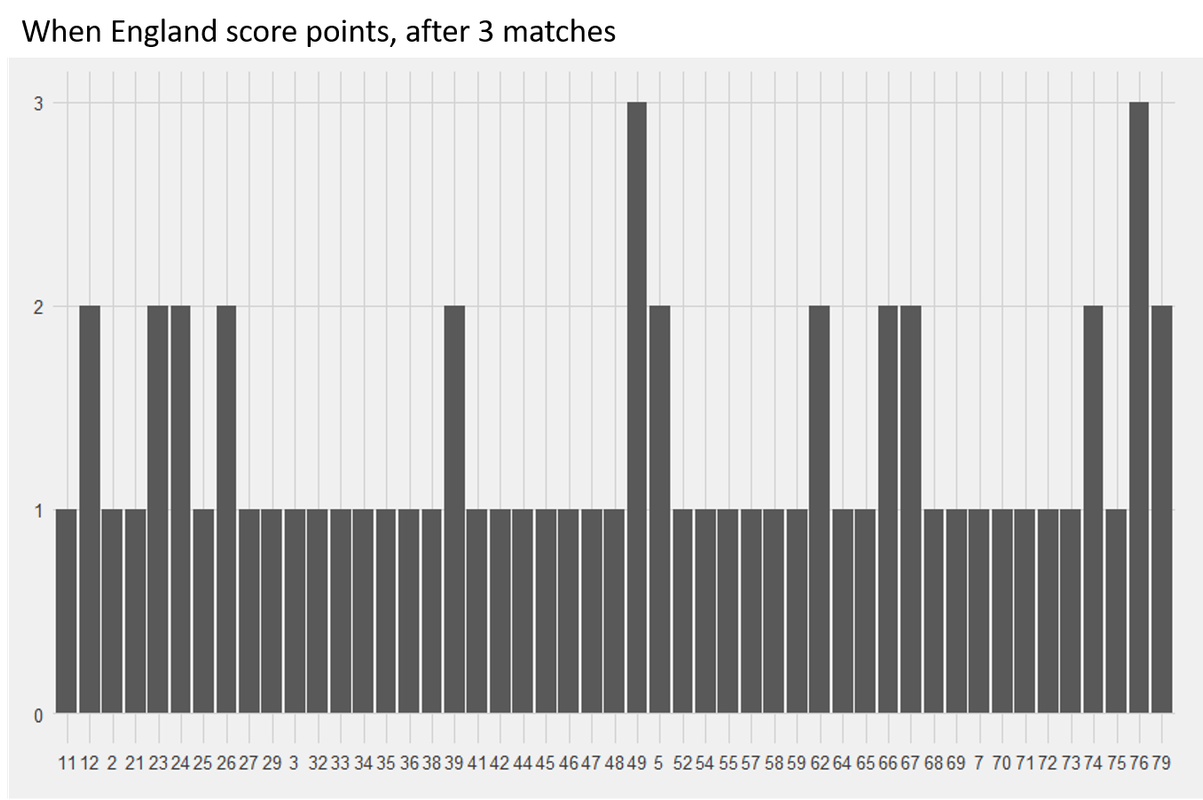
When did England score?   When-England-score-points-after-the-3rd-game 
There are a couple of minutes where there are a higher concentration of points. They are at 5, 12, 23-26, 39, 49, 62, 66-67, 74, 76 and 79 minutes.

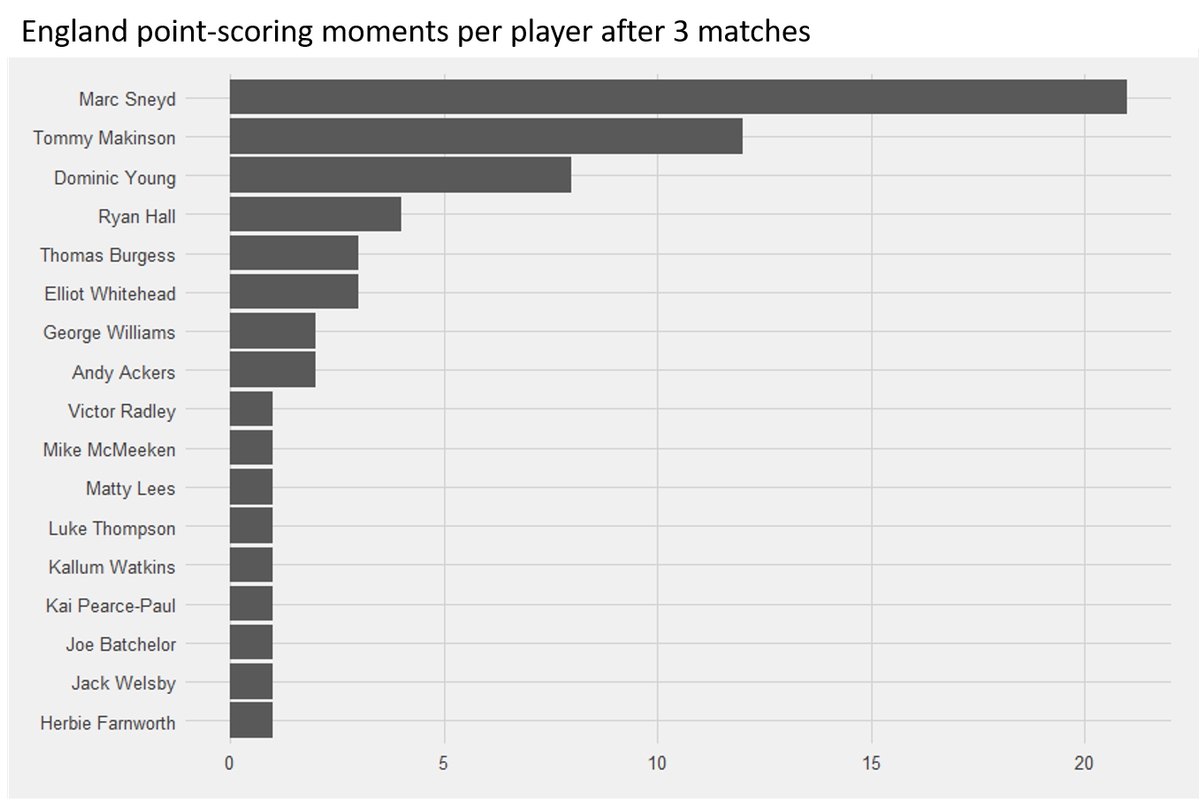
Who scored for England?

  England-scoring-moments-per-player-after-3-game 

17 different players have scored for England. The only England players who haven't scored are Michael McIlorum, Mikolaj Oledzki, John Bateman (!), Chris Hill, Mike Cooper, Morgan Knowles and Sam Tomkins of all people. What's going on there then?

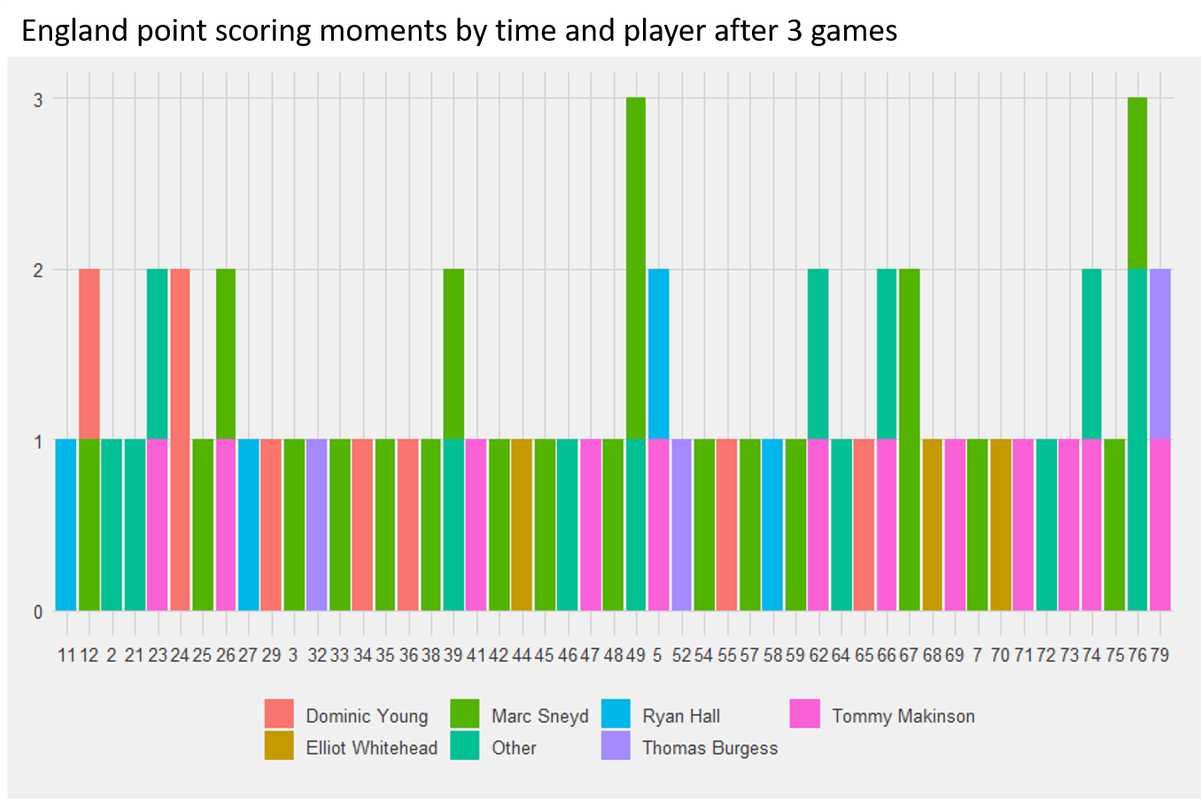
England point scoring moments by time and player:

  England-Points-Scoring-Moments-by-Time-and-Player-After-3-matches

Number of England point-scoring moments players were on the pitch for:

Number-of-Scoring-Moments-Players-Were-On-The-Pitch-For-After-3-Matches Dominic Young and George Williams were on the pitch for every England scoring moment (all 64). Oledzki was on for the least of any English players (6). 

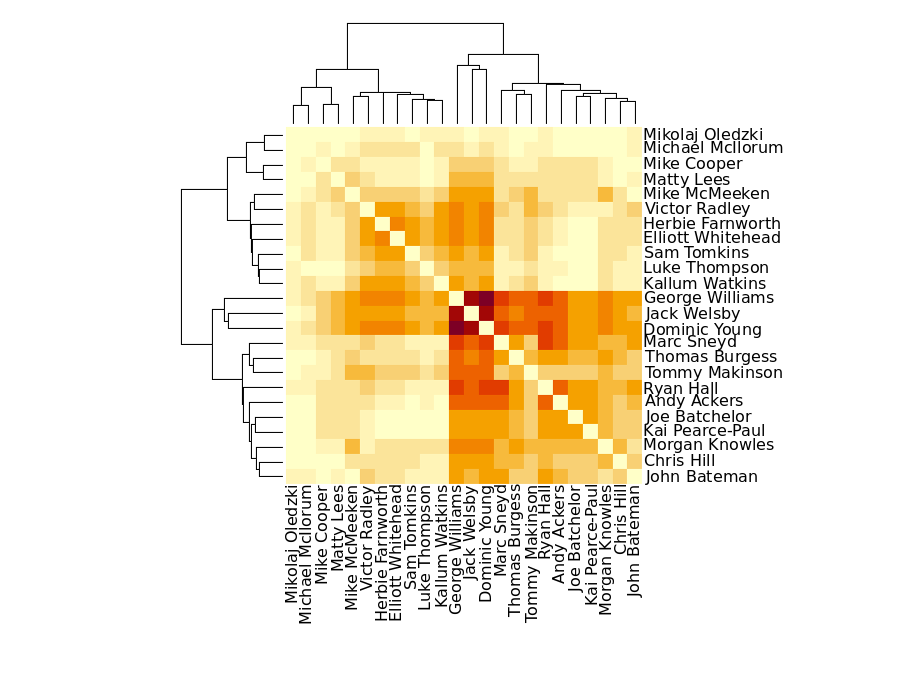
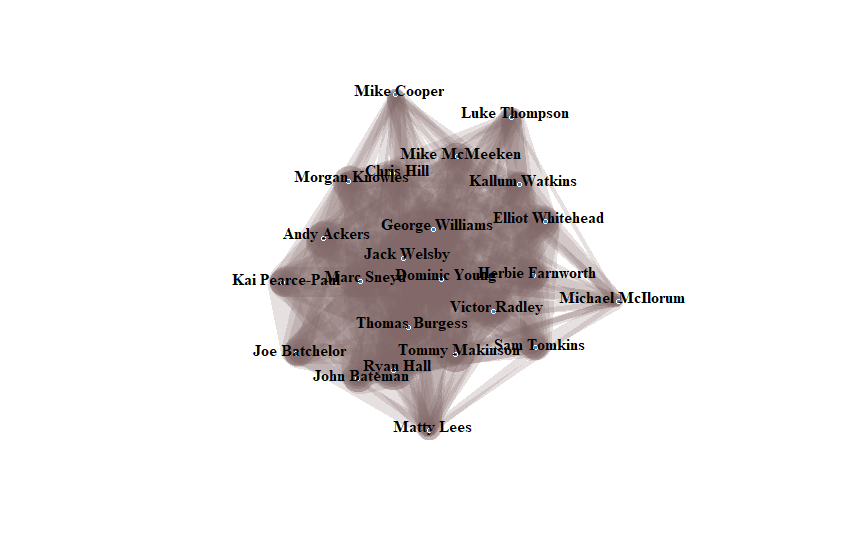
If we look at the players who were on the same time with each other when points were scored, looking at both the matrix and the network diagrams, Oledzki has played himself out. He is the player with the least interactions in the matrix diagram and the only England player not present on the network diagram. Matrix-after-3-games Network-diagram-after-3-games From the matrix, you can see a clear core (Young, Williams, Welsby), with two groups of possible teammates. 

The lower group of teammates are slightly darker, suggesting more frequently co-occurring when England score. If Wane goes with that, it's a team of Young, Williams, Welsby, Sneyd, Tom Burgess, Tommy Makinson, Ryan Hall, Andy Ackers, Joe Batchelor, Kai Pearce-Paul, Morgan Knowles, Chris Hill and John Bateman as your starting 13. Which is ... not a terrible idea. 

It's obviously skewed by the sheer number of points England scored against Greece, a game Sam Tomkins missed, but I suspect that 13, with Tomkins instead of Makinson, Radley instead of Hill (providing he doesn't have an elbow injury) and Elliot Whitehead instead of Joe Batchelor might be the starting 13 for the quarterfinal. 

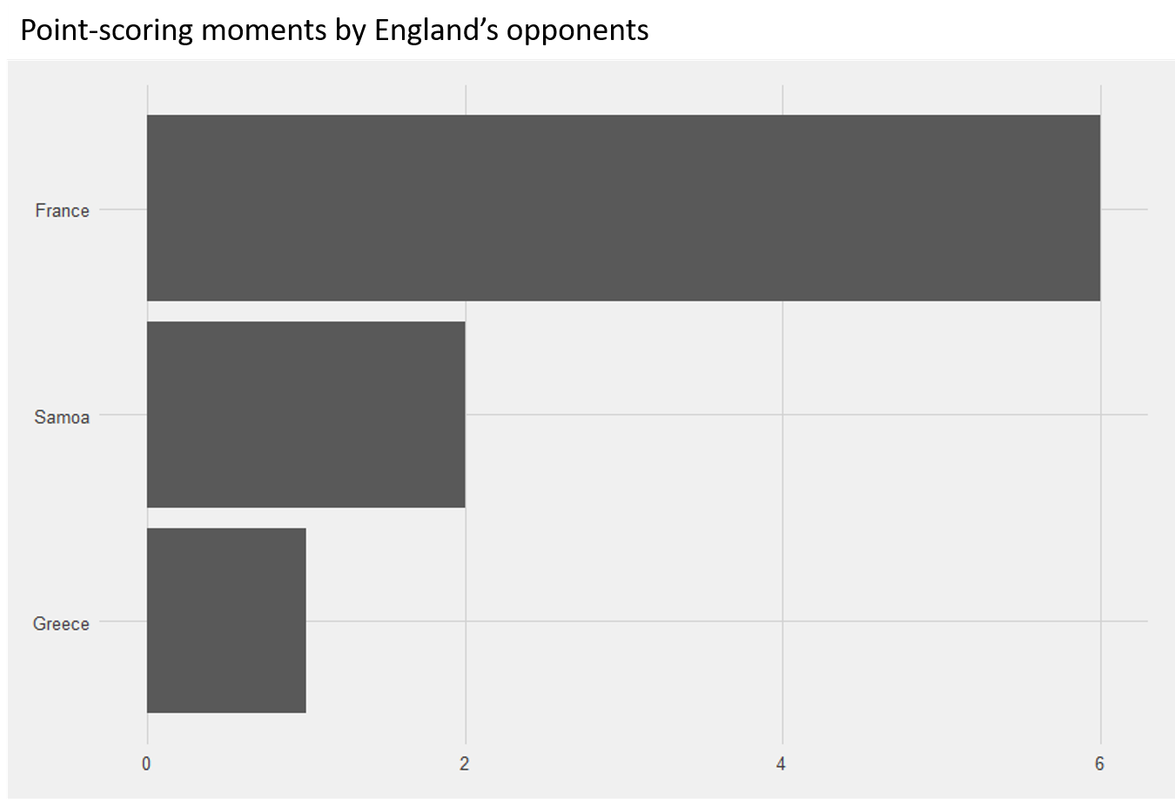
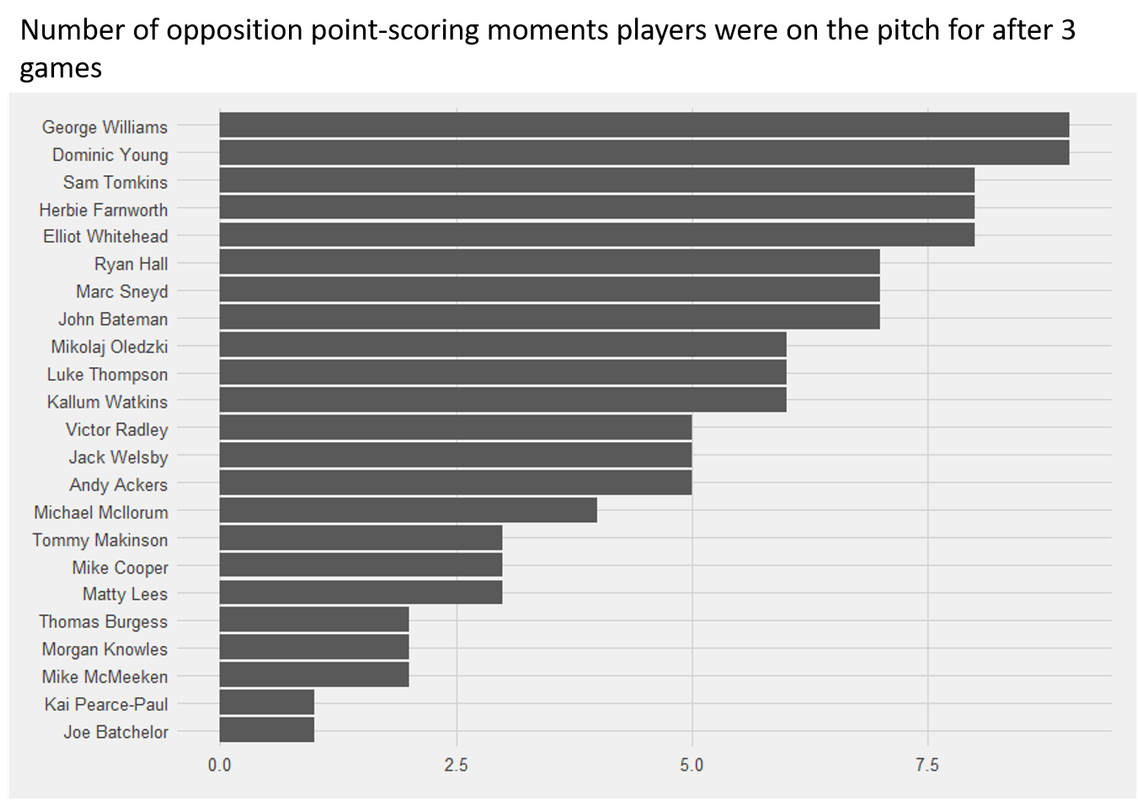
If we look at the points England conceded: Points-scored-against-England-after-3 

 I still cannot reconcile myself to the French game having been tighter than the Samoa game for England. It makes no sense. 

The Greek game put paid to my theory that England concede more in the 30-40th minute. Opponents-Score-Time-and-Team-After-3 

As to who is on the pitch when England concede: England-Players-on-pitch-when-opposition-scored-after-3 

It's slightly unfair because Williams and Young were on for more than anyone else because they played 80 minutes in all 3 games. 

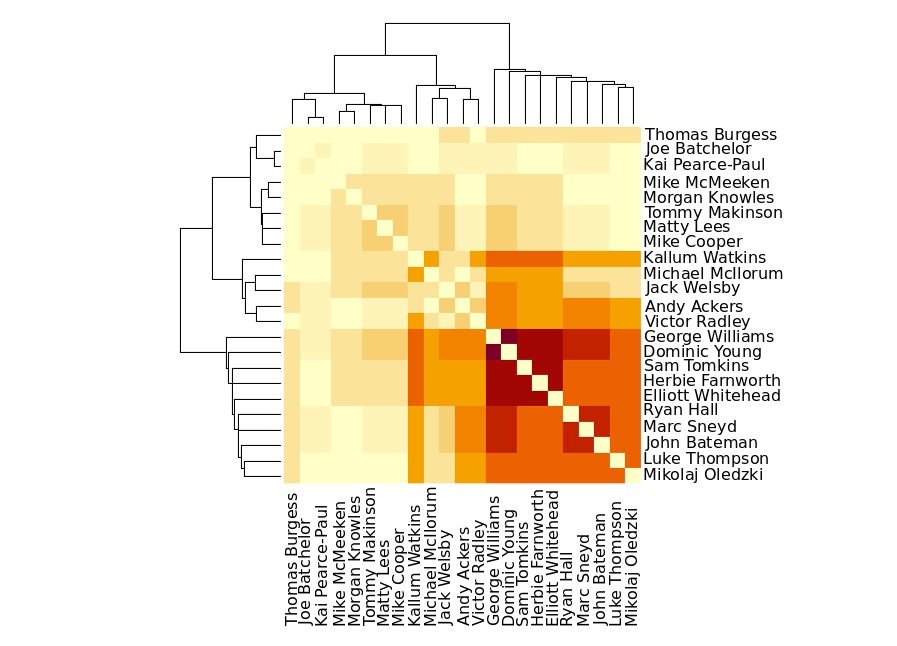
The interesting and unexpected is that Chris Hill wasn't on the pitch for any concession of points, the only player where that is the case. Partly, I suspect it's because he's only played limited minutes, but it suggests there's life in the old dog yet. Concede-matrix-after-3 

I think England only conceding 9 point-scoring moments is skewing this, just because most were in the France match so the players from that match are strongly highlighted.

Thursday, 27 October 2022

Rugby League World Cup Data Visualisation Project - England point-scoring moments after 2 games

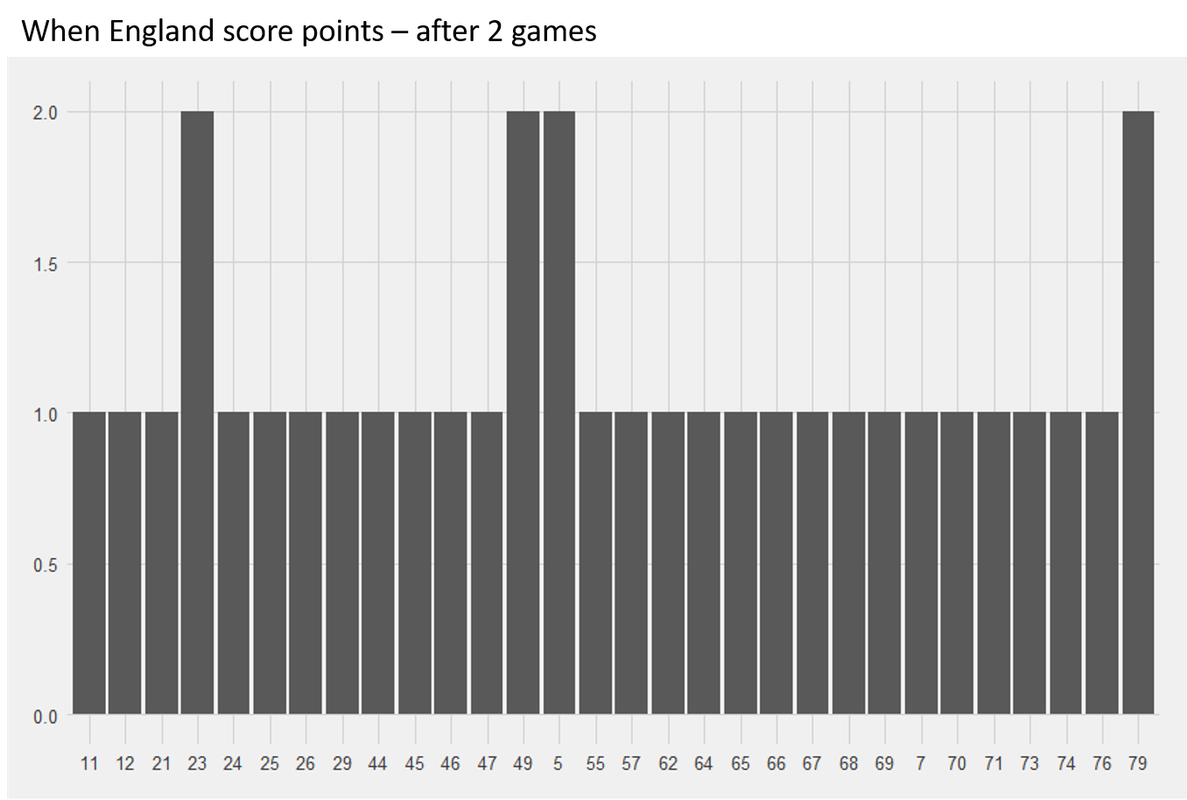
After the second game, when do England score their points?

When-England-score-points-after-the-2nd-game 

The points are reasonably spread through time - the most interesting thing is probably that this is two matches in a row where England have scored in the fifth minute, which suggests that Wane's philosophy may well be hit 'em hard, early. 

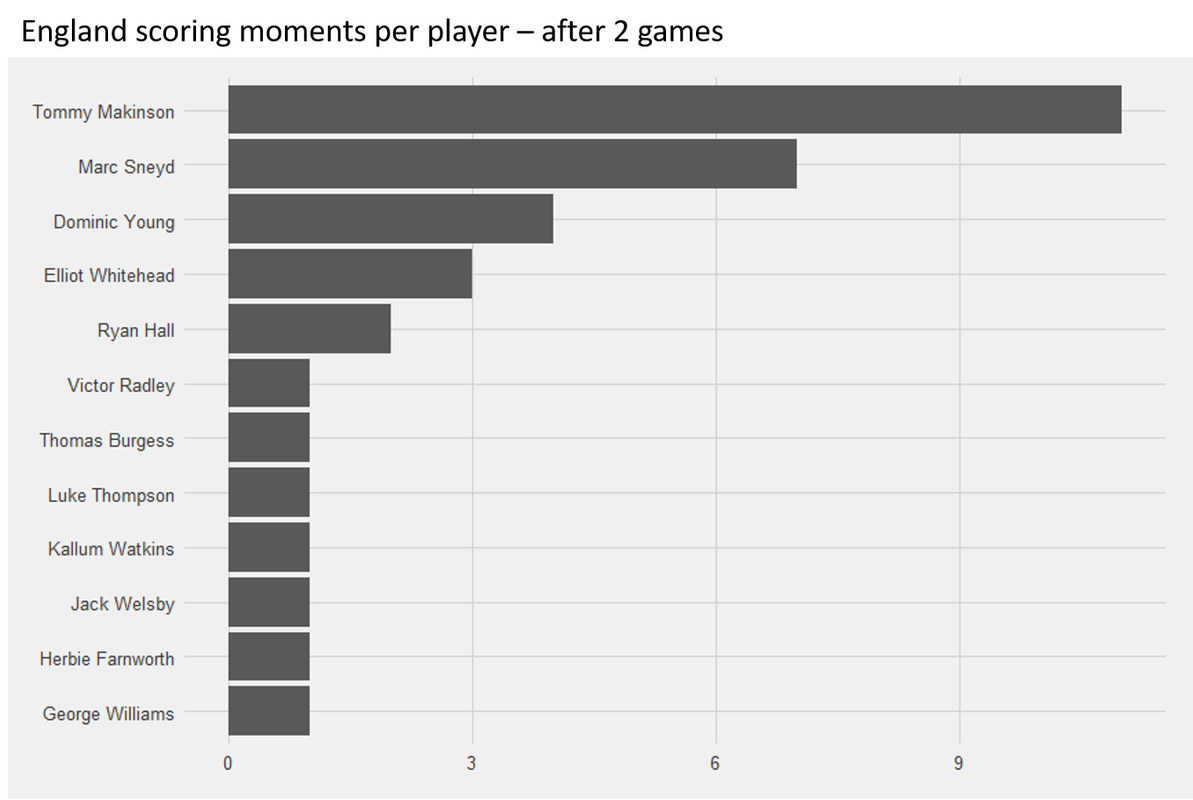
If we look at who scored the points, England-scoring-moments-per-player-after-2-games Tommy Makinson still tops the scoring-moments chart, even though he didn't play the second game. As a rugby league fan, it feels very odd saying an England game vs France was harder, with fewer scoring opportunities, than a game against Samoa. 

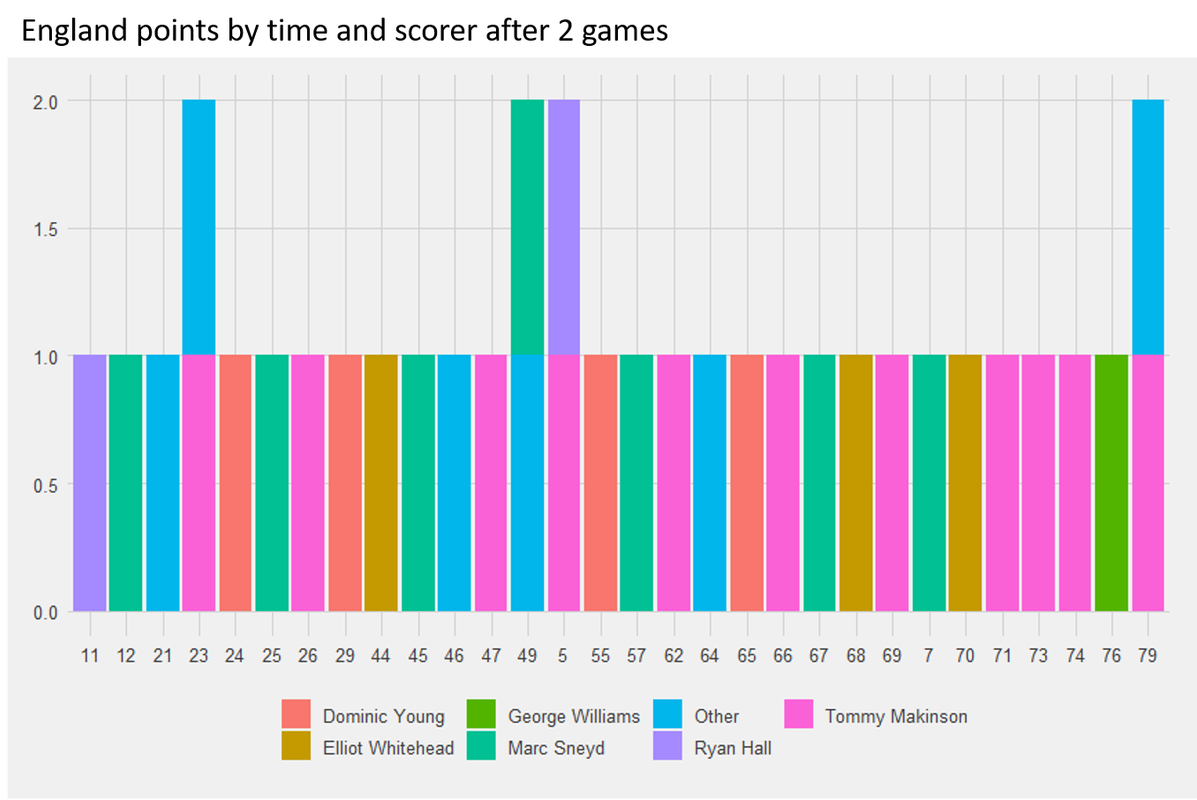
If we look at who scored when, England-Points-Scoring-Moments-by-Time-and-Player-After-2-matches Yes, that is Ryan Hall in the top 6 points scores despite only playing one game. Because if England give him the ball he will score. If only Wayne Bennett had remembered that during the last World Cup.

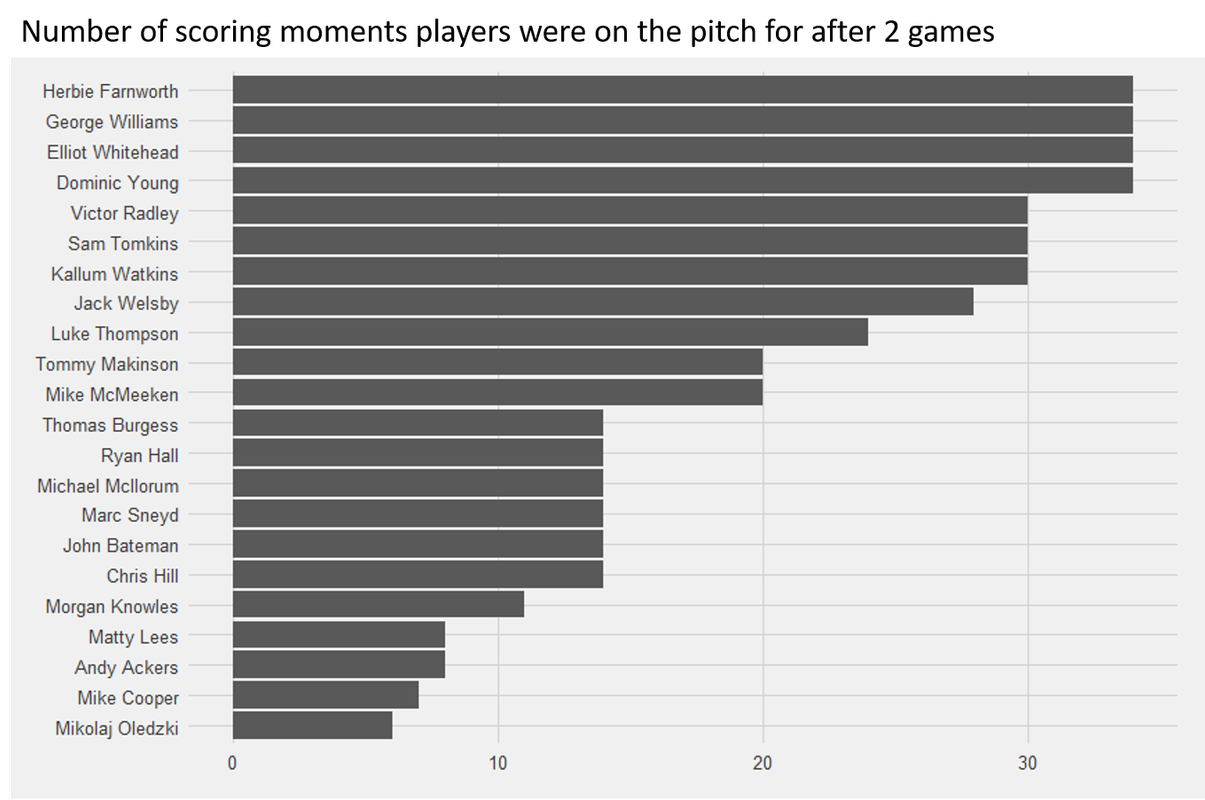
Number of point-scoring moments England players have been on the pitch for: Number-of-Scoring-Moments-Players-Were-On-The-Pitch-For-After-2-Matches Four players have been on the pitch for all of England's points - Herbie Farnworth, George Williams, Elliott Whitehead and Dominic Young. 

Other than enjoying pulling L's tail about George Williams coming up good, one of those four players is not like the others. 

Elliott Whitehead is a second rower who has now played two 80 minute matches back to back. Given how much of the noise before the tournament was about his age, I think large meals of humble pie are required for many people. 

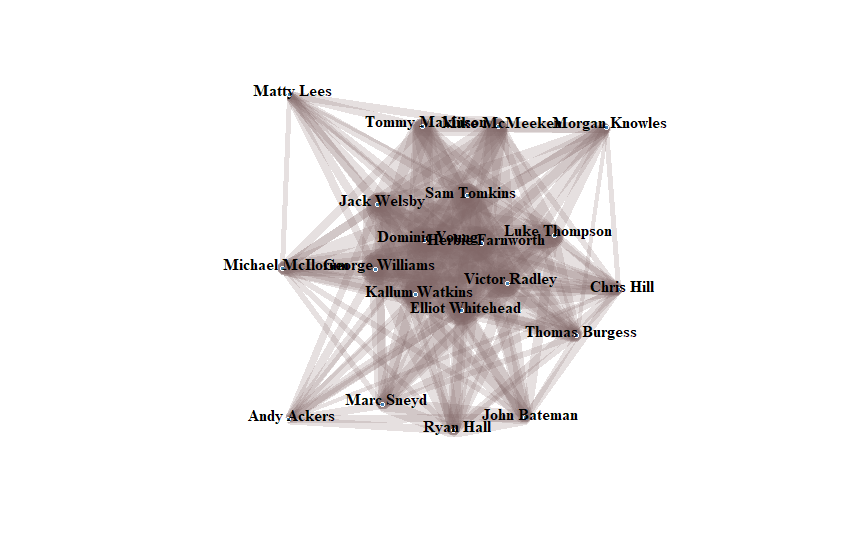
The network diagram and matrix figures have changed, but I think the major differences reflect the personnel changes between the two matches (Ackers, Oledzki, Bateman, Sneyd and Hall in, Makinson, McMeeken, Knowles, Lees and Cooper out) rather than either set of players being better or worse at creating chances. 
  Player-Network-Diagram-After-2-Games Player-Matrix-after-2nd-Game I've also now got some more info on when the opposition have scored. It's not as well formed as the scoring information so I'm only going to share one picture at the moment. When-the-opposition-teams-score-after-2-minutes The main thing I take away from this is that England concede in the last 10 minutes of the first half. 

Now, due to Samoa's implosion, that wasn't a problem against them, and again England had a decent head start against France, but later on in the tournament, that could really come back to bite them in the bum. The teams England are most likely to face in the quarter and semifinals are both momentum teams and a score then will really give them heart and might well give them the extra oomph to score another before halftime. 

What Australia might do in that situation ... it's too horrible to contemplate. 

The match against Greece is unlikely to provide final proof either way on this one, but if Greece do score in those last 10 minutes of the first half, then I think that'll prove the pattern and demonstrate a really weakness that can be exploited by England's opponents.

Monday, 17 October 2022

Rugby League World Cup Data Visualisation Project - What Combinations Score For England

This is a follow up to the Six Nations 2021 project.  In the summary for that I said, "It would be interesting to see how things like this look in sports with rolling subs (odd that there's a Rugby League World Cup this year that might fill that gap ;) )". 

It was a good plan, it was just that the Rugby League World Cup was delayed for a year. 

But it's here now.  

Since what I am interested in is whether having rolling substitutes affects the shape of the patterns, I will focus on a single team. I have, for reasons of obvious bias, chosen England. 

England's first match was versus Samoa, and I was expecting it to be close and tight. There was always the chance that it was going to be a blow out victory for England against a Samoan team who hadn't had any warm-up games. But I don't think even the most optimistic England fan (or pessimistic Samoan fan) was expecting a score of 60-6 for England (match report here - https://www.bbc.co.uk/sport/rugby-league/63271368). 

Okay, so that should have given me plenty of data to work with. Shame that the official RLWC site didn't have any stats, nor did the BBC. 

Luckily for me, NRL.com did have the info. 

For the first game, all the information came from here - https://www.nrl.com/draw/rugby-league-world-cup/2022/round-1/england-v-toa-samoa/

When do England score?   

When-England-score-points-after-the-1st-game 

The points come in waves, basically at 20 minutes, 45 and then 60-80 when Samoa ran out of energy, players because three of them had either broken bones, dislocated hips or injured ligaments I've never even heard of and were a man down due to Anthony Milford being sin-binned for a late tackle.

Who scores for England?   England-scoring-moments-per-player-after-1-game 

Tommy Makinson, so England can join Saints fans in the traditional pastime of hoping he doesn't get injured.

Who was on the pitch when England scored?   

Number-of-Scoring-Moments-Players-Were-On-The-Pitch-For-After-1-Match 

And then same but as percentages: 

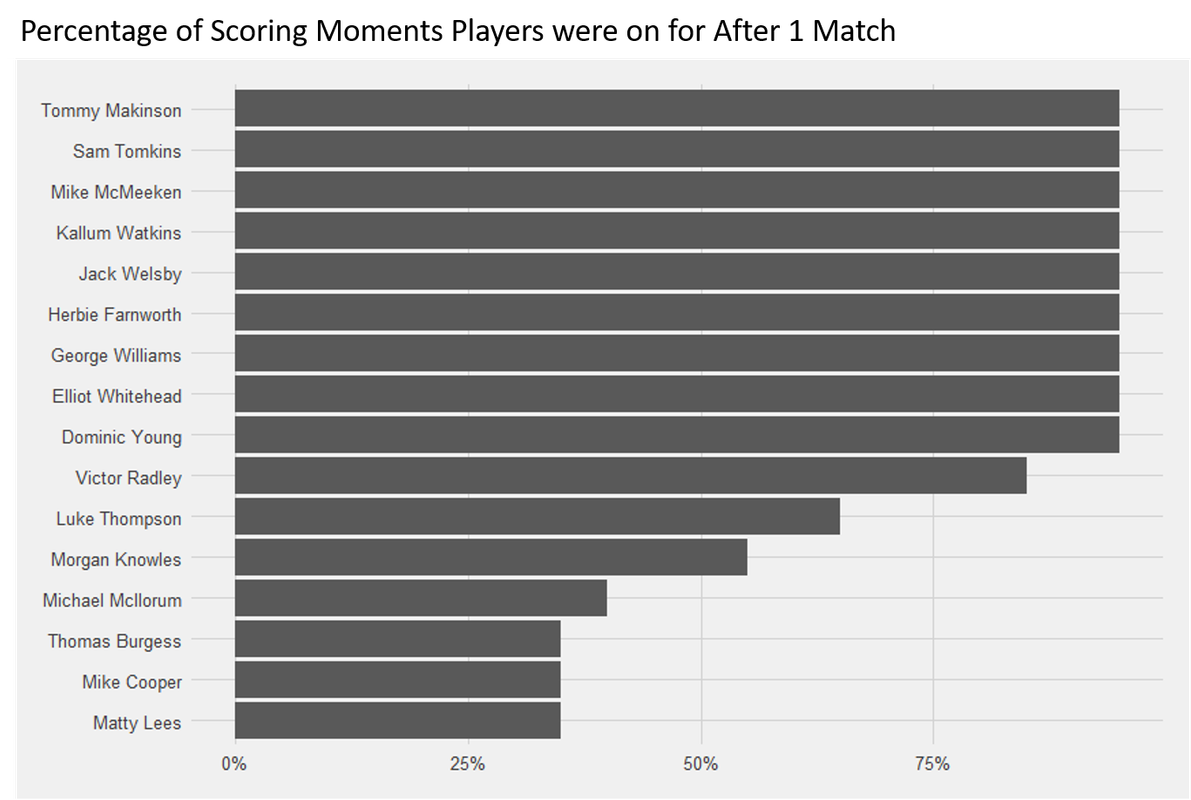
Percentage-of-Scoring-Moments-Players-were-on-for-After-1-Match 

I'm going to watch how this changes, and, at the end of tournament correct for percentage of games played. At the moment it mostly shows which forwards were being rotated out (about which, more next).

Network diagram and matrix diagram of which players were on the pitch together when England scored   Player-Network-Diagram-After-1-Match Player-Matrix-after-1st-game 
After 1 game, the network diagram doesn't tell us much, but the matrix diagram interests me. 

Okay, so forwards play together less than the backs, that's expected - forward are the players you sub on and off to keep them fresh. 

What I didn't expect was the pattern: 
Morgan Knowles (LF, SR) and Matty Lees (Prop) played together infrequently, which is odd since they play different positions. 
Matty Lees (Prop) and Chris Hill (Prop) not playing together makes more sense because they're both props. 
Michael McIlorum (hooker) and Chris Hill (Prop) and Tom Burgess (Prop) not playing together is odd, because, again, not the same position 
Mike Cooper (Prop, LF) and Chris Hill (Prop) and Thomas Burgess (Prop) and Chris Hill (Prop) and Tom Burgess (Prop) not playing together, again, makes sense because they'd be prop for prop replacements. 

The two "proper" forwards that played the full 80 minutes were Mike McMeeken (second row) and Elliot Whitehead (also second row). It's both interesting, given the pre-tournament chat about Whitehead's age, and not surprising because McMeeken is the second most underrated player in Super League. 

The thing that strikes me is that there was a period of the game, when McIlorum was off the pitch, when there was no recognised hooker on the pitch. In fact, had anything happened to McIlorum, there was no other recognised hooker in the matchday squad - Shaun Wane has only picked two of them, McIlorum and Andy Ackers. 

Now I'm sure that someone, probably Victor Radley, could have deputised but it's a risky tack to take. 

Obviously, I'll keep updating these as the tournament carries on. I'm also going to look at who is on the pitch when England concede. However, at the moment, it's an uninformative set of information. 

The R project is here https://github.com/fulltimesportsfan/RLWC2021/blob/a49975981f6054b70a48b7b265a86b5a6d599d61/Rugby%20League%20World%20Cup%202021%20Summary.R 

I've fixed all the random movies and casts. I think it's given me a better idea of how the code works. 

Json file if you want to do cooler things with it is here - https://github.com/fulltimesportsfan/RLWC2021/blob/35effbc084c65f3383e420f02ccfaf81524ac1b1/England1stgame.json

Friday, 14 October 2022

Rugby League World Cup 2021/2022

Much like the last Olympics, I am not sure if we're giving this the number of the year it should have been in or the number of the year it is in. 

Whatever we're calling it, it kicks off tomorrow with what is probably the most interesting match of the group stage, England, the hosts, vs Samoa. 

Partly I am just excited to see international rugby league again, but partly this could be a stormer of a match. Or it could be a completely implosion of either side. It's that lovely thrill of the unknown. 

Because on paper, Samoa should be excellent, and England are coming in with a few injuries and short at least two players who I think would have been in the starting 13. But rugby is played on pitches not paper, and this is a Samoa team who haven't played together often and ... oooh it could be interesting. 

The other rugby league fan at work (a Salford fan for his sins) feels much the same way as I do. It's all very oooooh. 

In group B, Australia vs Fiji could be good, if Fiji play like they did last World Cup, or it could be appalling, if they play like they did in their warm-up game (England 50-0 Fiji, Fiji you are better than that.) 

In group C, Ireland vs Lebanon is probably the most intriguing match, because Lebanon (coached by Michael Cheika, yes that Michael Cheika) come together nicely for World Cups and Ireland look solid, and neither team have ever lacked heart and effort. 

Group D features the other candidate for the potentially most interesting match - Tonga vs Papua New Guinea. Tonga, lead by the ever-wonderful Kristian Woolf, ex-Saints coach and based in St Helens and training with our academy boys Tonga, vs Papua New Guinea, the national team of the only country on the planet that has rugby league as it's national sport. 

The rugby will be beautiful, the score unpredictable. 

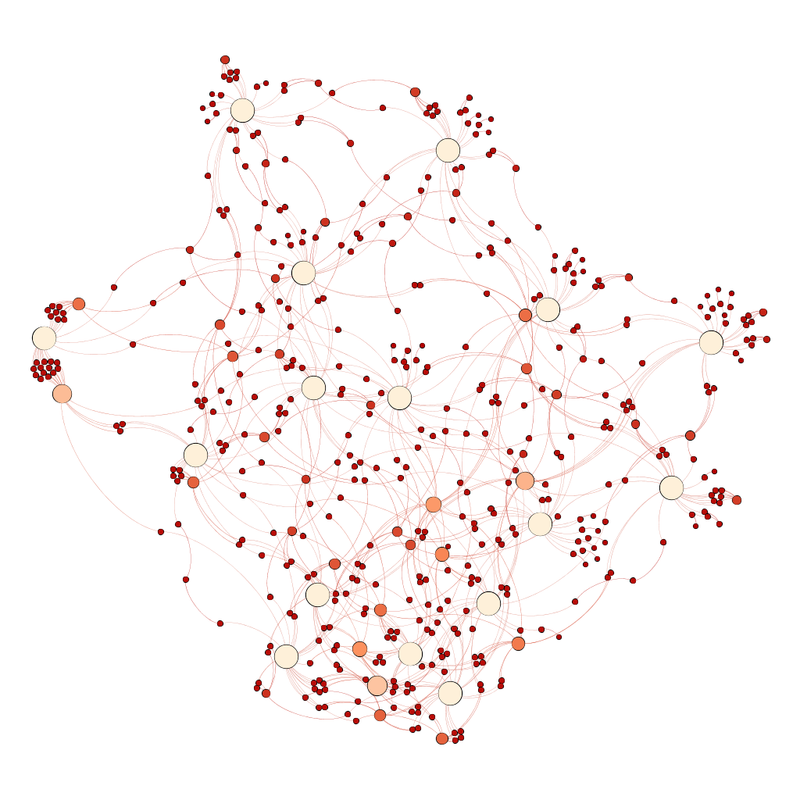
I've made the usual network diagrams. 

Due to the number of New Zealandish, Fijian, Samoan and Australian players that play on the same teams, that part of the diagram is tightly clustered so I've had to tweak the settings to make that part readable. Men-s-Group-Stages Men-s-Group-Stages-labelled 
Everyone else is much more spread out. 

The national team closest to the centre, pretty much bang on centre in fact, are the Cook Islands, with Leeds being the club team closest to the centre. 

These diagrams would have been posted sooner, but a couple of players had to be replaced at the last minute by some of the teams so I had to make a last minute update. Interestingly, before that, there were no Hull F.C. players, but both replacement players play for Hull. I had thought it odd that there weren't any. 

The Penrith Panthers are the club team with the most players present, with 19, followed by Catalan Dragons with 18 (not all playing for France) and South Sydney Rabbitohs with 17. 

The community view of the network diagrams is also interesting. Men-s-Group-Stages-Communities Men-s-Group-Stages-Communities-labelled 
There are 16 teams in this group stage but they fit into just 13 communities. Samoa and New Zealand are 1 community, as are Fiji and Australia and so are England and Ireland. The other teams are their own separate communities. 

Certainly I'd expect the winners to come from the Australia/New Zealand/Fiji/Samoa cluster, and even with a team with 13 players making their debut Australia are still strong favourites. 

I was hoping to have similar diagrams for the Women's World Cup and the Wheelchair World Cup, which are being held at the same time as one giant festival of rugby league, but unfortunately, most reports don't name the club teams the players play for. 

If I can find the information, I will make the diagrams.

Wednesday, 12 October 2022

Formula 1 2022 - There will be no review of the Japanese Grand Prix

There will be no review of the Japanese Grand Prix because it has become obvious that the people running the Japanese Grand Prix do not care about previous Japanese Grand Prix so I don't see why I should.

What could have happened to Pierre Gasly is unforgiveable.

Motorsports will never be completely safe, but that just makes it more important that people who run races reduce risk where possible.  

Having a tractor-type truck on track while drivers are racing in poor visibility in rainy conditions that lead to poor ability to control the car is a known danger - https://www.bbc.co.uk/sport/formula1/63190448

Jules Bianchi sustained the injuries that killed him at Suzuka in precisely those circumstances.

After the investigation, once that combination of factors was identified, everyone involved with the Japanese Grand Prix and Suzuka circuit said "never again".  

I don't think doing the same thing 8 years later counts as never again.

Friday, 7 October 2022

Formula 1 2022 - Singapore Grand Prix

Other than actually winning, as a Ferrari fan, I can't see any way the Singapore Grand Prix could have gone much better for us. 

The inevitable was delayed that little bit longer, and for once, we were not the most incompetent. 

I mean, there was one moment of glorious Ferrari idiocy but one per weekend is less than usual. Despite that, I was underwhelmed by the race. Marc Priestly, on BBC commentary for the weekend, said something that I think explains it. He said that he normally doesn't like the Singapore Grand Prix because nothing happens and he wasn't sure if this year's race was interesting or whether it was just because a lot of nothing happened. 

And I think he was right. Very little actually interesting happened, but, boy, was there a lot of not interesting happening.