Showing posts with label r stats. Show all posts

Friday, 26 December 2025

Saints Ahoy - Game 30, 2024 season round up and an overall summary of the whole project

Game 30 itself: 
Saints, despite having a pretty pants season overall, still reached the 2024 playoffs. 

And somehow only lost by one point, in golden point extra time, to a Warrington team who'd had a pretty solid season overall. A Warrington team we'd lost to twice, 10-24 and 16-2 (or a combined score of 12-40) 


Going through the data visualisation for this game, the 30th and last game of the season. 

There were 7 point scoring moments for Saints. 

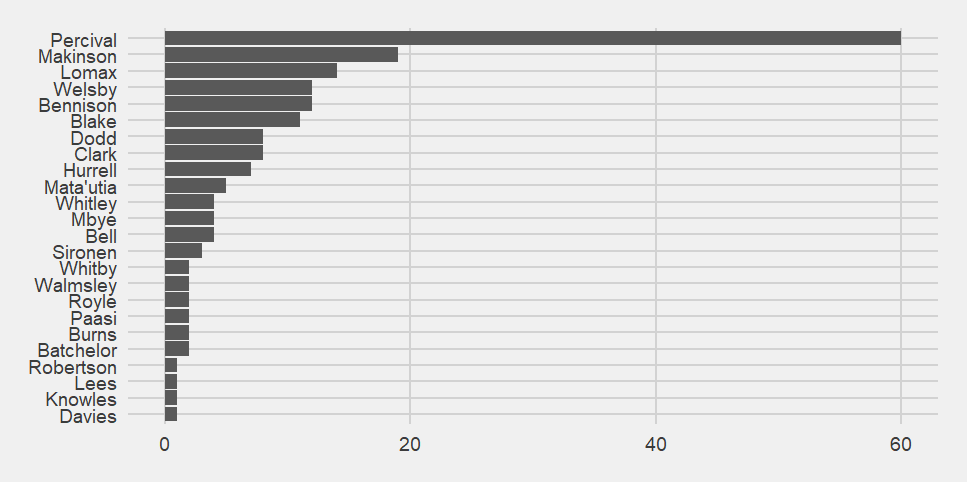
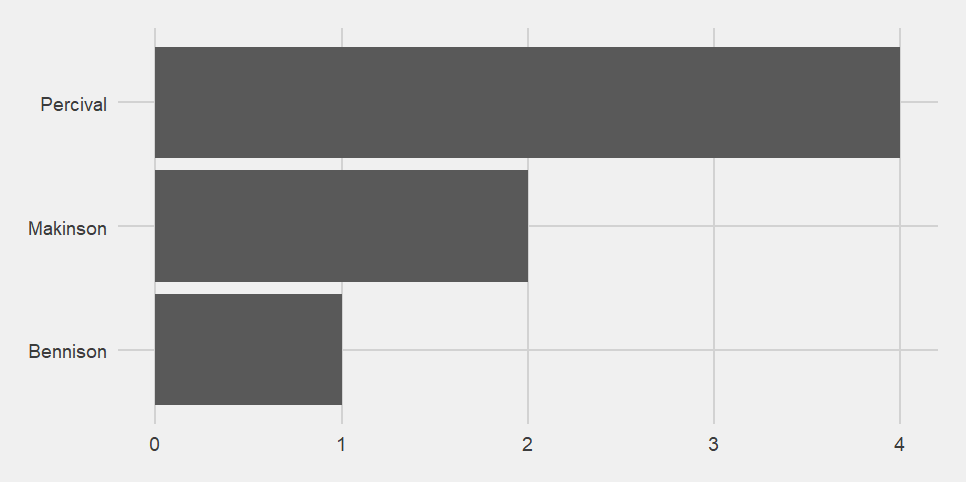
Who scored for Saints in Game 30? Bar chart of who scored for Saints in game 30.  There are three players on this bar chart, Percival with 4, Makinson with 2 and Bennison with 1. 
There is something very apt about there being a Tommy Makinson special in his last game for Saints. 

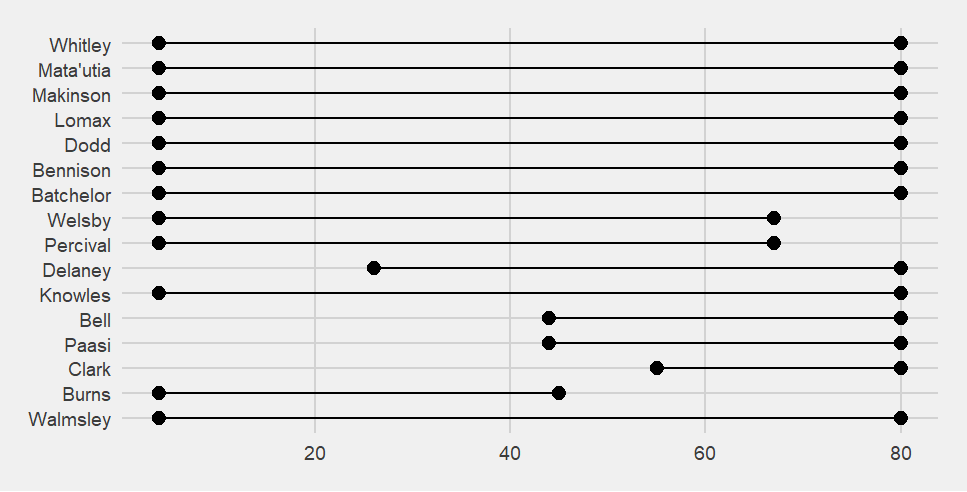
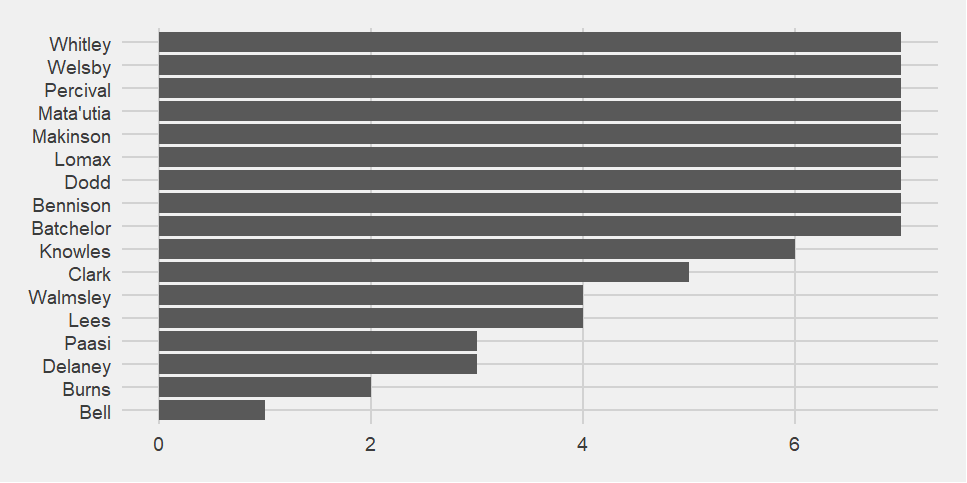
How many point-scoring moments the players were present for? Bar chart of the number of point-scoring moments players were present for.  Whitley, Welsby, Percival, Matautia, Makinson, Lomax, Dodd, Bennison and Batchelor were present for all 7. Knowles was present for 6 out of 7 point-scoring moments, Clark for 5, Walmsley and Lees for 4, Paasi and Delaney for 3, Burns for 2 and Bell for 1. 
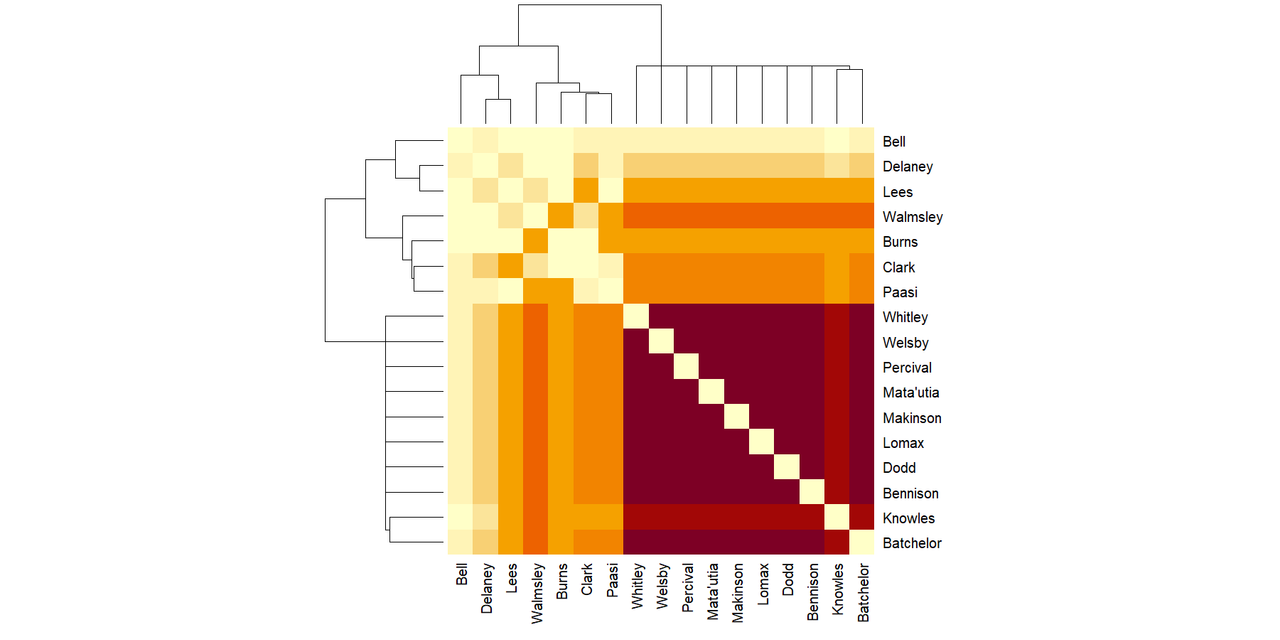
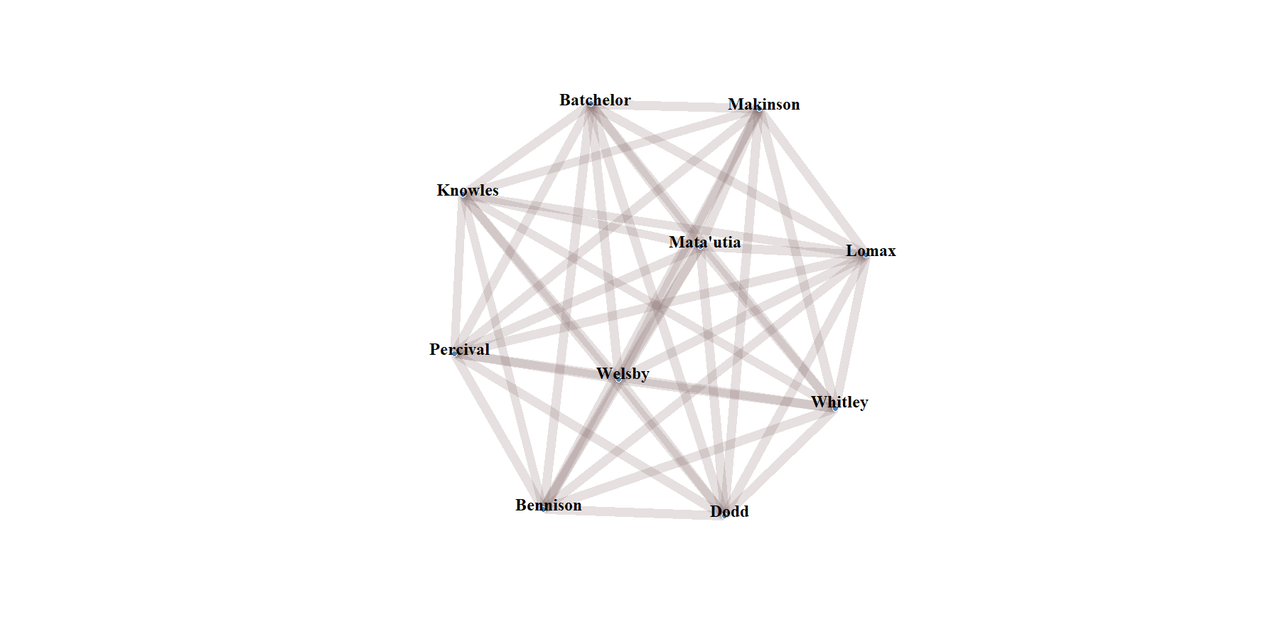
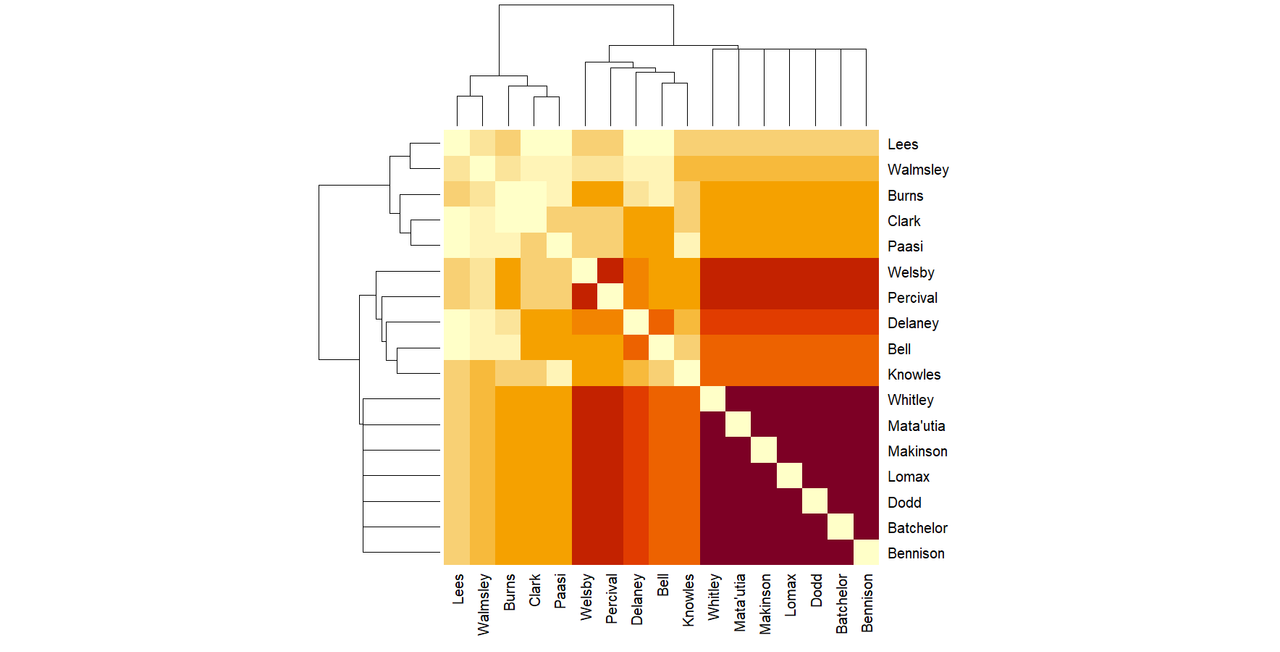
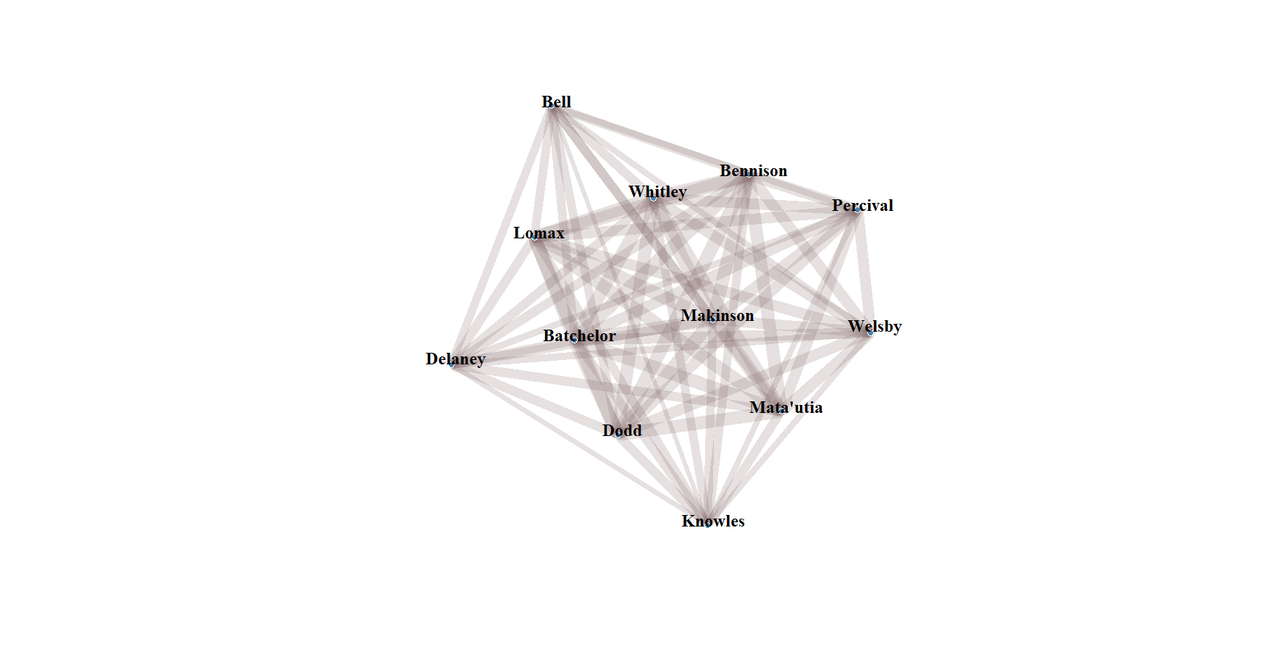
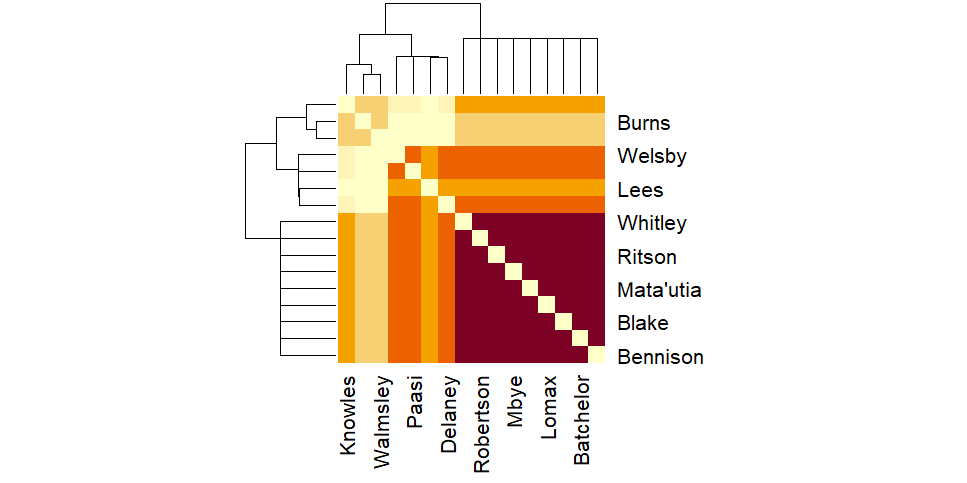
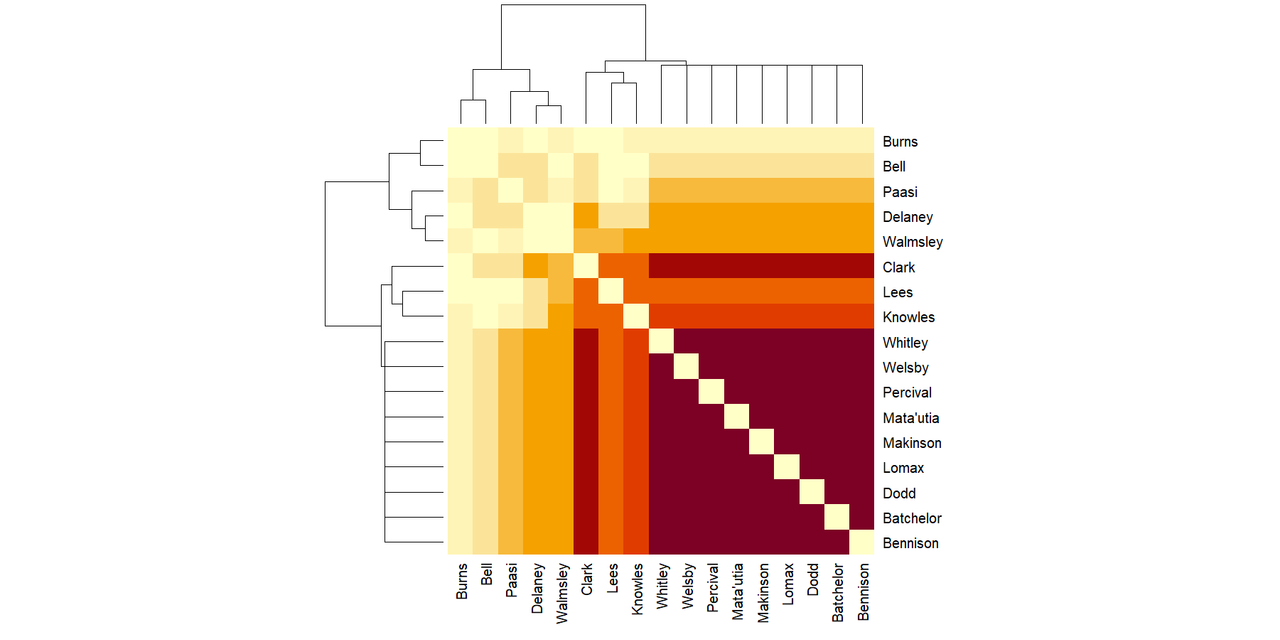
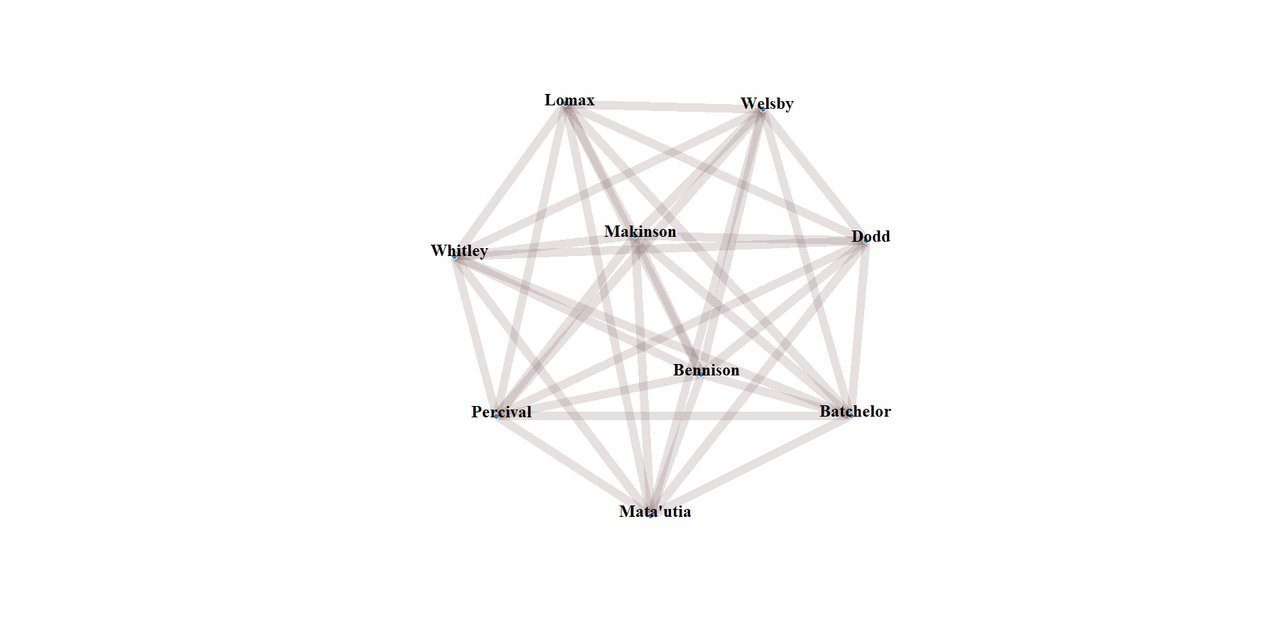
Which Saints players are together when Saints score? Matrix of which players are together when Saints score.  The dark purple, most commonly together section is at the bottom right.  There is a red line running through it, which represents Knowles who was not on for one of them.  The next darkest line (dark orange) is for Walmsley, but he is all the way up.  Between purple and Walmsley lies a paler orange cohort.  The palest in this section is Burns, because he swapped in for Clark late on.  Lees, on the other side of Walmsley, is the same shade of orange because he got swapped on and off.  Delaney is one shade paler, then Bell is the palest. Only 10 players are on the network graph. The ten players on this graph are Batchelor, Makinson, Knowles, Matautia, Lomax, Percival, Welsby, Whitley, Bennison and Dodd. 

The 10 players are the ones in the dark purple patch in the matrix graph. 

Looking at which players were present when Saints conceded: 

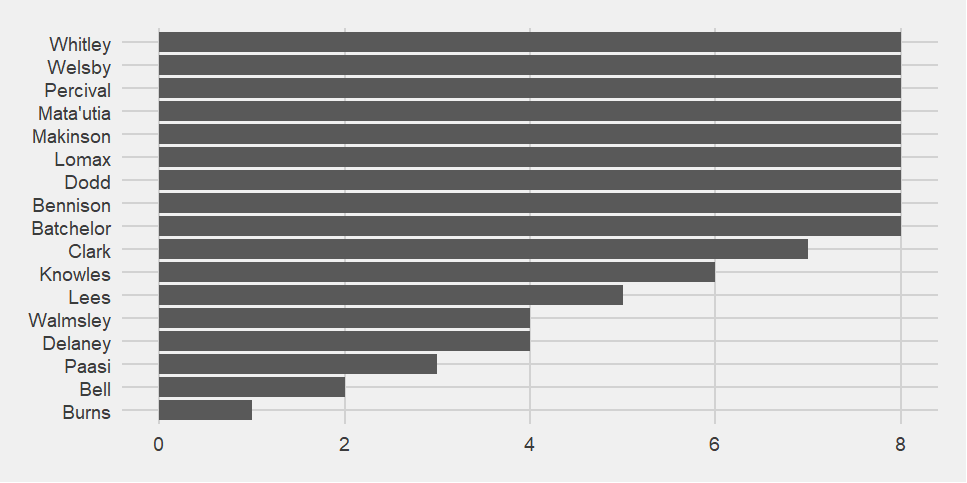
There were 8 point-conceding moments. Bar chart showing how many point-conceding moments players were present for.  Whitley, Welsby, Percival, Matautia, Makinson, Lomax, Dodd, Bennison and Batchelor were present for 8 point-conceding moments.  Clark was present for 7, Knowles for 6, Lees for 5, Walmsley and Delaney for 4, Paasi for 3, Bell for 2 and Burns for 1. 
The who is present when Saints concede matrix does the same thing that the scoring matrix does, where it doesn't put all the players in the same colour together. Matrix of which players are together when Saints concede.  The dark red, most commonly together section is at the bottom right.  It contains Whitley, Welsby, Percival, Matautia, Makinson, Lomax, Dodd, Batchelor and Bennison, are in that group.  Clark who might be marginally less dark red is separated from that group. Between dark red and Clark is Knowles in orange, and Lees in a paler orange.  Following Clark in a paler orange than Lees are Delaney and Walmsley, then Paasi in the palest of the oranges.  In yellow are Bell, and in paler yellow, Burns. There are only 9 players on the concession network graph. The nine players on the network graph make a sort of multi-faceted diamond shape.  They are Lomax and Welsby on the top row, then Whitley, Makinson and Dodd on the next row down.  Then Bennison and a short space further down Percival and Batchelor then Matautia on his own at the bottom. Rounding up the whole season 
There were 210 point-scoring moments scored and 148 point-scoring moments conceded 

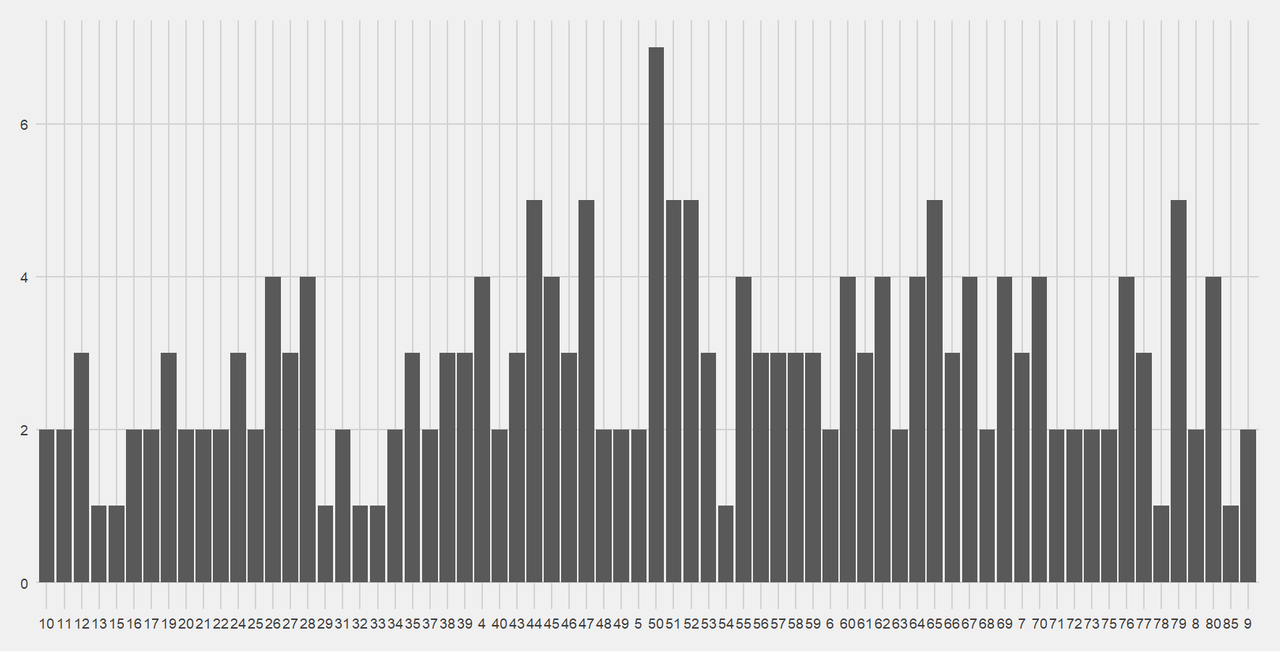
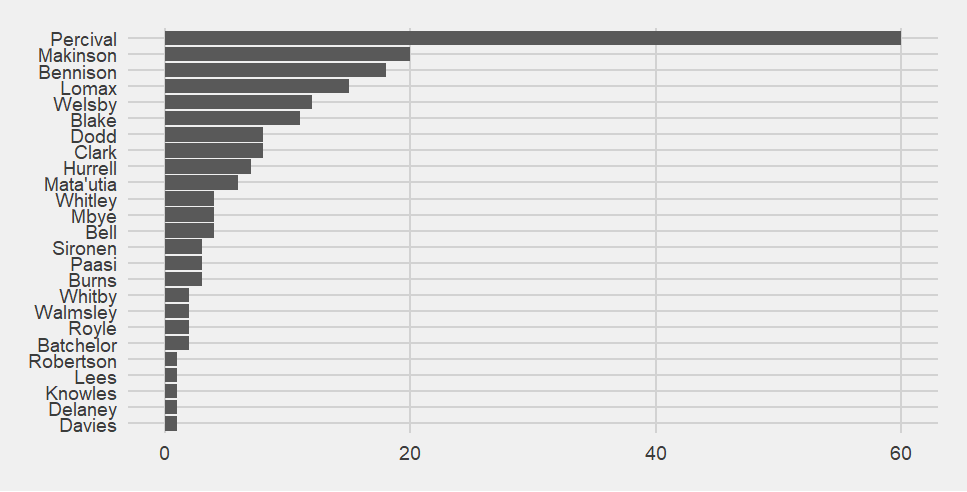
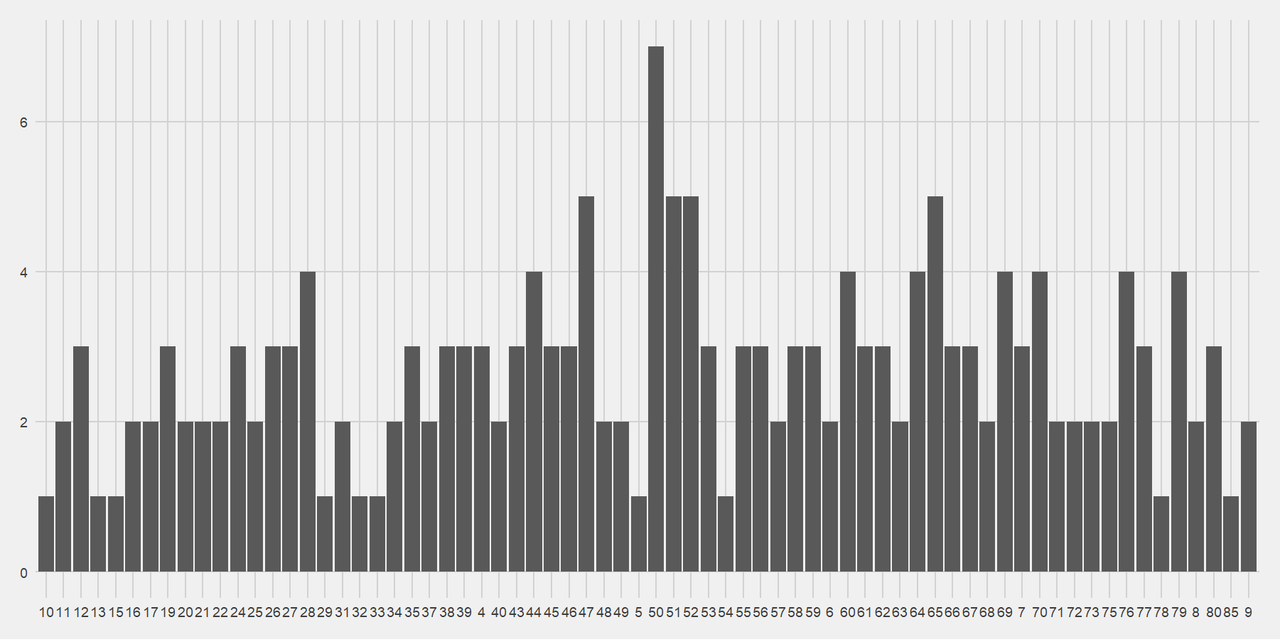
When do Saints score: Bar chart of when Saints score.  The highest point is in the middle, with seven point-scoring moments in minute 51.  The rest of the graph is roughly normally distributed.  There is possibly another slight rise in minutes 75-80, presumably as weaker oppositions tire.></a></lj-cut>No obvious pattern at the end of the season.Who scores for Saints:<lj-cut text="Under the cut"><a href="https://postimages.org/" target="_blank"><img src="https://i.postimg.cc/Y0b4FpbY/Who_scored_for_Saints_up_to_game_30.png" alt="Bar chart of who scores for Saints.  Percival is far in the lead with about 65 point-scoring moments.  The next player is Makinson, who scores tries and can kick, he has about 23 point-scoring moments.  Bennison is next with 21.  He can also kick and has kicked when Percival is not available. Unsurprisingly, Percival is way in the lead, because as well as scoring tries, he's also Saints's kicker. That's also, I think, why Bennison is that high, because he also kicks when Percival can't. 
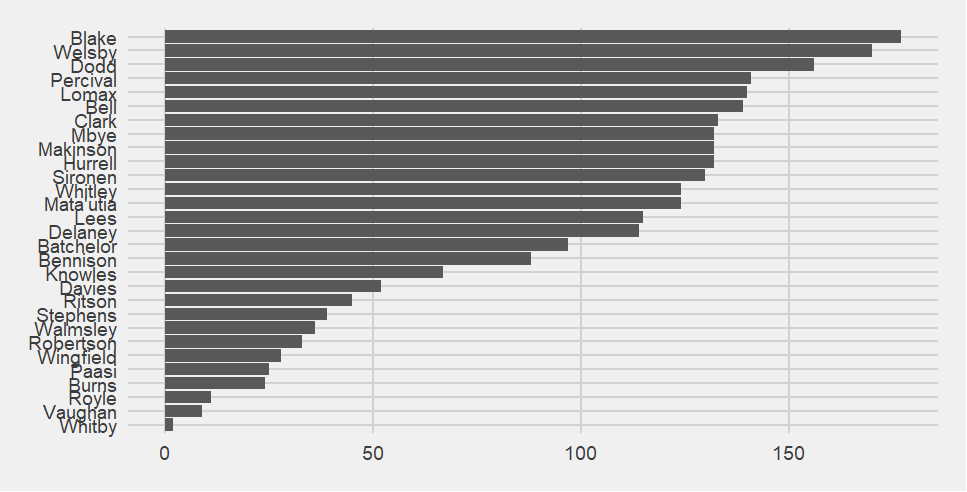
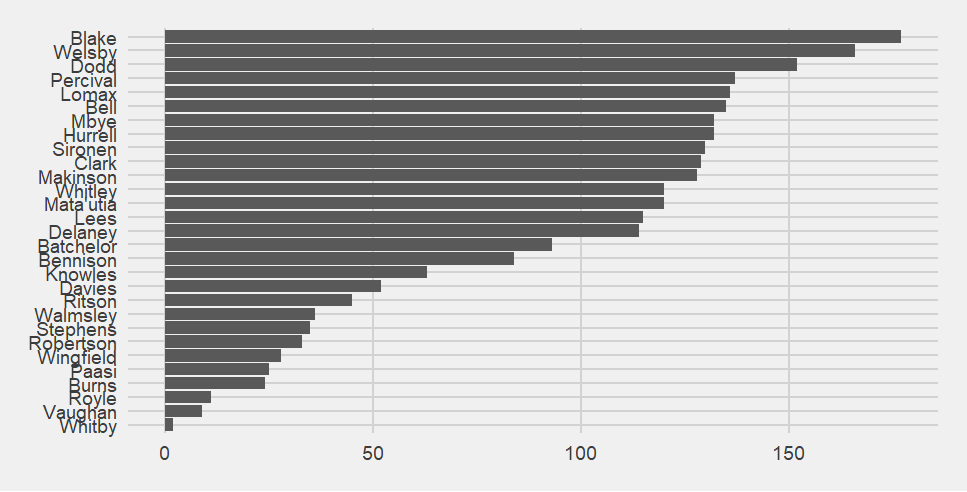
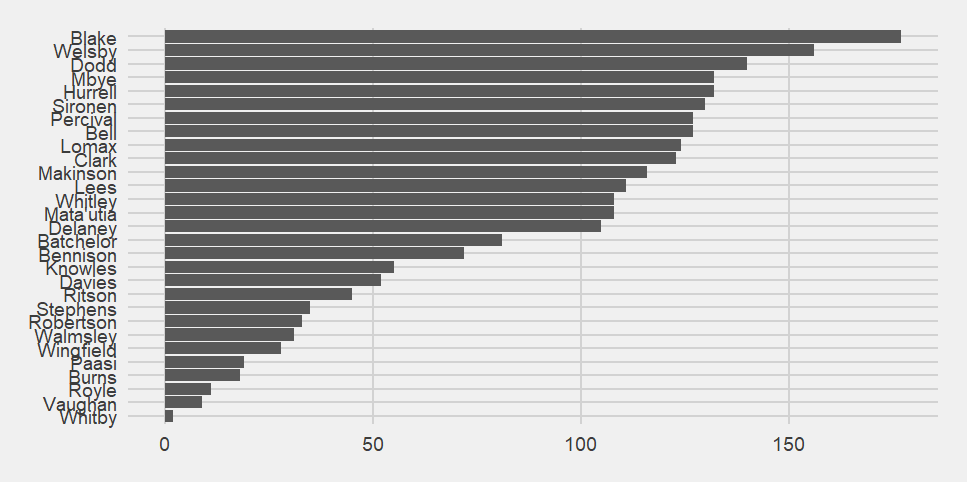
Who is present when Saints score? Bar chart of who is present when Saints score.  Blake and Welsby share the lead, followed by Dodd.  Everyone else is present for less than 150 point-scoring moments. 
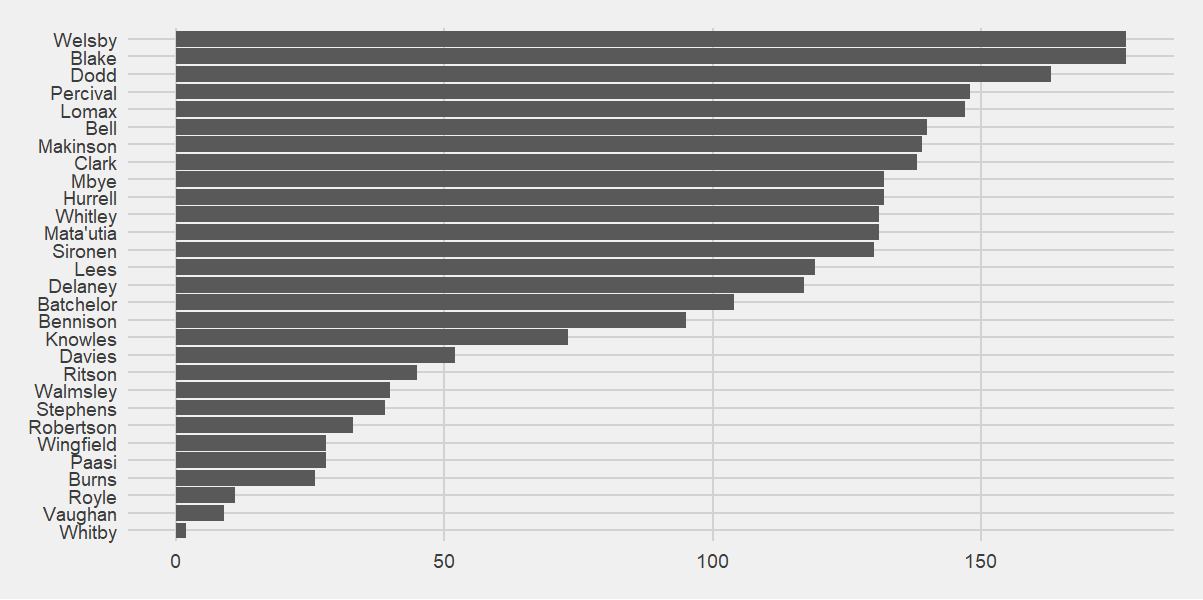
It is clear that there's the very often present, then a chunk of often present, followed by the injured and their replacements. 

An interesting visualisation I haven't shared before, because I wasn't quite sure what it added, but I'm sharing now because as an end of season piece is when players are present at point-scoring moments. Bar chart of when the top 16 players are present for Saints point-scoring moments.  Blake, Dodd, Clark, Mbye, Sironen and Matautia have similar shaped curves, while the curves for Welsby, Percival, Bell, Makinson, Hurrell and Lees are similar to each other. 
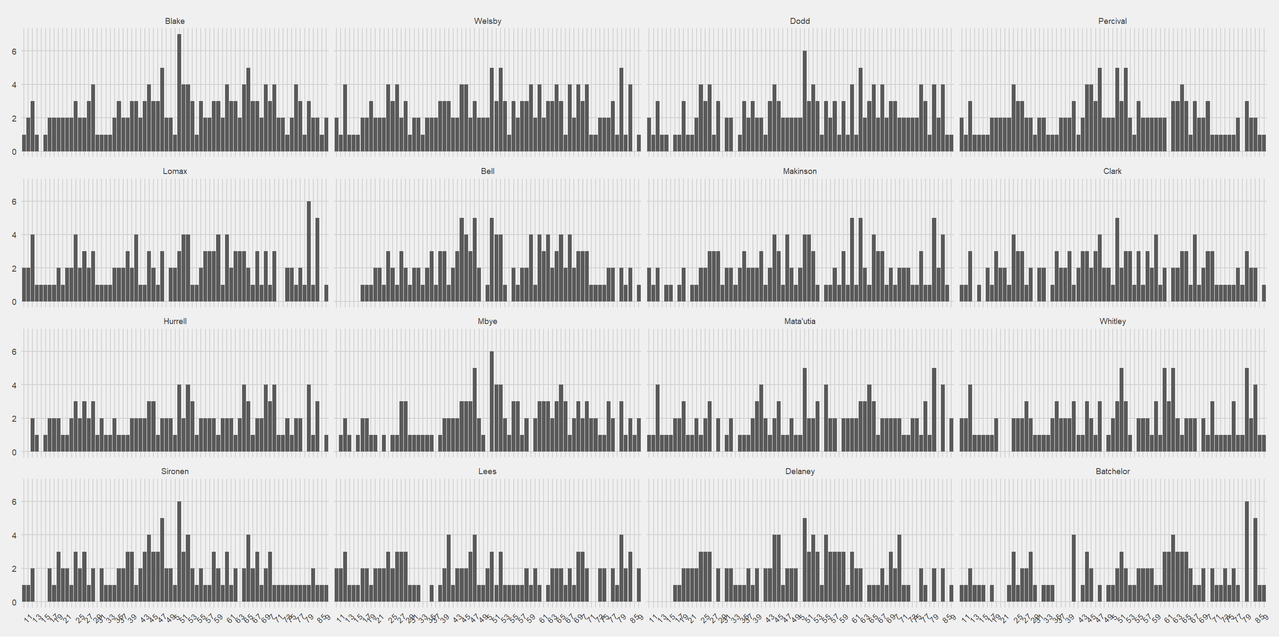
I'm not quite sure how to interpret it, but it's interesting that the graph shapes can almost be grouped into clusters. The clusters aren't based on position, or anything obvious like that. 

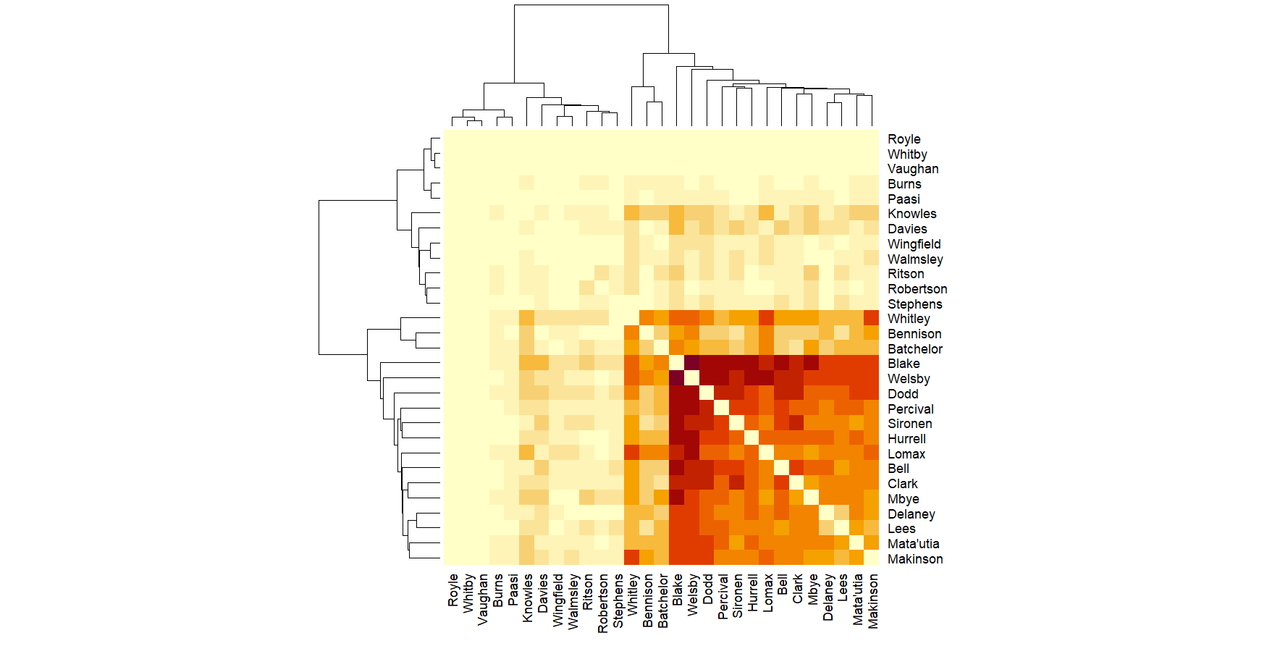
Looking at the which players are together when Saints score matrix at the end of the year. 

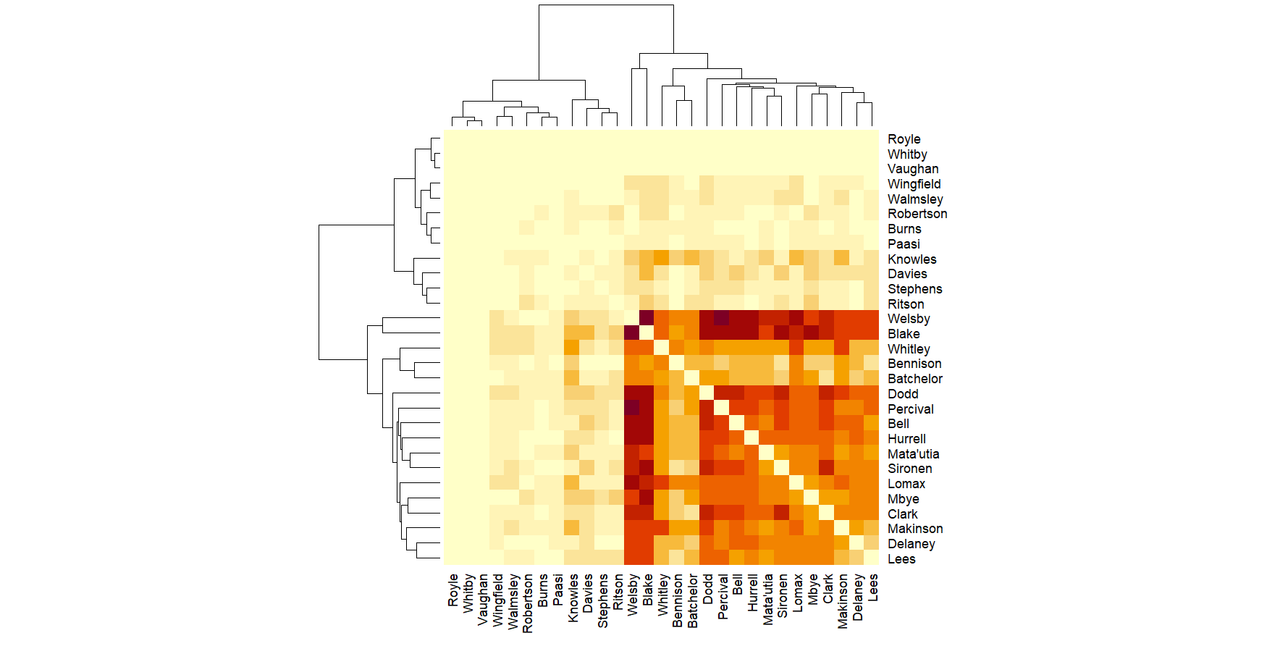
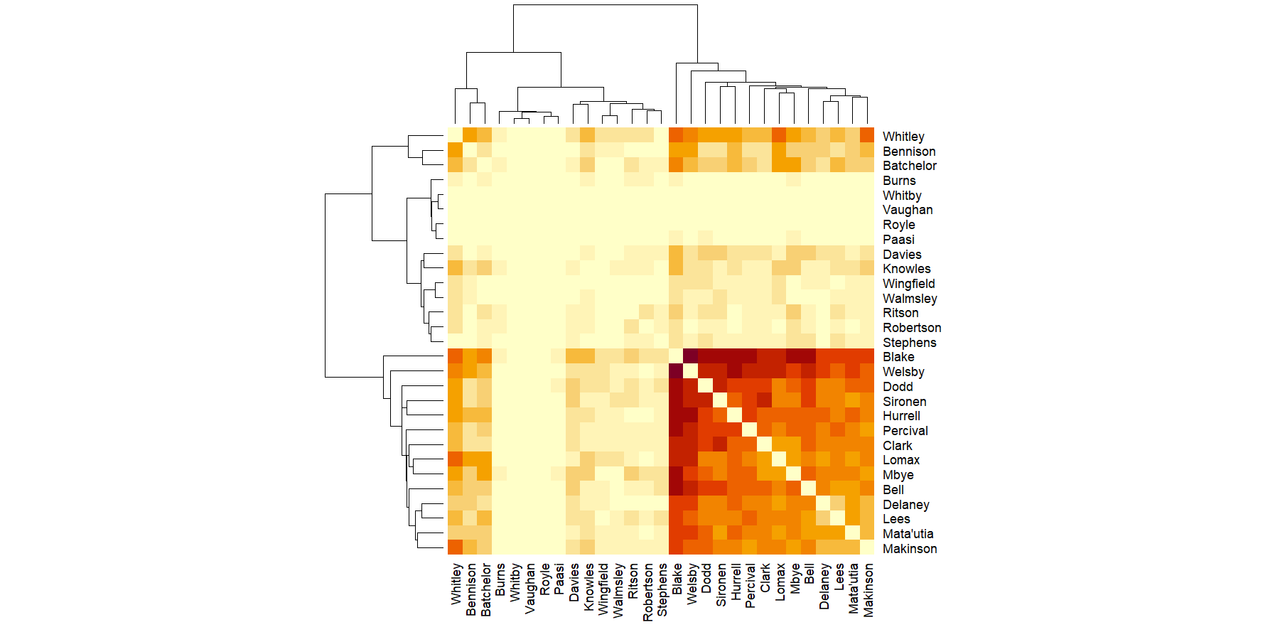
Following game 30, the shape has changed significantly. Where previously it had gone (radiating up from the bottom right) darkest, most often together area, then paler and paler as you move up or to the left, now there's a medium dark border at the upper left as well. This cluster has to be players who play together often when Saints score, but not as often with the darkest bottom right cluster. Matrix graph described above.  The darkest most often together when Saints score section in the bottom right has Blake, Welsby, Dodd, Whitley, Percival, Lomax, Mbye, Clark, Hurrell, Makinson, Bell, Delaney, Lees, Sironen and Matautia.  Then there is a paler section, Davies, Wingfield, Walmsley, Stephens, Ritson, Robertson, Burns and Paasi, followed by the palest section, Royle, Whitby and Vaughan.  The interesting and second darkest section now on the top and left border includes Knowles, Bennison and Batchelor. 
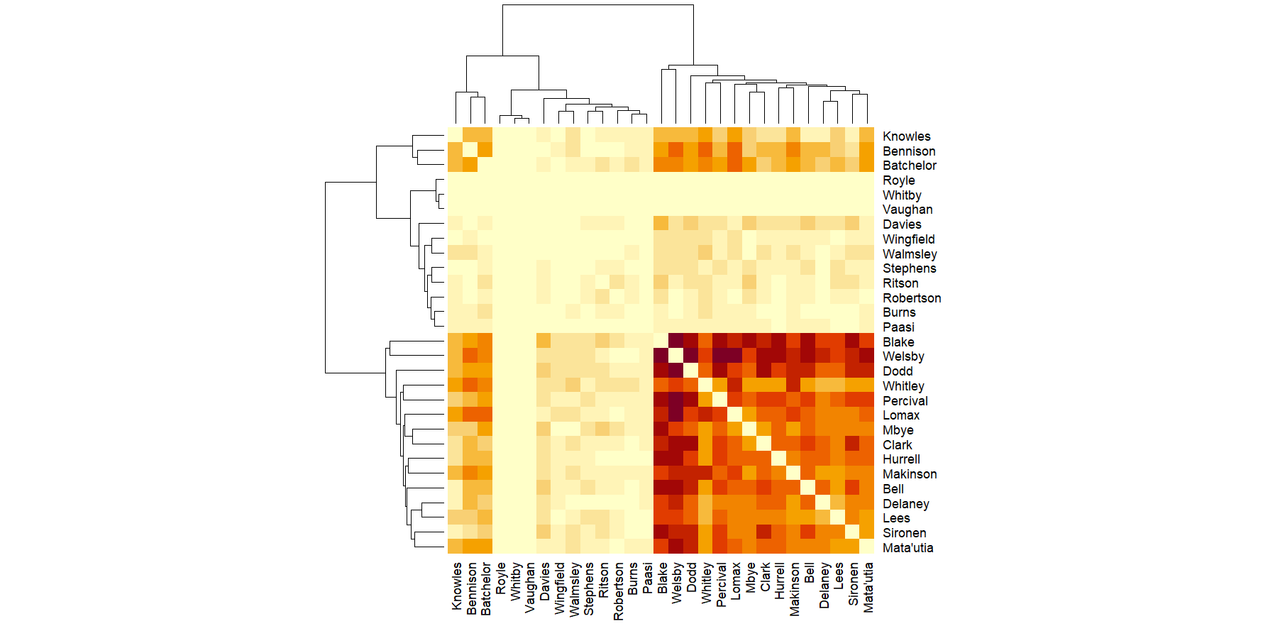
I know that Knowles, Bennison and Batchelor all had either injuries, suspensions or are first reserve, which means it makes some sort of sense, but it's interesting that the pattern has only come out right at the end of the season. 

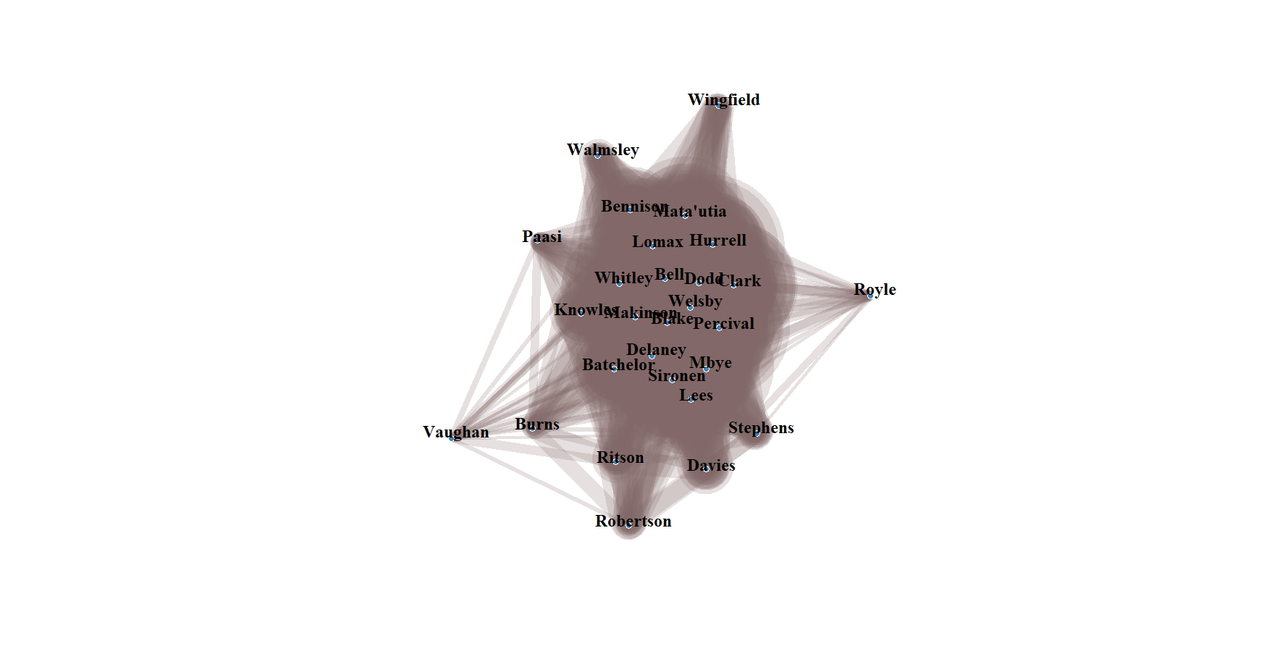
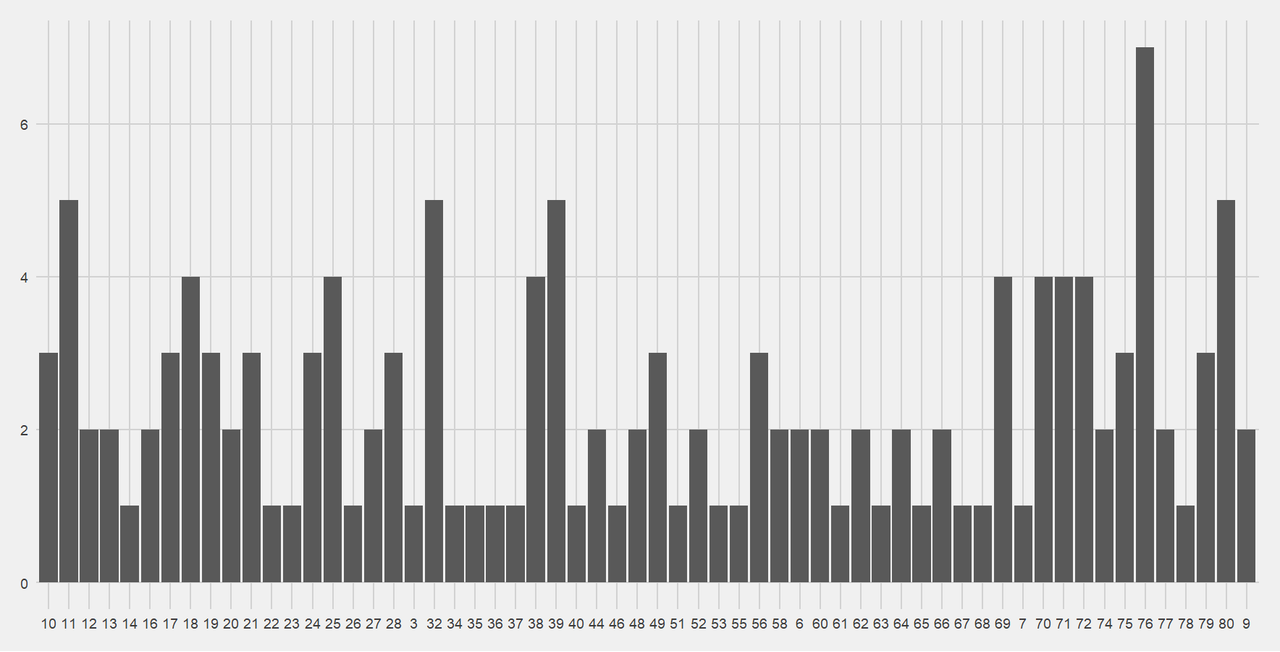
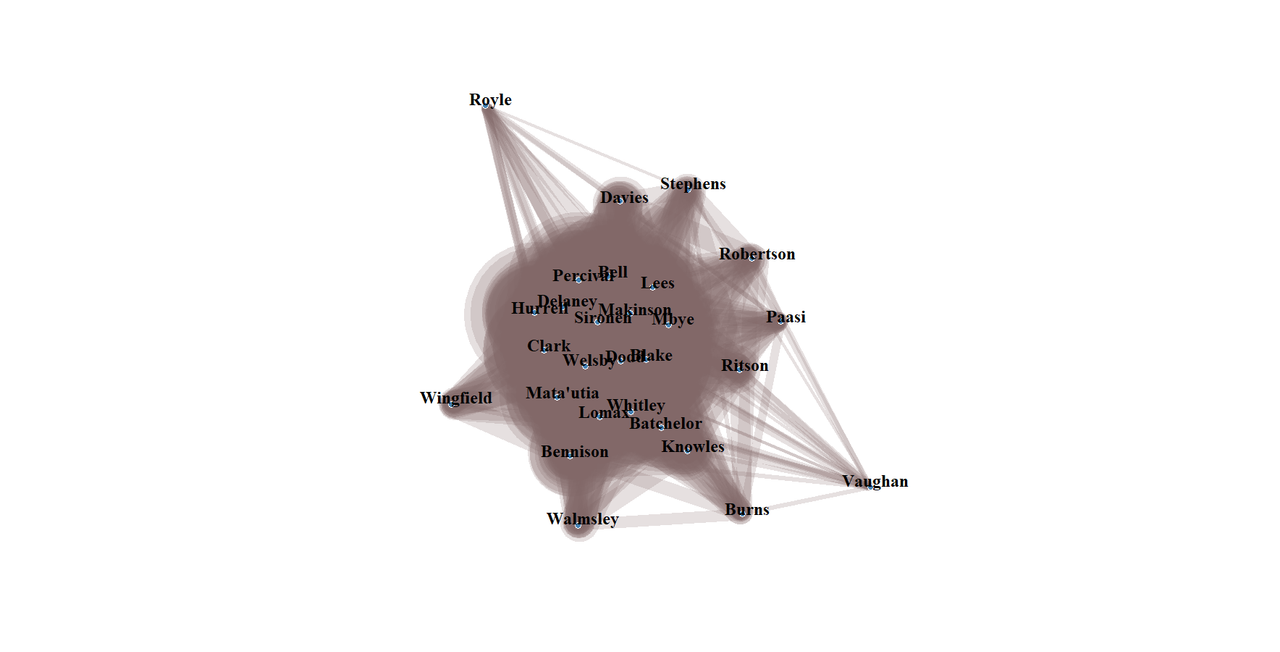
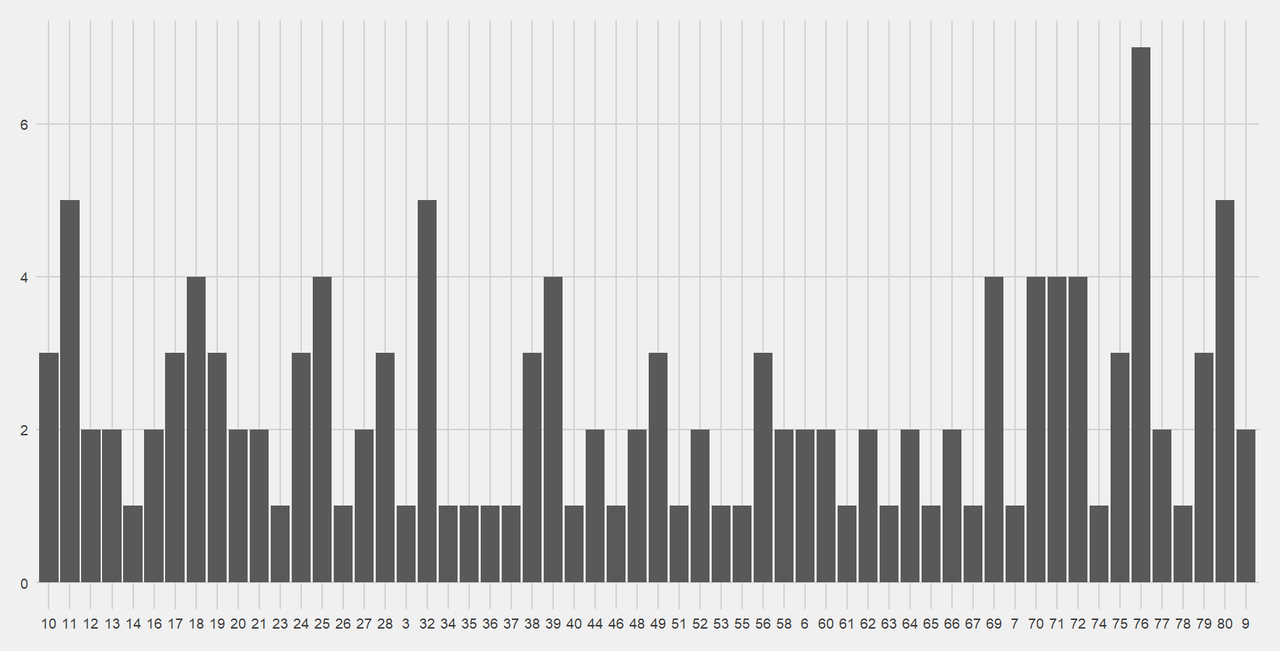
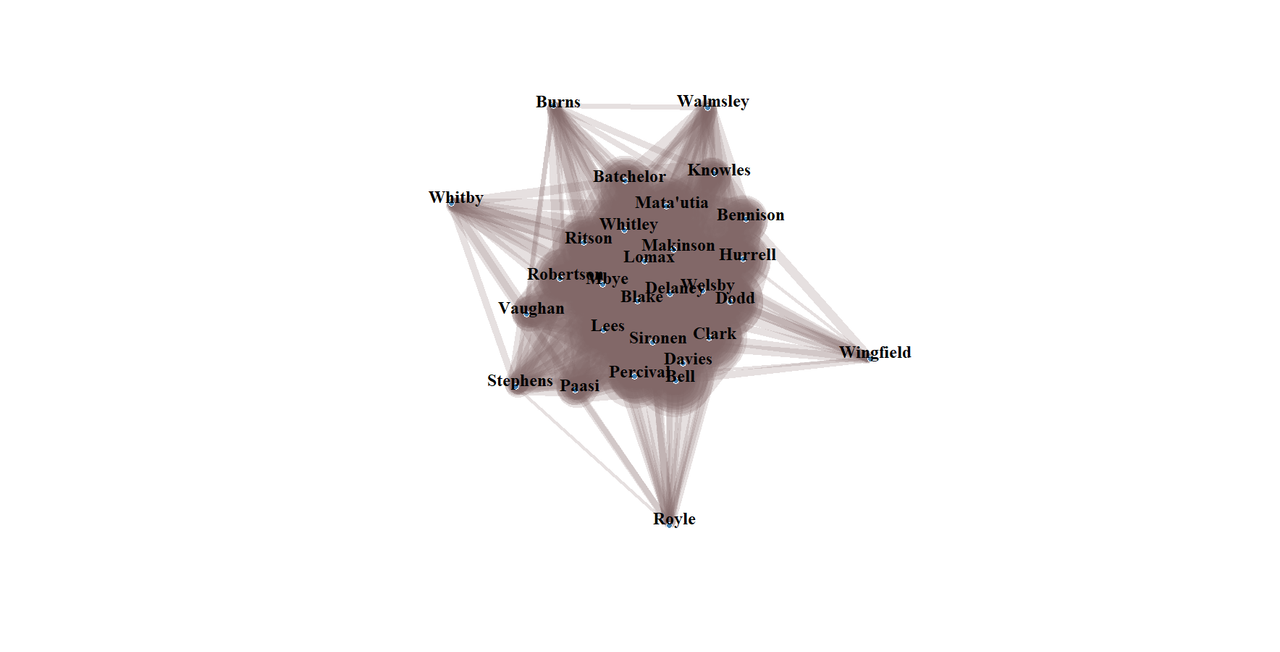
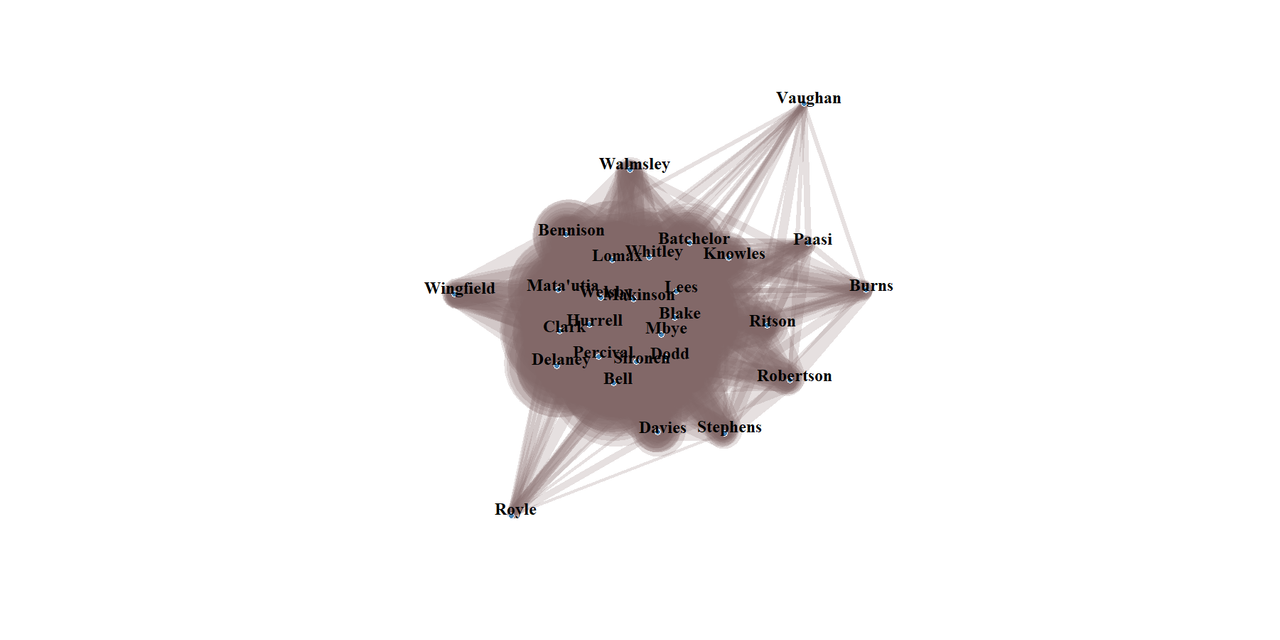
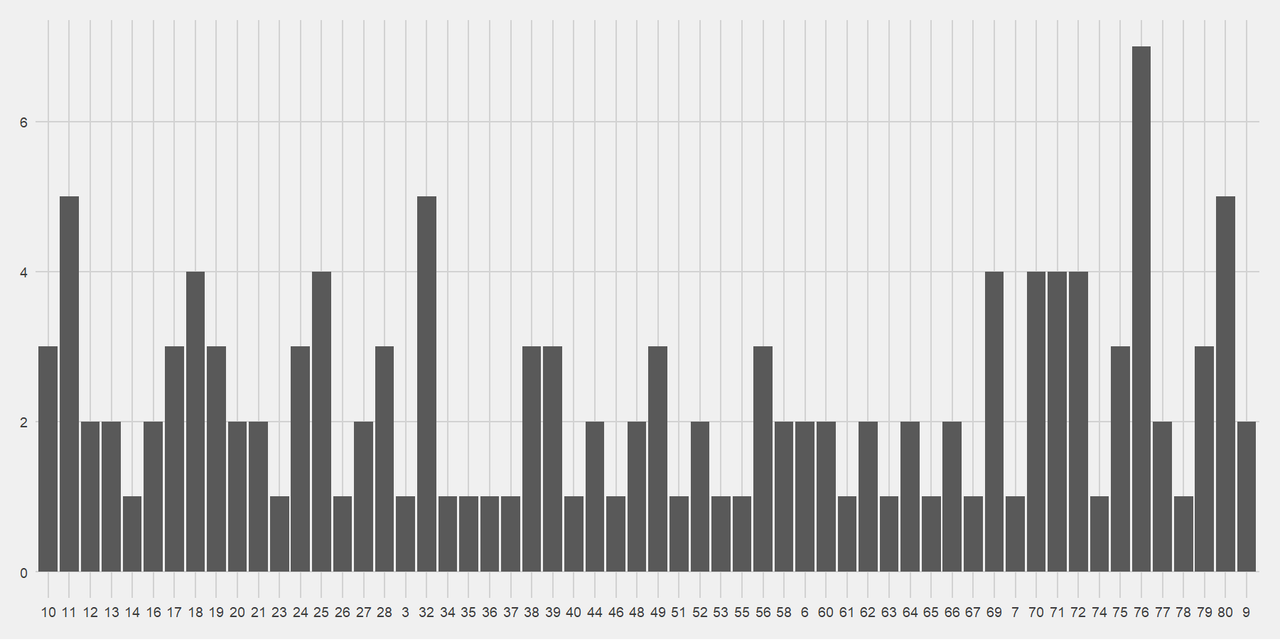
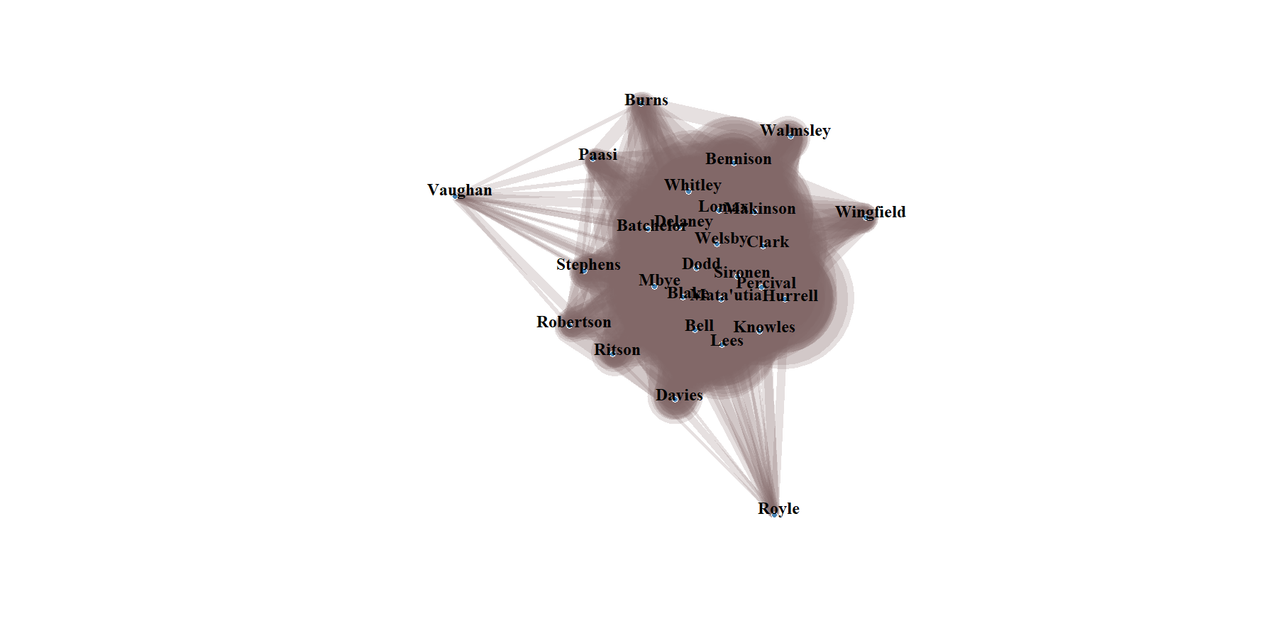
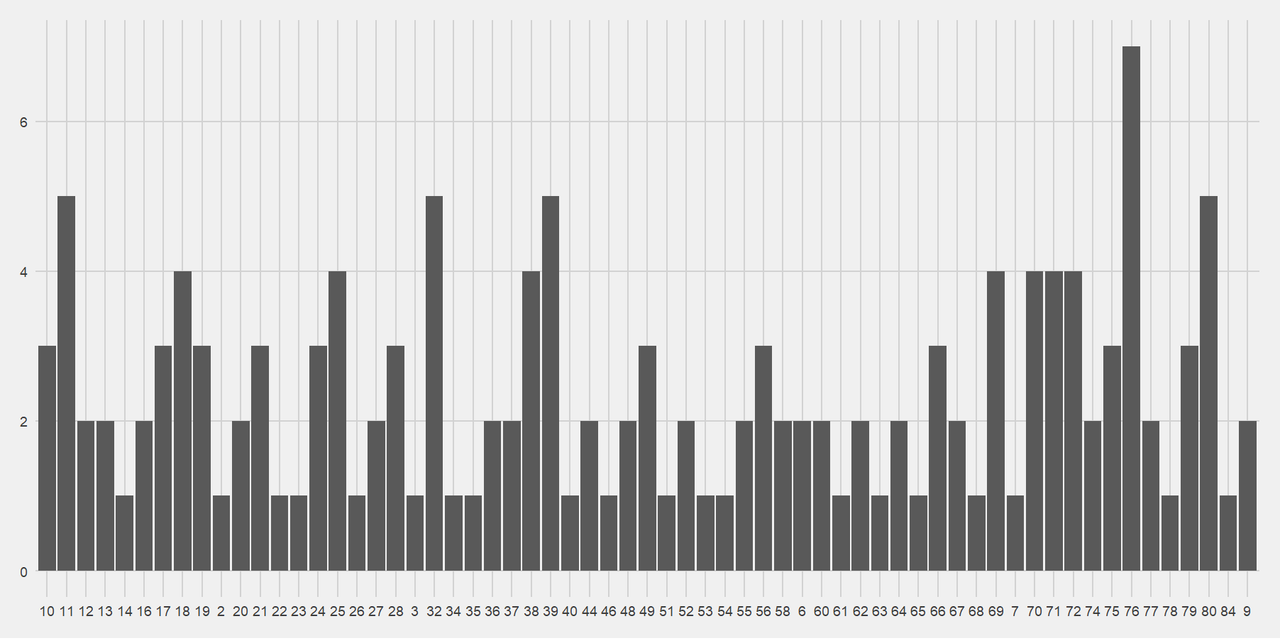
The equivalent network graph looks like this: Network graph.  There is a central blob.  On the outside of the central blob are (reverse clockwise) Bennison, Paasi, Stephens, Robertson, Ritson and Davies.  Further out Wingfield, Walmsley, Burns, Vaughan and Royle. Looking at points conceded, this is when Saints concede. Bar chart of when Saints concede.  The minute with the most point-conceding moments is minute 76, which had 7 point-conceding moments.  Four minutes had 5 point-conceding moments (minutes 11, 32, 39 and 80).  Minute 84 is the latest and was the heart-breaking golden point moment from the last game.  There is no obvious pattern. 
There is no obvious pattern. 

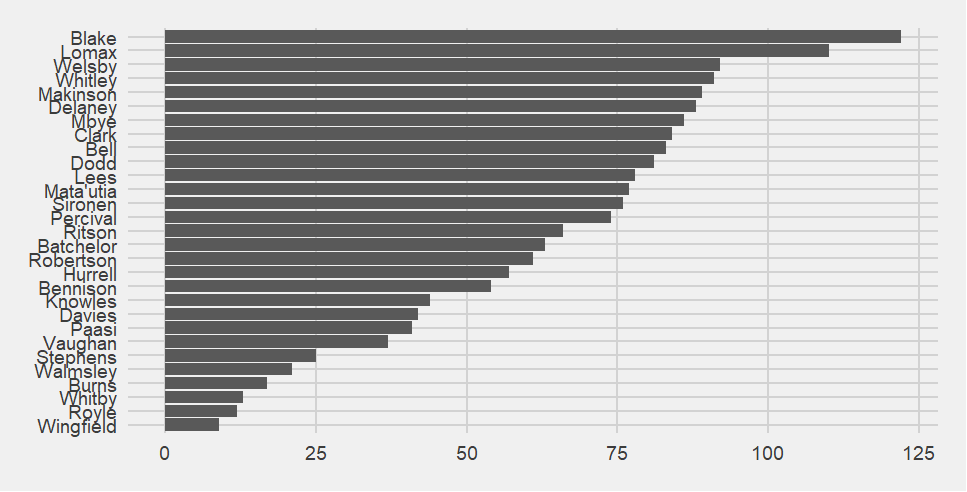
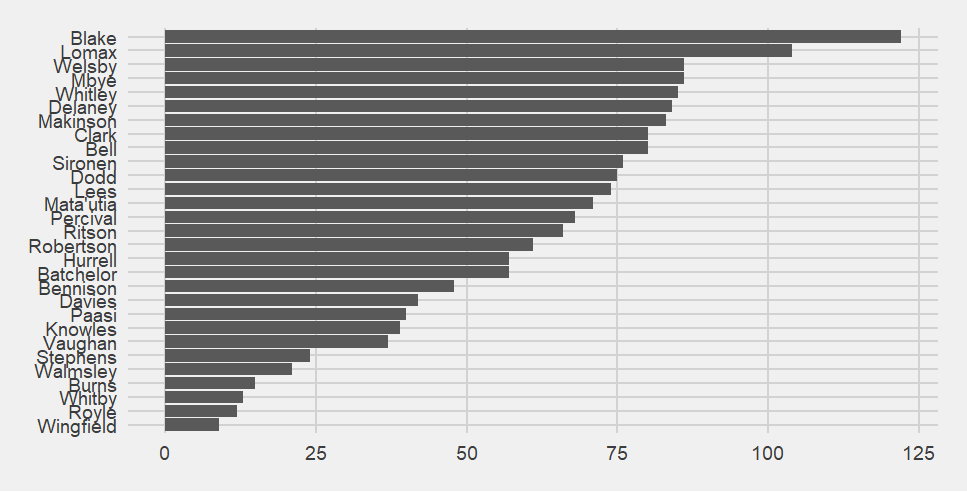
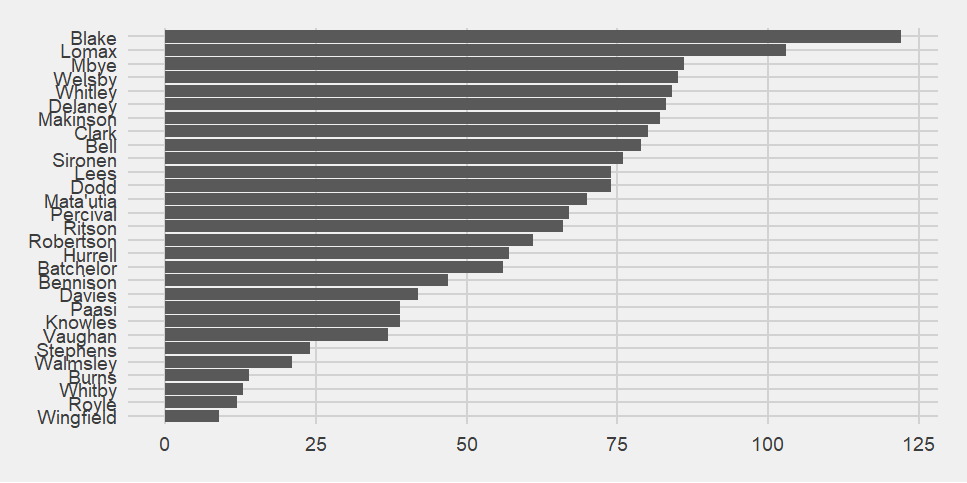
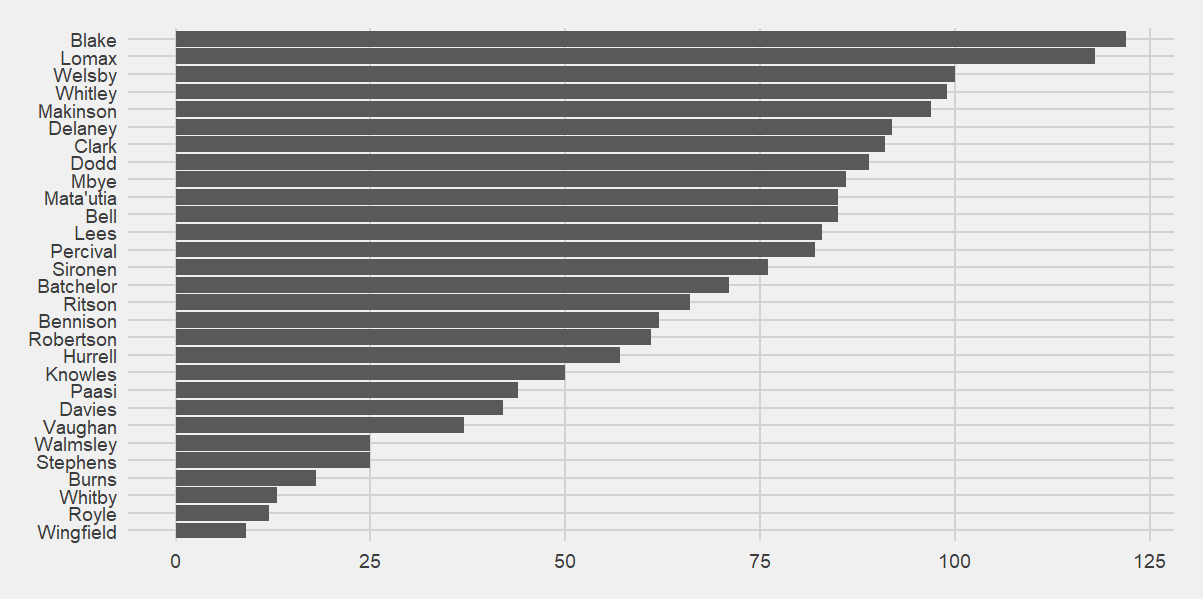
Who is present when Saints concede? Bar chart showing who is present when Saints concede.  Blake is present for the most point-conceding moments, around 120 of them.  He is followed by Lomax and then there is a sharp drop to Welsby.  From there, there is a slow reduction to Percival.  There is another drop to Sironen, and medium sized drops down to Vaughan.  There is a large drop to Walmsley and Stephens and the last 4. 
Here is the shape of when the players were present when Saints conceded. Bar chart of when the top 16 players are present for Saints point-conceding moments.  All 16 bar charts have different shapes. 
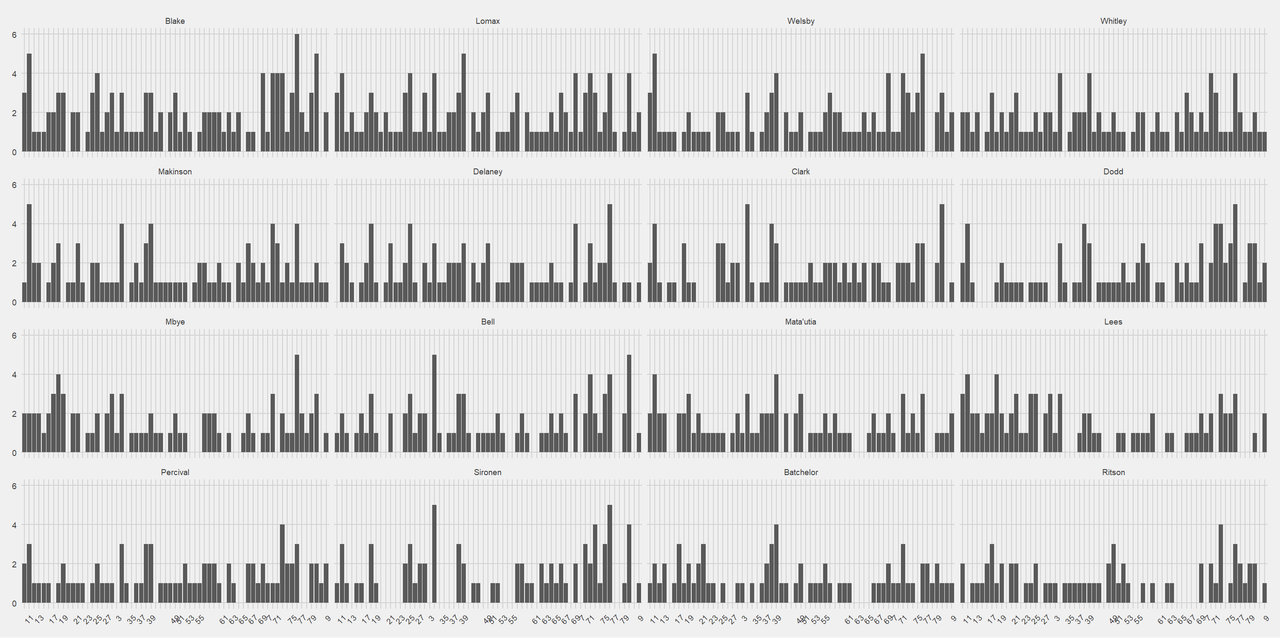
There is less of a pattern than in the equivalent figure for when players were present when Saints scored. 

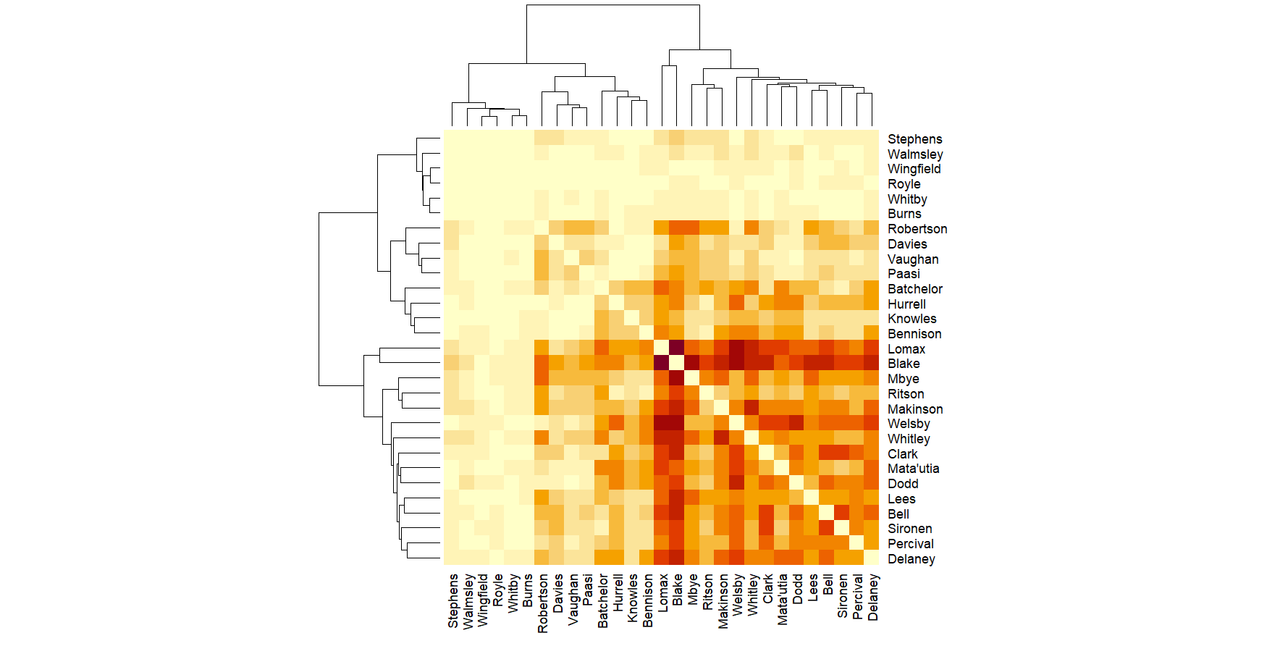
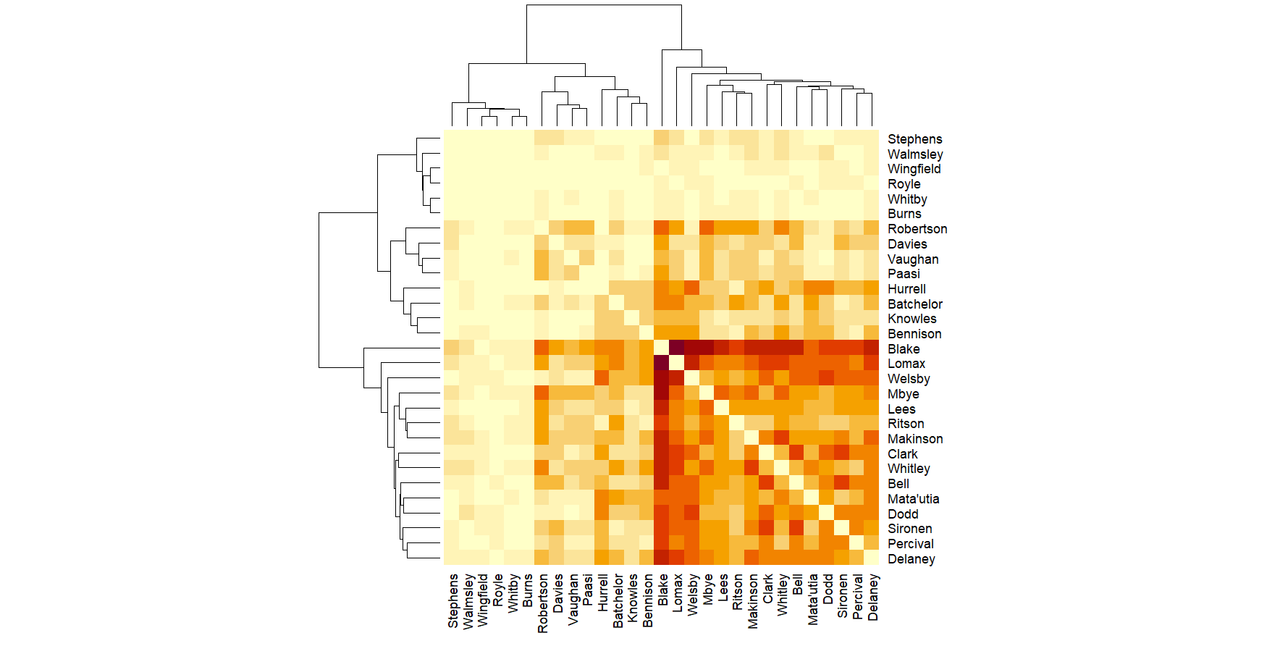
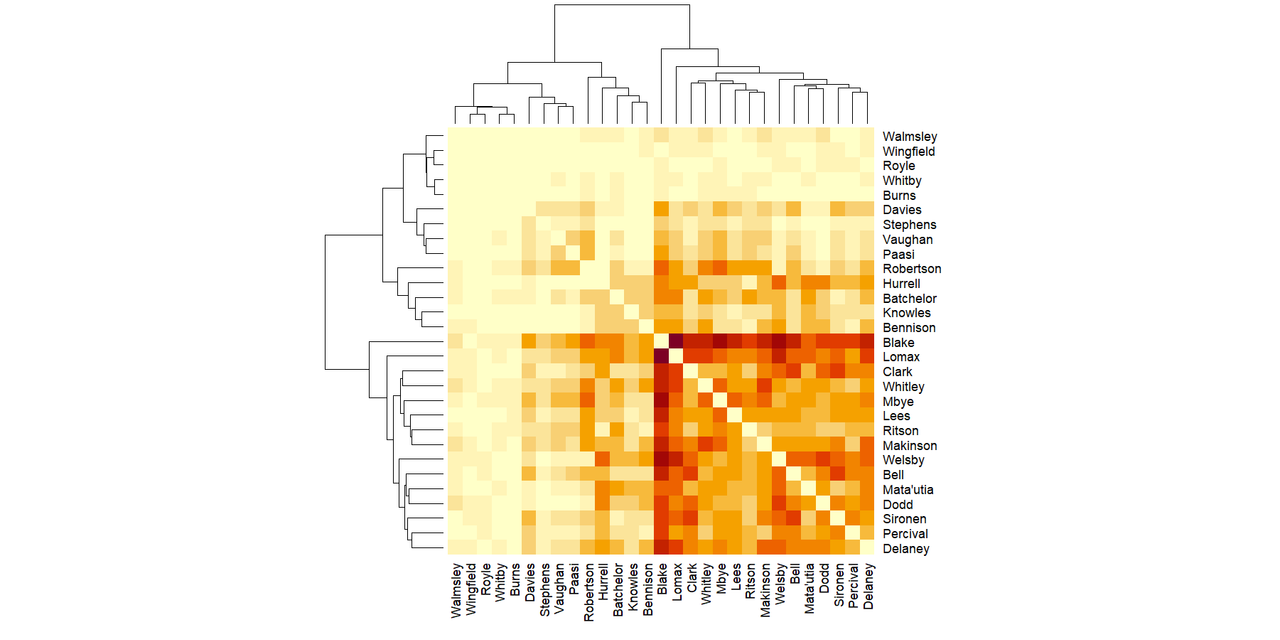
This is what the matrix for who is present when Saints concede. Matrix chart of which Saints players play together most often when Saints concede.  It looks like the top left quarter of a fuzzy mosaic of the sun.  The darkest, most often together group are in the bottom right.  They are Lomax, Blake, Welsby, Whitley, Matautia, Dodd, Clark, Makinson, Mbye, Sironen, Lees, Bell, Percival and Delaney.  The quarter of the axis up from them is paler, these players are together less often when Saints concede.  They are Stephens, Vaughan, Davies, Paasi, Robertson, Ritson, Batchelor, Bennison, Knowles and Hurrell.  Finally at the top and leftermost are the palest and least often together section.  They are Walmsley, Wingfield, Royle, Whitby and Burns.  They are players who were injured or played few minutes. 
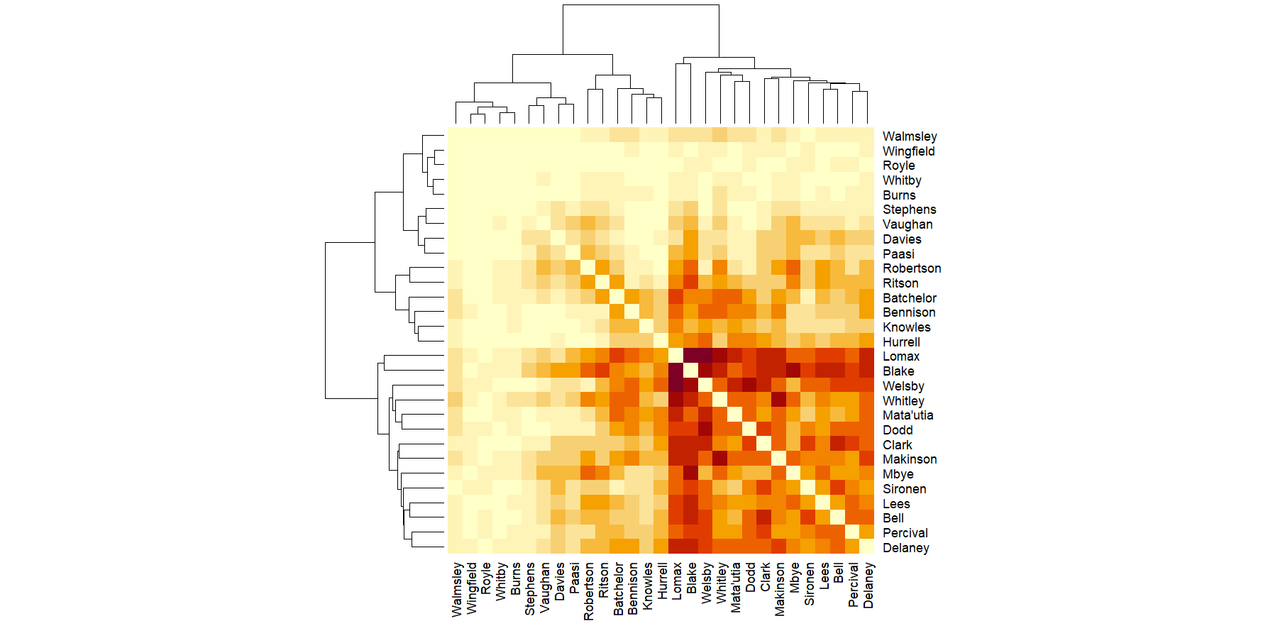
The edges between the different areas of "played together" have got a lot fuzzier in this one over time. It still looks very much like the top left quarter of a mosaic of the sun. Interestingly, the "dark top and left border" that the "point-scoring moments" equivalent developed is not present here. 

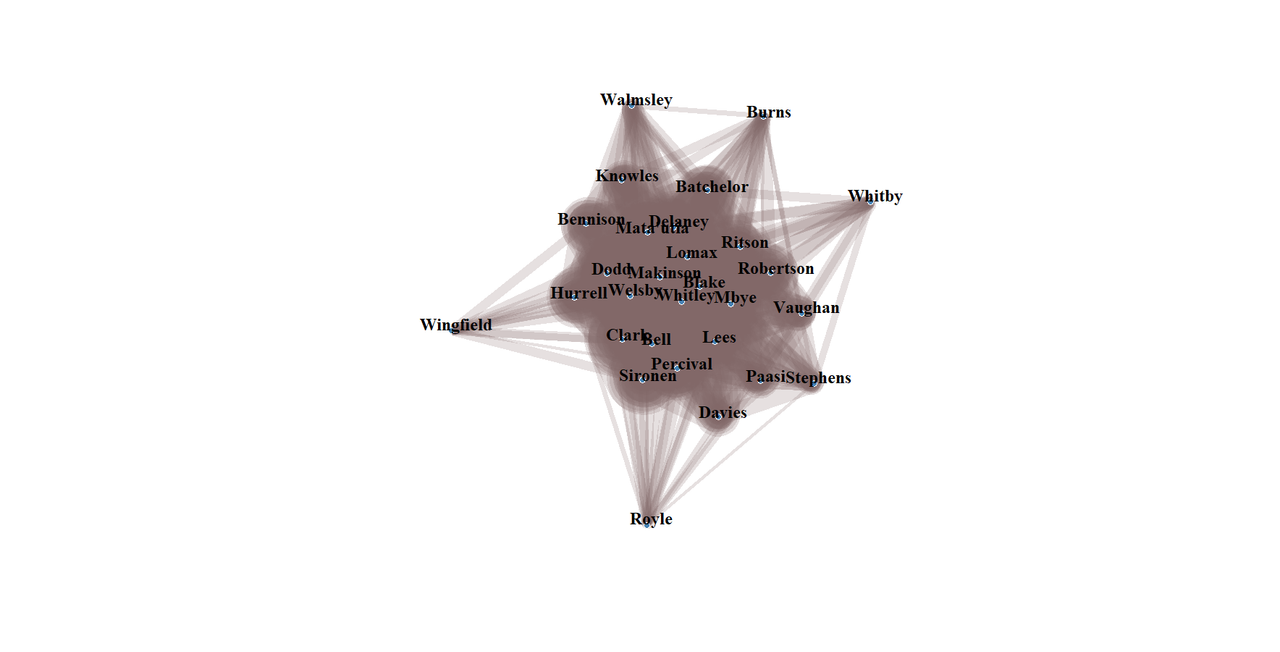
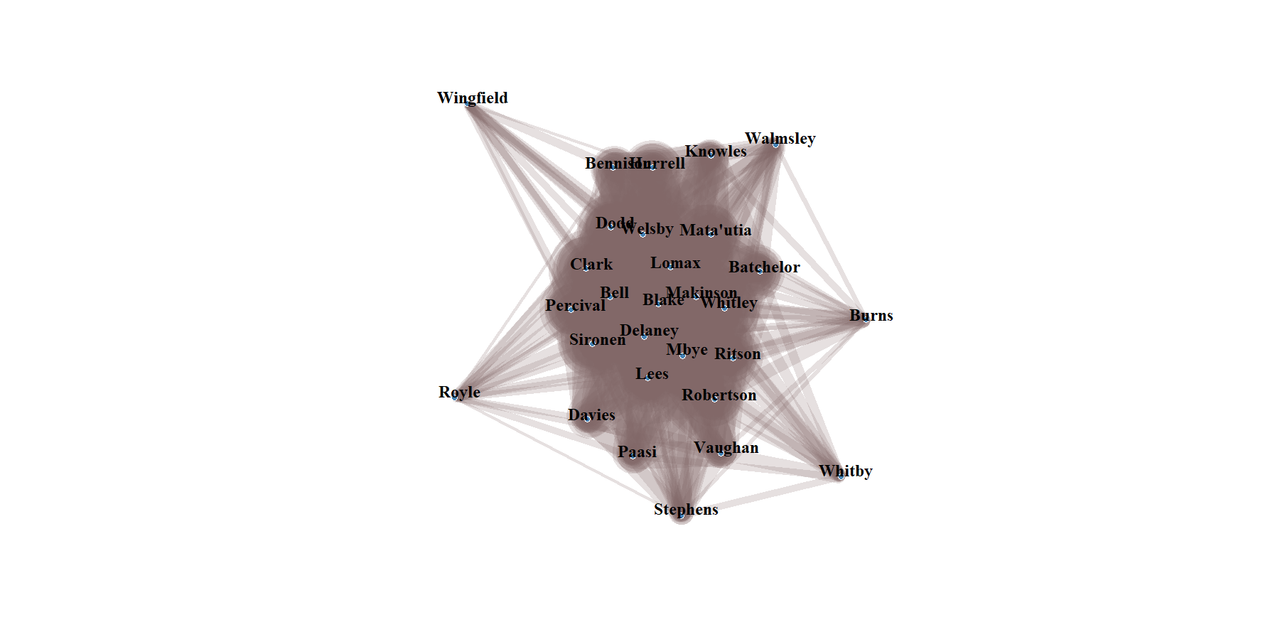
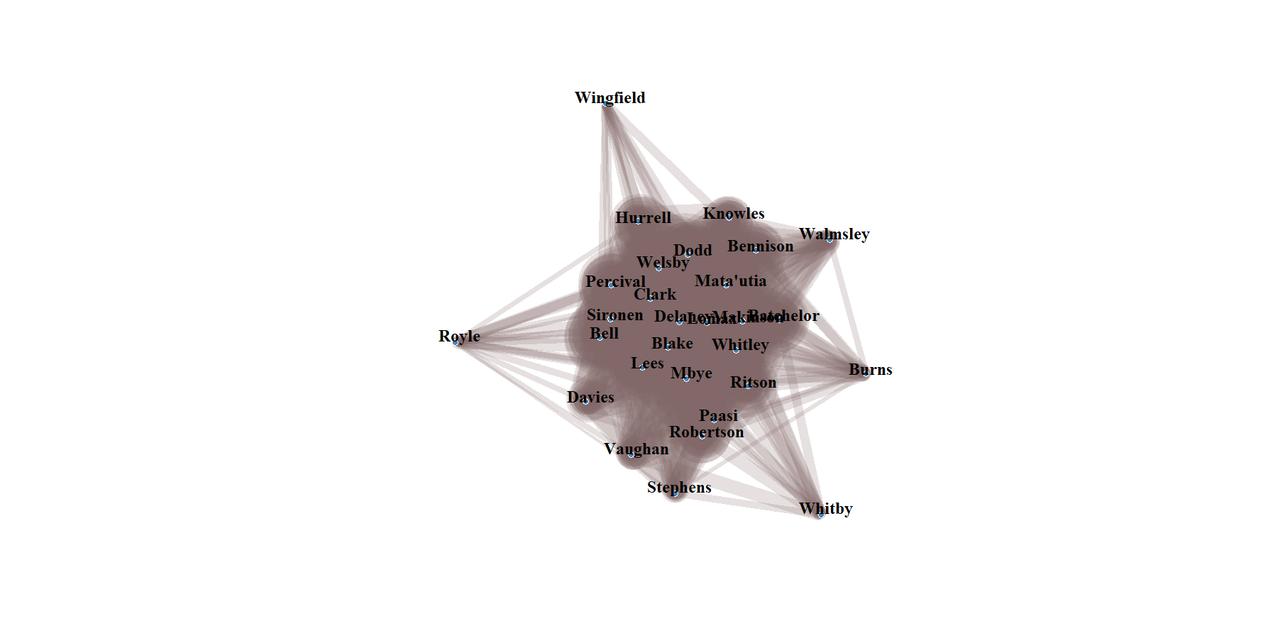
The equivalent network graph looks like this: Network graph of which players play together when Saints concede.  There is the central blob.  Davies, Vaughan and Stephens are just outside it.  Further out on the left are Wingfield and Royle, and on the right are Walmsley, Burns and Whitby. Comparing players's position on the "present when Saints score" vs their position on the "present when Saints concede" graphs - in a purely ranking based analysis not the number they were present for, there's some interesting numbers. 
The players with the greatest difference between present when Saints score vs when they concede are: Hurrell and Percival were present for relatively fewer concession moments than scoring moments. Whitley and Delaney were present for relatively fewer scoring moments than concession moments. 

I am sure that's skewed slightly but interesting none the less. 

2024 Summary: 

I think, taking 2024 and 2025 into consideration, as a Saints fan I have to accept that this is one of the rough (ish) parts we take with the smooth. For whatever reason, Saints have not been playing like themselves (except in fits and starts like *that* try against Leeds in the playoffs in 2025 - https://www.bbc.co.uk/sport/rugby-league/articles/cn95qgeyn3lo). 

Lack of results for Saints always worries me. Now with the IMG rankings nonsense (https://en.wikipedia.org/wiki/IMG_Grading_for_the_British_Rugby_Football_League), it worries me more, because Saints's supporter base is never going to be huge because of the size of the town. There's us, and Wigan, Leigh, Warrington and Widnes within a 40 minute driver and Oldham and Salford not much further out, so limited chance for expansion. So our "fandom" (yuck!) score will always have a ceiling, as will our ability to diversify our income streams, while the thing Saints the club do well (community work) counts for the least. We need to do well to maintain our ranking. 

As always, I am pleased to see Saints bring on young players, for instance Harry Robertson who got his debut in the 2024 away match against Wigan has gone on to be the Super League Young Player of the year in 2025. 

I am very sad about some of the players who left at the end of 2024, even if it made sense for people at their various stages of life - https://www.seriousaboutrl.com/st-helens-confirm-seven-player-exits-with-one-major-name-omitted-from-list-97627/ 

What did I get from the season-long data visualisation project? 

Not what I expected, which is a good reason to have done the project. 

I was expecting a clearer separation between the players who were played often and those who weren't, because if you asked me as an external viewer I know who I would have put in each of those groups.  The data tells me I was wrong on my placement. 

In terms of point-scoring, it highlighted the people I expected, and how high Bennison is really highlights the importance of conversion kicking. 

I was hoping to see a pattern in when players played e.g. these two are our props for minutes 0-20, 21-40, 41-60 and 61-80, but that didn't happen, even before the injury disasters. 

I did see how important the non-first team players are to covering for those injuries because you could see players moving in and out of the network graphs over the course of the season. 

Experiment definitely worth doing. 

If you have enjoyed reading these, the following charities are definitely worth contributing to: 

The Steve Prescott Foundation - https://www.steveprescottfoundation.co.uk/ 

Saturday, 4 October 2025

Saints Ahoy - Game 29 and the 2024 Season to Date

Yes, I am writing this post to try and distract myself from their match against Hull KR in the 2025 play-offs. (No, I have no idea how we got past Leeds.) 

This game, the last of the 2024 regular season, was a narrow loss to Leigh (https://www.saintsrlfc.com/2024/09/20/saints-suffer-narrow-defeat-to-leigh/), 18-12. Now we had a try chalked off, but Leigh were the better team for the whole game and all of Saints actual points were scored in the 10 minutes that Leigh were down to 12 men because of yellow card to Leutele for attempted Welsby murder. 

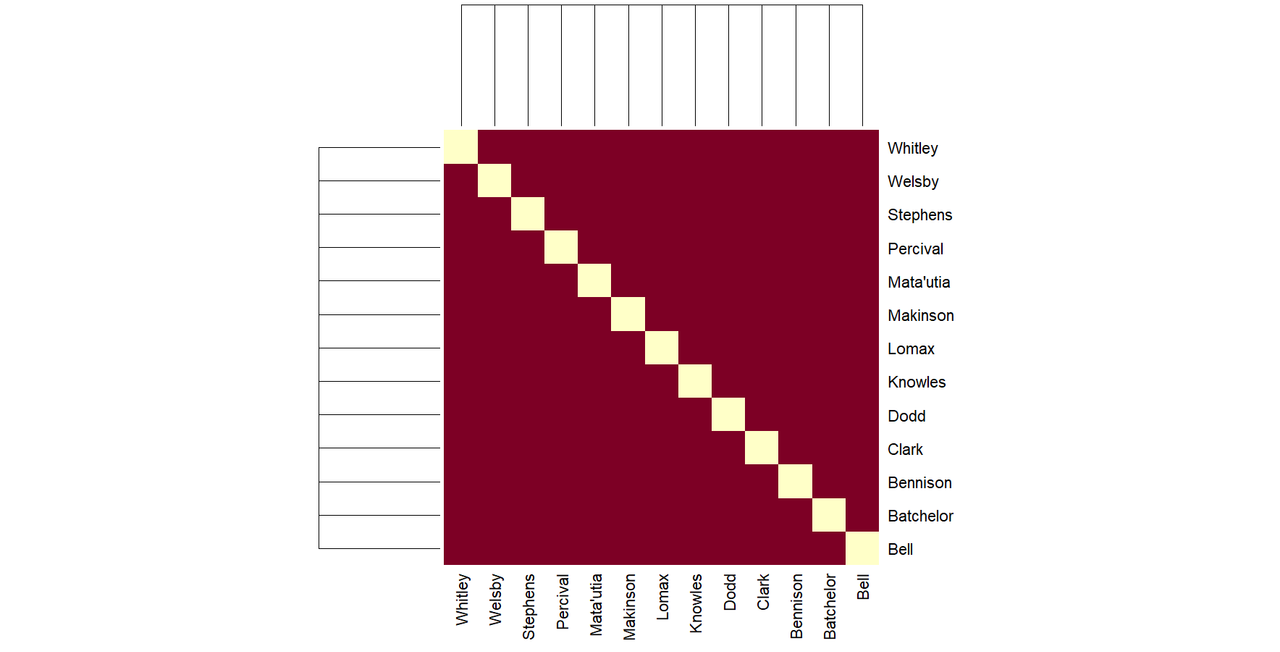
Because it was all in that 10 minutes, the "who played together when Saints scored" matrix chart is ... uninformative. Matrix chart showing which Saints players were together when Saints scored.  Because it all happened in 10 minutes, all players in the graph are the same shade of purple.  It gives no information. 

So, instead, let's look at the season up to the end of game 29. 

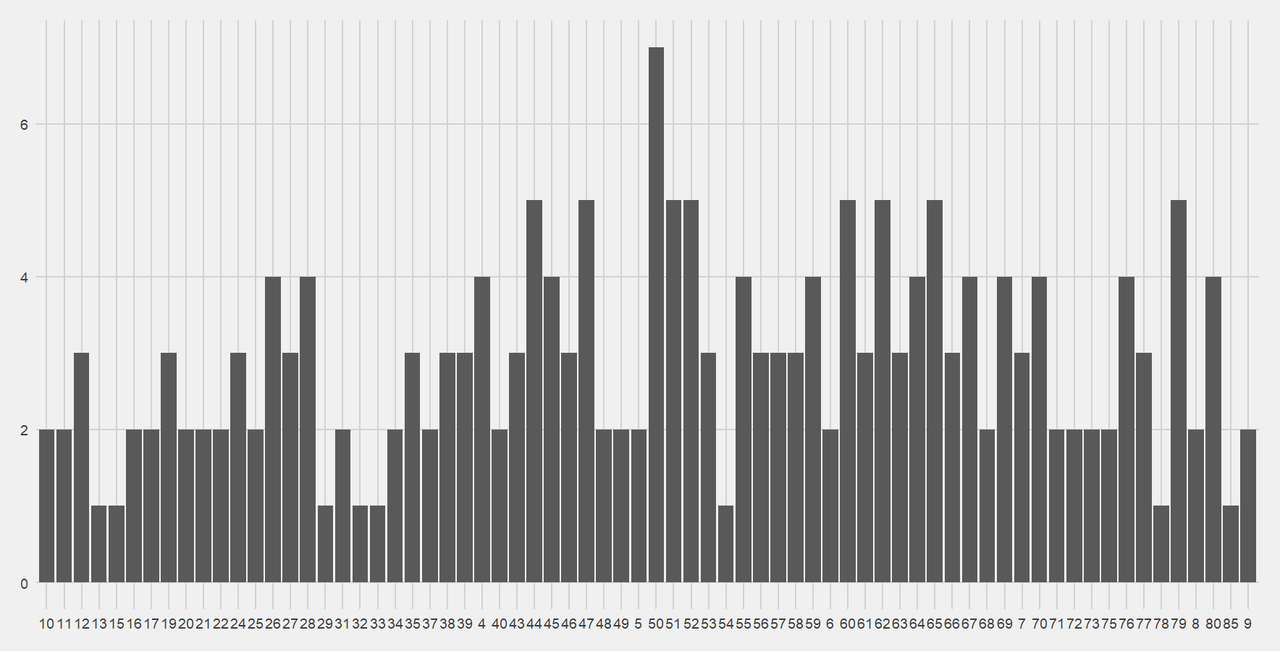
When do Saints score? Bar chart of when Saints score.  The point-scoring moments are oddly in almost a normal curve.  The most point-scores are 7 in minute 50, the next most point scores are 5, which happened in minute 44, 46, 51, 52, 60, 62, 65 and 79. 

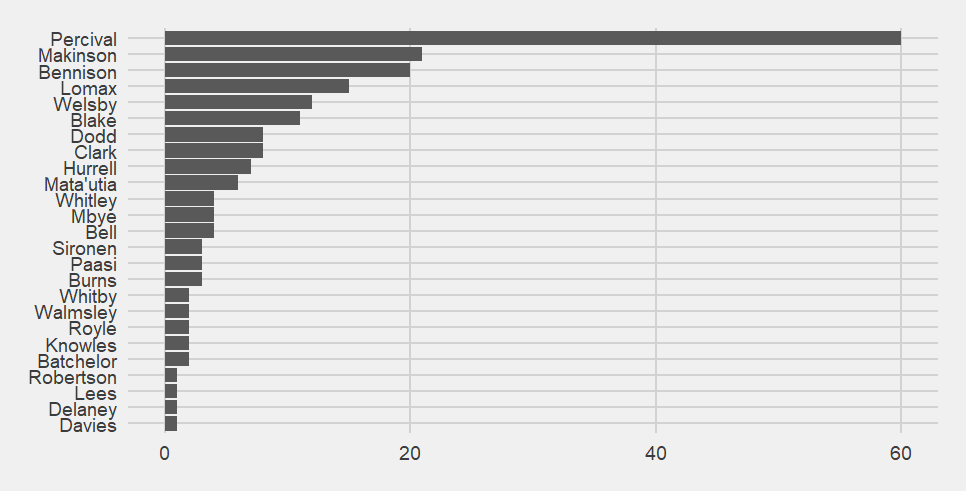
Who scores for Saints? Bar chart of who scores for Saints.  Percival has the most point-scoring moments, with 60.  I think this is because he is the kicker.  The next highest is Makinson, with 21 (I think), and Bennison on 20.  Bennison is the reserve kicker. 

Who is present when Saints score? Bar chart of who is present when Saints score.  The top 3 are Blake, Welsby and Dodd.  They are a long way ahead of another chunk of players present for between 120 and 140 scoring moments.  Then there is a steady decrease in point-moments present for until the bottom 3, Royle, Vaughan and Whitby. 
Saints reached the 200 point scoring moments in this game (vs 160 point-conceding moments), so it's a good time to see if there's any players present for more point-scoring moments than point-conceding moments (or vice versa). Percival is one of the players with the greatest differences, he is present for a lot fewer point-conceding moments, but that is because he got substituted at around minute 50. Hurrell and Dodd are also present for relatively fewer point-conceding moments. 

Delaney is the player present for relatively more point-conceding moments, as does Whitley. That I can't explain. Matrix chart of players who play together when Saints score.  The bottom quadrant is a mid-orange.  Then there are three players in a paler orange section (Whitley, Bennison and Batchelor), then the darkest section, a purple-orange two of Welsby and Blake.  Above them is much paler indicating that those players are not together as often when Saints score. There's two clear teams, the most often together (a full match day 17 - Welsby, Blake, Whitley, Bennison, Batchelor, Dodd, Percival, Bell, Hurrell, Mata'utia, Sironen, Lomax, Mbye, Clark, Makinson, Delaney and Lees) and the less often together (12 - Royle, Whitby, Vaughan, Wingfield, Walmsley, Robertson, Burns, Paasi, Knowles, Davies, Stephens and Ritson). 

Oddly, only 10 players are not in the central blob, when you look at the network graph. Network graph of which players are together when Saints score.  There is a central blob, then Paasi sticking out top left, Walmsley a little further right, then Wingfield left.  Royle sticks out on middle right.  Under the blob bottom right are Stephens and Davies.  Middle bottom, interestingly almost on top of each other are Ritson and Robertson, then Vaughan and Burns bottom left. Looking the point-conceding moments 

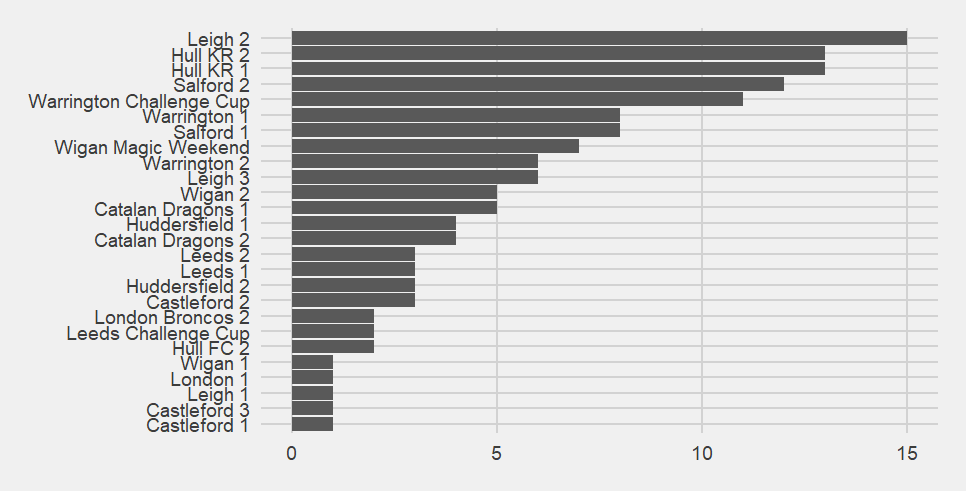
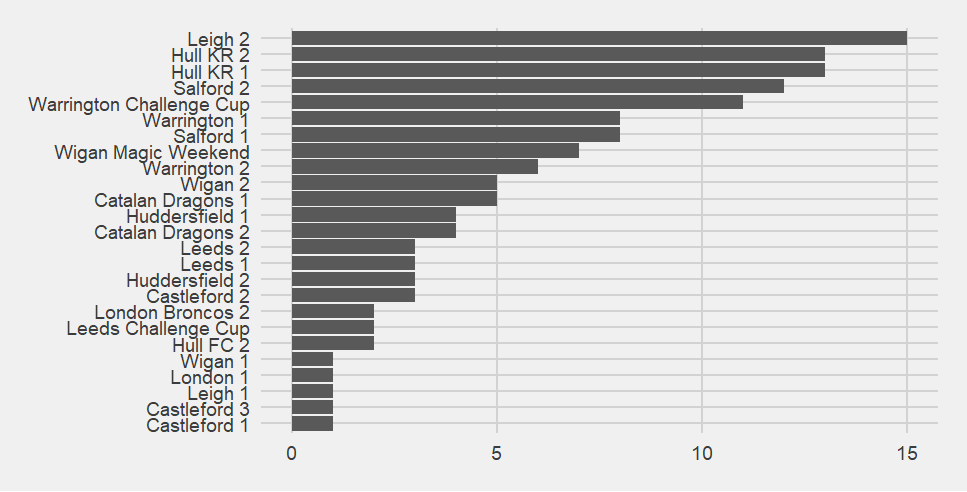
This was the third time Saints and Leigh played this season. Leigh 3 are about mid-way up the chart. Bar chart of the number of point-scoring moments different teams had against Saints.  Leigh 2 still lead the way.  Leigh 3 are on there with 6. 
When do the point-conceding moments occur? Bar chart showing when Saints concede.  The most point-conceding moments come in minute 76, with 7.  The next highest number of points is 5, which happened in minutes 11, 32, 39, and 80. 
That these aren't in a normal curve makes me happier that the point-scoring moments truly are normally distributed rather than it being some artefact. 

Who is present when Saints concede? Bar chart showing who is present when Saints concede.  Blake and Lomax are the players present for the most point-conceding moments.  There is then a steep drop to Welsby, who is the next player down.  Then there is a slow decrease down to Whitby, Royle and Wingfield, the players present for the least point-conceding moments. 

The who is present together when Saints concede matrix now looks like this: Matrix chart of Saints players who are present together when Saints concede.  There is a bit of a pattern which makes it really hard to describe.  There is a section at the bottom right which is the players most often together (Lomax, Blake, Mbye, Ritson, Makinson, Welsby, Whitley, Clark, Matautia, Dodd, Lees, Bell, Sironen, Percival and Delaney), then a less often together section (Robertson, Davies, Vaughan, Paasi, Batchelor, Hurrell, Knowles and Bennison), then a pale section of players who are not often together when Saints concede (Stephens, Walmsley, Wingfield, Royle, Whitby and Burns). 

The equivalent network graph looks like this Network graph of players who play together when Saints concede.  There is the central blob then Walmsley out of the blob middle top, Burns top right, Whitby lower and righter, Stephens, Paasi and Davies being merged into the blob Again, the matrix and the network graph don't quite match.

Saturday, 30 August 2025

Saints Ahoy - Game 28 and the 2024 Season to Date

Two points specifically about game 28. 

The first is about the diagrams. 

You will notice that this is game 28. In a 12 team league, the most games you should get is 22. Even counting Saints's two Challenge Cup games, that would be 24. Super League has 27 games in the regular season. 

How do you get from 22 to 27? 

To fill these "gaps" they have Magic Weekend, the Rivals round and a couple of seemingly random loop fixtures. Mysteriously, this means that we have to play our best/worst rivals more often - Saints got 2 extra games against Wigan in 2024 :( 

In 2024, one of Saints's loop fixtures was versus Castleford, which is why you'll suddenly see Castleford 3 in the figures. I'm putting this explanation in this post because it's the first time one of the teams will be referred to as [team name] 3. 

The second is about an odd tradition Saints have. For the last home game of the season, if a dearly beloved forward is retiring, and we've already won the match, we let them kick a conversion towards the end of the game. I suspected Mata'utia was going, but him getting given the kick to take was when I knew for sure. (Yes - this is often how we find these things out) 

It makes me sad, because I like him. He's an excellent forward, gives his all, and seems to care. I ask for very little and demand only two out of those three. 


Now onto game 28: 

The who was on the pitch when Saints scored figure looks really good. You can see the replacements coming on and off. Line chart showing who was present when Saints scored in game 28.  You can see from it that Clark was the replacement for Burns, and that Bell and Paasi were brought on. 
Who played together when Saints scored in game 28. Matrix of who played together when Saints scored in game 28.  The darkest area, the players most often together, are in the bottom right hand corner.  It contains Whitley, Matautia, Makinson, Lomax, Dodd, Batchelor, Bennison.  Above them is an orange pair, Bell and Knowles, then Delaney as a stronger orange on his own, above him is a darker orange pair of Welsby and Percival, then a paler section of Paasi, Clark, Burns, then Walmsley and Lees. Knowles's crossing point with several players is much paler than expected given where he is in the diagram. 

Network graph from the same game: Network graph, Bell, Delaney and Knowles are the outliers.  That might explain why some of the crossing points for Knowles are pale in the matrix diagram. 

On to the diagrams for the 2024 season. 

First of all, when do Saints score? Bar chart of when Saints score.  The shape is basically a normal distribution.  The highest point in minute 50 which has seen 7 point-scoring moments.  Minutes 44, 47, 51, 52, 65 and 79 feature 5 point-scoring moments. 
Who scores for Saints? Bar chart of who scores for Saints.  Percival is way in the lead with 60 point-scoring moments.  He is followed by Makinson on 20 (I was not kidding when I said way in the lead), then Bennison.  After Percival the number of point-scoring moments tails off quickly.  In total 25 Saints players have had at least 1 point-scoring moment - not bad from a squad of 36. 

Of the top 3, Percival and Bennison are kickers so should be up there. While Makinson can kick, he's there mostly because of his tries. Oh, we are going to miss him! 

Who is present when Saints score? Bar chart showing which players are present when Saints score.  The top three are Blake, Welsby and Dodd, then there is a distinct drop to Percival, a slow drop in point-scoring moments present for for the next 12 players down to Delaney, then another steep drop to Batchelor, then comes Bennison and a steep drop to Knowles.  Then a slow decline again from Davies down to Burns, and then Royle, Vaughan and Whitby at the bottom. 

What does the matrix diagram of players who play together when Saint score look like after game 28? Matrix diagram of which Saints players are together when Saints score.  The darkest, most-often-together-group are in the bottom right.  It contains Blake, Welsby, Dodd, Percival, Sironen, Hurrell, Lomax, Bell, Clark, Mbye, Delaney, Lees, Matautia and Makinson.  There is a small, paler section of Whitley, Bennison, Batchelor.  Then comes the next palest section of Knowles, Davies, Wingfield, Walmsley, Ritson, Robertson and Stephens.  At the top and leftermost comes the palest group, those least often present together, which contains Royle, Whitby, Vaughan, Burns and Paasi. 

The thing that interests me about the matrix as it stands now is that for each section, the player most often involved with the others (and therefore the darkest line) is at the top left of their section, but the darkest section over all goes at the bottom right and the sections get lighter as you move up and left. 

That pretty much matches the network diagram, but not exactly: The network graph of players who play together when Saints score.  It matches, but not quite, the matrix diagram.  There is a central blob of players then the outliers.  The outliers are Sam Royle, top left, Vaughan, bottom right, Burns, bottom right but in a bit from Vaughan, Walmsley, bottom middle, Wingfield, bottom left.  The players either being pulled into or falling out of the central blob are Bennison (I think being moved in as he plays more), Knowles (ditto), Ritson, Paasi, Robertson, Stephens and Davies. 

The player in the matrix but not in the network graph is Whitby. 

If we swap over to look at when Saints concede - here are the teams that have scored against Saints. Bar chart of who scores against Saints.  Castleford, the opponents in this game, are one of 5 times Saints kept the opposition to just one point-scoring moment.  The other 4 are, Wigan the first time Saints played them, London the first time Saints played them, Leigh the first time Saints played them and Castleford the first time Saints played them.  That Castleford 2 is not on there tells me the second Saints vs Castleford match ended without Castleford scoring. 
There have been 28 games but only 25 teams feature on this chart because Saints kept 3 teams to 0 point-scoring moments. 

When do Saints concede? Bar chart of when Saints concede up to game 28.  Minute 76 has the most point-conceding moments, with 7.  The next highest are minutes 11, 32 and 80 with 5.  There is no obvious pattern to when Saints concede. 

I can't really see a pattern to the times. 

Who is present when Saints concede? Bar chart of who is present when Saints concede.  Blake is present for the most, followed by Lomax, then Welsby and Mbye. 
Who plays together when Saints concede? Matrix of players who played together when Saints concede up to game 28.  The colours are more spread out that in the scoring equivalent.  But there are still three obvious sections.  The darkest, most often together, section (Blake, Lomax, Welsby, Mbye, Lees, Ritson, Makinson, Clark, Whitley, Bell, Matautia, Dodd, Sironen, Percival and Delaney), then the medium section (Robertson, Davies, Vaughan, Paasi, Hurrell, Batchelor, Knowles and Bennison) then the palest, least often together section (Stephens, Walmsley, Wingfield, Royle, Whitby and Burns). 

The equivalent network graph looks like this: Network graph of players who play together when Saints concede up to game 28.  There is a central blob.  Stephens, Paasi and Vaughan are either being pulled into it, or falling out of it.  They are all in the bottom left corner.  Further out are, top left, Whitby, top, Burns and Walmsley, bottom right is Wingfield, and bottom is Royle.

Tuesday, 24 June 2025

Saints Ahoy - Game 27 and the 2024 Season to Date

Game 27 was a dismal loss to Warrington. 

Dismal because Warrington, and even more dismal because the only points that Saints scored was from a penalty. It seemed to be that sort of game (https://www.saintsrlfc.com/2024/09/07/saints-beaten-by-warrington-at-the-halliwell-jones-stadium/), with lots of their points also coming from penalties and 3 yellow cards - 2 for them, 1 for us. 

Yup, the team with fewer cards lost.

The "who is present together when Saints concede in game 27" matrix indicates quite clearly who the "missing" player was, enveloping Matty Lees in one group even though his line is paler than the players around him. 

Yes, I wonder who got the yellow card! Matrix chart of who is present together when Saints conceded in game 27.  Of interest is the second darkest group (they are in orange), containing Welsby, Paasi, Lees and Delaney.  The line for Lees is a paler orange because he was not present with that group every time Saints conceded.  On this occasion, it is a mark of shame because he had been yellow carded, which Warrington exploited to score twice. Looking at the season to date: 

When do Saints score? Bar chart showing when Saints score.  The highest number of point-scoring moments is 7 in minute 50.  The next highest if 5 point-scoring moments, which has happened in minutes 47, 51, 52 and 65. 
Bennison is now equal to Welsby in the "who scores for Saints?" bar chart. Game 27 was when Welsby made his return from injury. Bar chart showing who scores for Saints up to game 27.  Percival is still way in the lead, as befits the kicker.  He is followed by Makinson, Lomax and now Welsby and Bennison, who are on the same number of point-scoring moments. Who is present when Saints score, up to game 27? Bar chart of who is present when Saints score.  Blake is still way in the lead, then comes Welsby (some way behind) and then Dodd, a little bit behind that. 

To my mind, the interesting thing here is you've got the three present the most (Blake, Welsby and Dodd), followed by one slowly declining cluster (Mbye, Hurrell, Sironen, Percival, Bell, Lomax, Clark, Makinson, Lees, Whitley, Mata'utia and Delaney) then a drop to the bottom cluster who also slowly reduce in number present as you go down the list (Batchelor, Bennison, Knowles, Davies, Ritson, Stephens, Robertson, Walmsley, Wingfield, Paasi, Burns, Royle, Vaughan and Whitby). 

In the matrix of who plays together most often when Saints score, now updated to game 27, the top left border of Whitley, Bennison and Batchelor, first seen in game 26 is still there. Matrix of which players are together most often when Saints score.  There are now 4 clear sections - the darkest, most often together section, in the bottom right corner (Blake, Welsby, Dodd, Sironen, Hurrell, Percival, Clark, Lomax, Mbye, Bell, Delaney, Lees, Matautia and Makinson).  The next two groups are much paler, the first is pale yellow with the occasional beige square, and contains Davies, Knowles, Wingfield, Walmsley, Ritson, Robertson and Stephens.  Then there is the palest section, all pale yellow, which has Burns, Whitby, Vaughan, Royle and Paasi.  Then there is the odd, darker (pale brown, orange and yellow) border along the top and left.  It contains Whitley, Bennison and Batchelor. 

The network graph looks like this:Network graph, there is a central blob.  Sticking immediately out from that blob, clockwise starting from 12 are Walmsley, Paasi at 2.30, Ritson at 3.30, Robertson at 4, Stephens at 5.30, Davies at 5.45 and Wingfield at 9.  Further out is Royle out in the bottom left, Burns all the way out centre right and then Vaughan far far away in the top right. When do Saints concede? Bar chart showing when Saints concede.  The minute with the most point-conceding moments is minute 76 with 7.  The next highest are minutes 11, 32 and 80 with 5. 

The "who is present when Saints concede" chart has a very different shape to the "who is present when Saints score" bar chart. While that has three distinct sections, this chart has Blake and Lomax in the lead (because they have played a lot of minutes), then a slowly degrading curve covering most of the other players, then a small section of the infrequently present players at the bottom. Bar chart of who is present when Saints concede.  Blake is far in the lead, followed, some way behind by Lomax, then Mbye in third.  Mbye is at the start of that sloping curve I mentioned above.  The small section of infrequently present players are Stephens, Walmsley, Burns, Whitby, Royle and Wingfield. 

The concede matrix looks very similar to last time, except fuzzier once more. It's interesting that as there's more data, the boundaries between the groups get weaker, then they suddenly pop back into strong colours, then weaken again (and so on). Matrix chart of players together when Saints concede.  The darkest area, the players most often together when Saints concede, is in the bottom right hand corner and includes Blake, Lomax, Clark, Whitley, Mbye, Lees, Ritson, Makinson, Welsby, Bell, Matautia, Dodd, Sironen, Percival and Delaney.  The next most commonly together section is much paler, with occasional swirls of darker colour.  It includes Davies, Stephens, Vaughan, Paasi, Robertson, Hurrell, Batchelor, Knowles and Bennison.  The top and left-most is the palest and least often together.  It includes Walmsley, Wingfield, Royle, Whitby and Burns. Another interesting this is that, although the shape is similar, some of the players have moved section e.g. Ritson has moved from the middle group to the darkest group, in just one game. The network graph is the same shape but has shifted about 15 degrees clockwise. Last time I suggested that players were either being sucked into the centre or moving out. It was being sucked in because they're all much closer now. Network diagram showing which players are present together when Saints concede.  Standing out from the central blob, clockwise starting at 10 are Wingfield, Burns at 3, Whitby at 5, Stephens at 6 (but he is almost within the central blob) and Royle at 8. Despite the piles of data, there are still changes, and the players brought in as other players were injured are now clearly part of the main group due to number of matches played. It's been interesting to watch that exchange of players coming in and out of the matchday squad. 

There may be a slight delay as I work on the Women's Euro 2025 network graphs. I am already seeing some interesting patterns.