Wednesday, 29 April 2026

Are the scrutineers picking on my driver? - Update after the Chinese Grand Prix

Results from the Chinese Grand Prix 

My first observation of the scrutineering at the Chinese Grand Prix is that different things are checked at different Grands Prix. 

That makes some sort of sense. 

F1 engineers are a bunch of overgrown schoolboys and girls looking for a way to get around the rules. If you always checked the same things, they'd make sure those things were legal and that everything else wasn't. But, at the same time, there is no way to check everything on every F1 car every race. So always checking most important things and varying which of the other things you check makes sense. 

On the other hand, some of the differences don't make sense. An example is that, after the Australian Grand Prix, one of the top 10 finishers (car 63 - George Russell) was chosen for "more extensive physical checks". 

After the Chinese Grand Prix, no car was similarly chosen. I don't think it was number of finishers, Australia had 16, China had 15. Possibly >15 is the cut off? 

It's something I'll keep an eye on as the season progresses. 

Below is a bar chart of the number of checks compared to expectation (measured using standard residuals). Driver numbers on the y axis compared to standardised residual levels for the Chinese Grand Prix.  The driver the most over-checked compared to expected is Leclerc, car 16, with a value of 0.54 compared to expected.  Next is a cluster of 4 drivers, 63 - Russell, 55 - Sainz, 31 - Ocon and 10 - Gasly on 0.36.  Car 30 - Lawson, was tested the exact expected number of times.  81 - Piastri, 23 - Albon and 14 - Alonso were tested the least compared to expected, with a deviation of -0.72. 
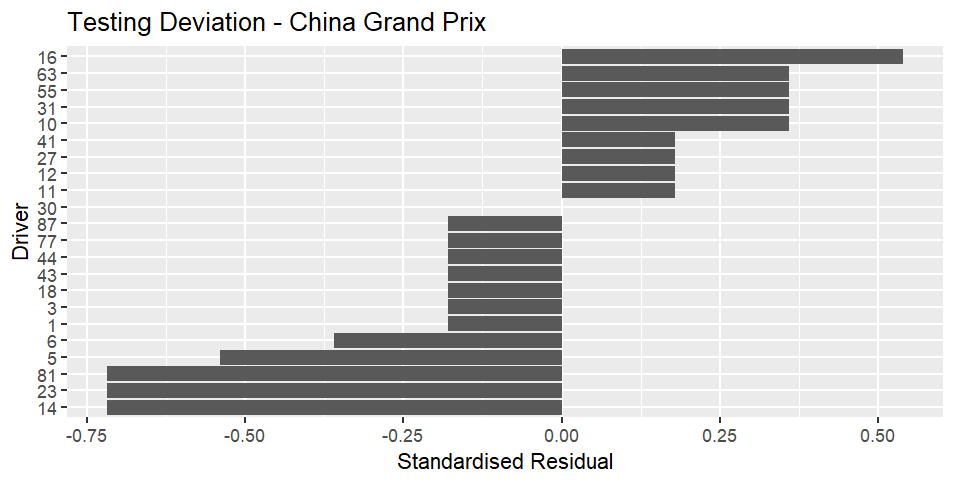
The most tested driver is Leclerc, while Piastri, Albon and Alonso are the least tested. 

None of the differences from expected are statistically significant. 

Most of the under-tested drivers are those that either did not start or had to retire from the race which supports the theory that under-testing is related to not completing the race. 

The season up to the end of the Chinese Grand Prix: The same sort of diagram but now covering all testing up to the end of the Chinese Grand Prix.  Cars 63 (George Russell) and 31 (Esteban Ocon) are the most over-tested compared to expectation.  Car 81 (Oscar Piastri) is the least-tested compared to expectation.  55 (Sainz), 30 (Lawson), 12 (Antonelli) and 10 (Gasly) have been tested exactly as much as expected. 
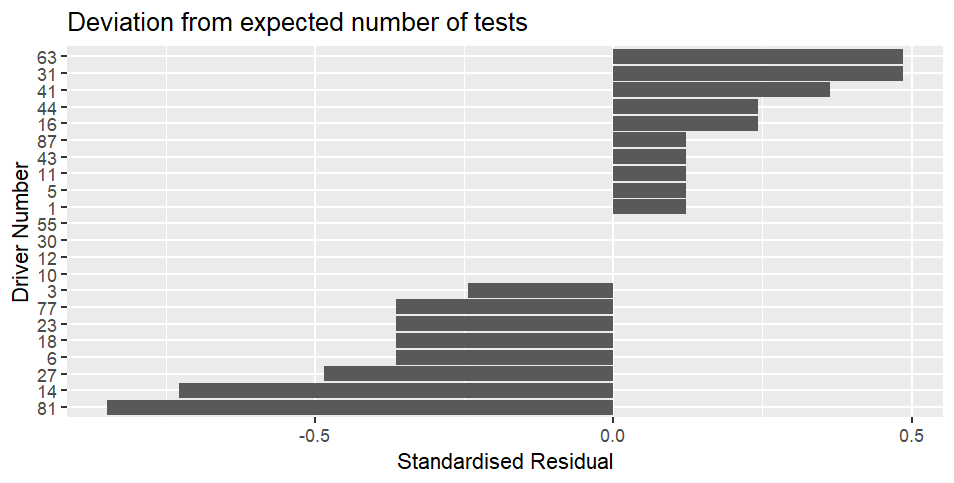
Piastri (car 81) being the most under-tested supports my theory that the under-testing is due to not finishing and is exacerbated by him not even starting those races. 

George Russell (car 63) being one of the most over-tested I can explain because of how well he and Mercedes have done. Ocon (car 31) being equally over-tested, I can't explain, because Haas haven't performed as well as Mercedes and Ocon isn't the top-performing Haas driver. 

The number of drivers that have been tested exactly the number of expected time, now 4 rather than the 2 after the Australian Grand Prix, also makes sense if, as hypothesised, the number of tests will converge towards expected as the season continues.

Wednesday, 22 April 2026

Are the scrutineers picking on my driver? - an unexpectedly timely series

Background: 
As in many sports, after each Formula 1 race, the equipment is scrutinised. 

In the heart of every Formula 1 fan lies a conspiracy theorist, and yes, the universe is out to get your driver or team. 

So, do the scrutineers pick on any particular driver? 

Methodology: 
This entire project would not be possible without the FIA Docs Bot on Mastodon (@fiadocsbot@mastodon.social - https://mastodon.social/@fiadocsbot) run by @seppewyns@mastodon.social (https://mastodon.social/@seppewyns). 

Originally, I started this last year, but things got away from me. FIA produce a lot of documents per race (normally 75-80 of them) so I lost track of the documents and I am not going back to find them. 

Therefore, I am restarting the project for this year. 

Matters are not helped by the tests not being the same each time, which means that putting the results in is a very manual process, but there will be more about that in the post about the Chinese Grand Prix. 

Results from the Australian Grand Prix 

There were a total of 812 checks. If they were evenly spread, you would expect 36.9 checks per driver. I have rounded this to 37. (I am aware that this rounding will affect the numbers over the season but you can't have .9 of a check.) 

Driver 5 (Gabriel Bortoleto) was checked the most, 41 times. 
Driver 27 (Nico Hülkenberg) was checked the least, 32 times. 

This makes me suspect that drivers that do not start the race get fewer checks. 

With 21 degrees of freedom, the χ² = 2.92 value is not statistically significant. 

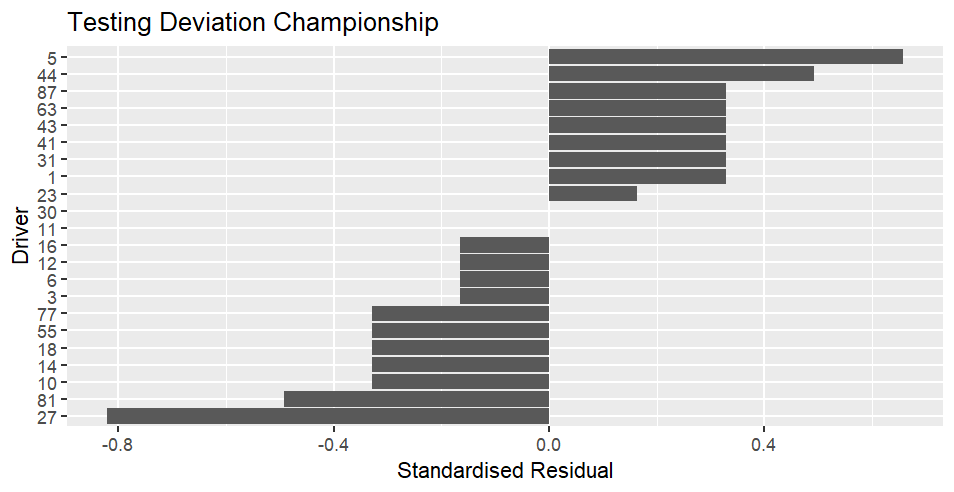
Let's look at the deviations in one chart (thanks to R stats). This chart compares the standardised residuals for each driver. A driver with the exact number of checks performed as expected would have a value of 0. Driver numbers on the y axis compared to standardised residual levels.  The four drivers furthest away from expected are 5 - Bortoleto with a standardised residual of 0.658, so higher than expected, 44 - Hamilton with a standardised residual of 0.493, also higher than expected, 81 - Piastri with a standardised residual -0.493, so lower than expected and Hülkenberg with a standardised residual of -0.822, also lower than expected.  Lawson (car 30) and Perez (car 11) have been tested exactly as often as expected. 

For the 4 drivers with the largest difference to expected, 2 had slightly more checks than expected (Bortoleto and Hamilton) and 2 had slightly less (Hülkenberg and Piastri). 

For Hülkenberg and Piastri this might be because they didn't start the race therefore their cars were not available for some of the pre-race tests as well as the post-race tests. 

Conclusion: 

At this time, no, the scrutineers are not picking on any driver. (I feel I need to add that's what I expect the end results to show too.)

Wednesday, 15 April 2026

Tutankhamun: Treasures of the Golden Pharaoh

The third event of the my 2020 birthday weekend was Tutankhamun: Treasures of the Golden Pharaoh. (The first two were Leonardo - Experience a Masterpiece (The Virgin on the Rocks) and The Duchess of Malfi

Like most people of my generation, I was fascinated by Egyptology from being a small child. I have vivid memories of attending an Egyptology exhibition with Mum at an age of less than 5, and the bug bit me. 

Mum actually attended the Tutankhamun exhibition first, and raved about it so much that when I had the opportunity to go, I had to take it. The exhibition website is here - TUTANKHAMUN: TREASURES OF THE GOLDEN PHARAOH » Saatchi Gallery 

The exhibition focussed on both the dig that uncovered the tomb and the contents of the tomb. Unless I ever get my act together and actually visit Egypt, this was the last chance I was ever going to have to see several of these items. 

Everything was exactly as beautiful as you’d imagine. I think having the objects in front of you makes it easier to imagine the artisans all those years ago making these things, and the talent and skill they had. I understand why lots of people are squeamish about mummies nowadays, and I understand “leave my bones alone”, but if immortality is having thousands of people pay homage and leave offerings of money at your tomb more than three thousand years after your death, I think Tutankhamun has achieved a kind of immortality very few ever will, and his immortality has pulled those artisans along with him.

(Note, it's very hard to write a blog post about "ancient beautiful objects are expectedly beautiful")

Wednesday, 8 April 2026

Did the sprint points and fastest lap points make a difference in Formula 1 in 2024?

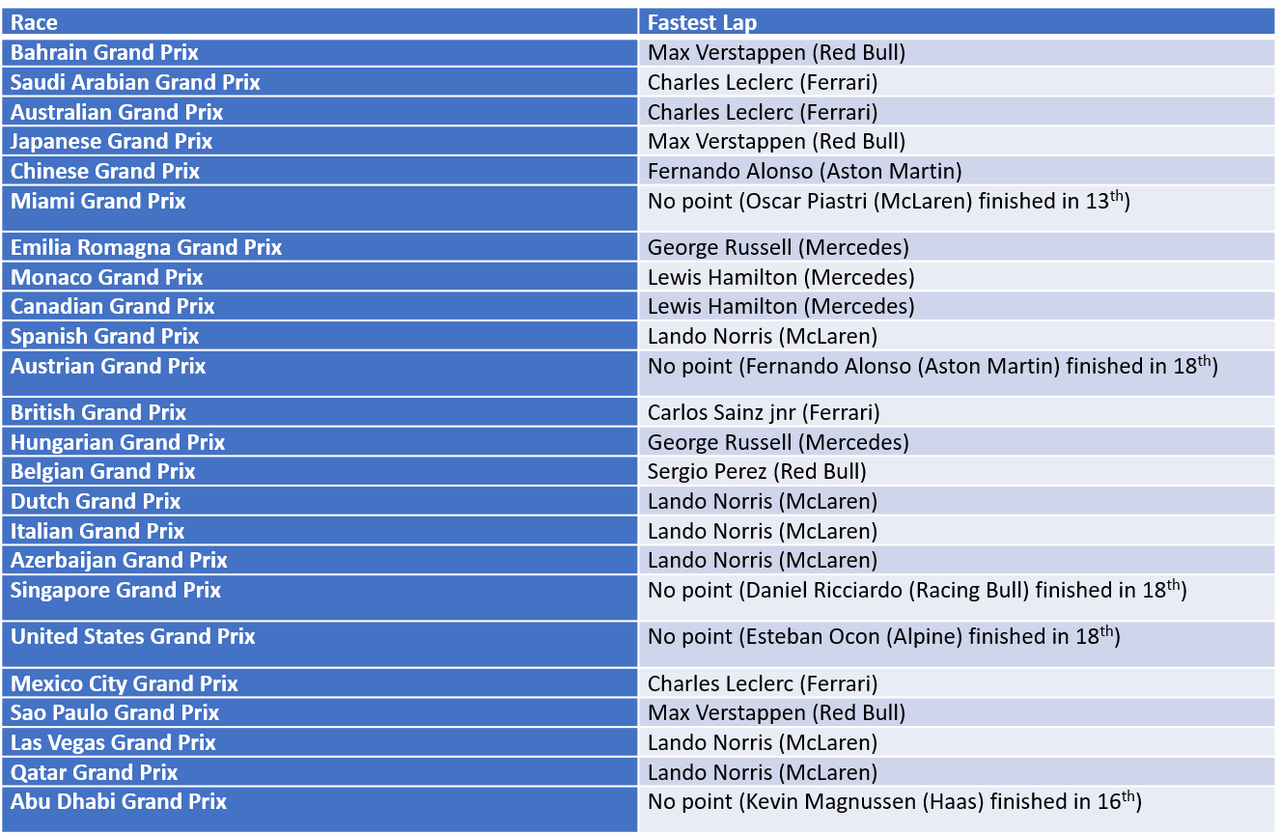
I'm now two years late with this update on whether fastest lap points made a difference and since then they've removed the fastest lap points. Which I find hilarious because 2025 is one of the rare years where it might have made a difference to an important outcome. But that's for a later post. Let's look at 2024. 

2024 Fastest Laps Table with the drivers who set the fastest lap in each race of the 2024 Formula 1 season.  The analysis is all in the text. 

8 different drivers and 4 different constructors won fastest lap points which is higher than the average for drivers (7) and equal to the average for constructors (4).

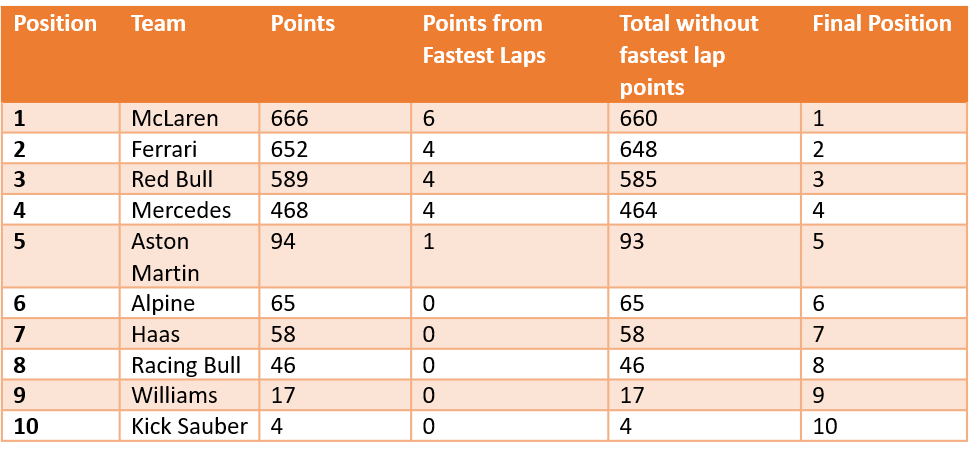
Constructors’s standings with and without fastest lap points Table of the 2024 Constructors results, with and without the fastest lap results.  No teams change position due to fastest lap points. Removing the fastest lap points makes no change in the Constructors’s Title. 

How about in the Drivers's championship? 

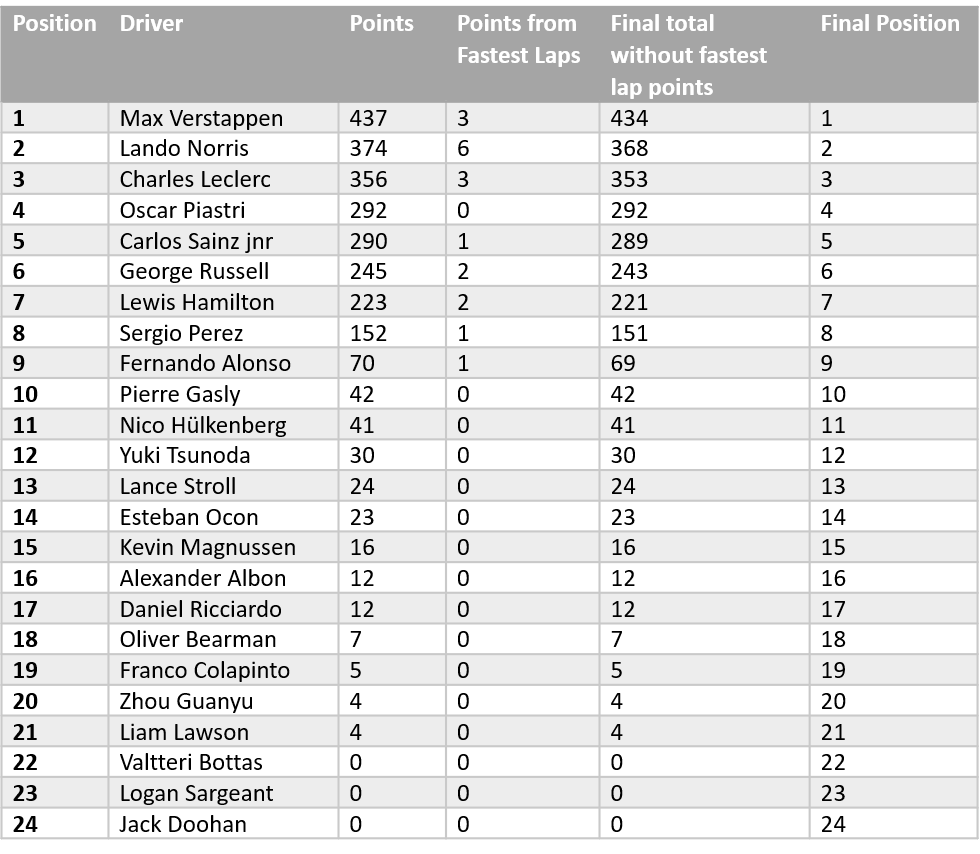
Drivers’s Championship standings with and without the fastest lap points Table of the 2024 Drivers results, with and without the fastest lap results.  No drivers change position due to fastest lap points. Removing the fastest lap points makes no changes to the standings in the drivers’s championship at the end of the season. 

That means if we put together 2024’s results with the calculated total points if there had been fastest laps from 2009-2018, and the actual results in 2019, 2020, 2021, 2022 and 2023, 0 constructors results out of 169 have been affected by fastest lap points. 

In the drivers’ championship, the number of results affected is 13/373 (3.49% of all results), and none of those are in the top 3 of any given year. 

Let’s look at the sprint races, which I expect to have a greater effect due to the quite frankly ridiculous number of them and the points available for them. 

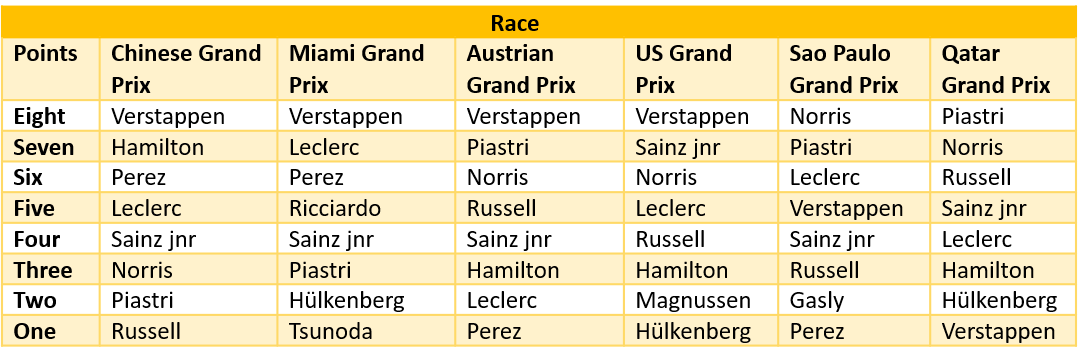
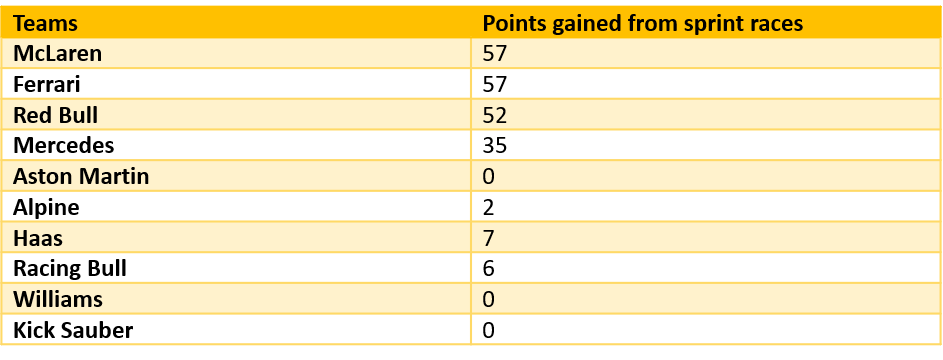
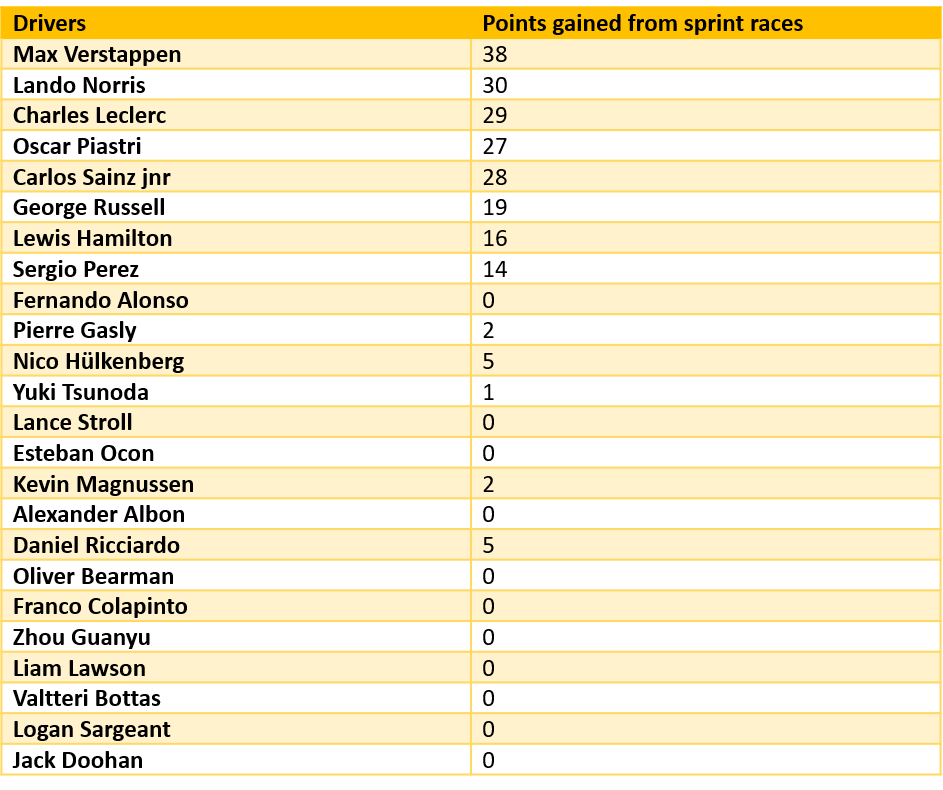
The sprint race points were as follows: Table of which drivers got sprint race points in 2024. 
Constructors points from the sprint races: Sprint race points per constructor in 2024 
Drivers’ points from the sprint races: Sprint race points per driver in 2024 

Do the sprint race points have an effect on either championship? 

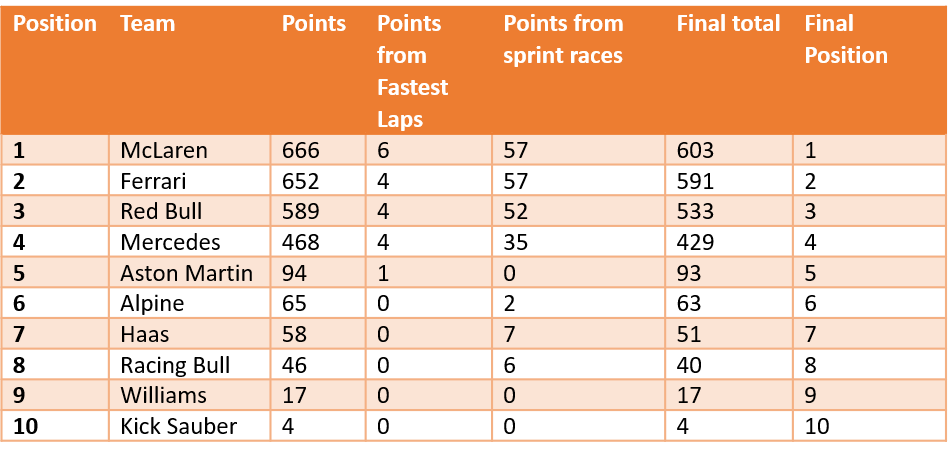
Constructors' championship with and without the sprint and fastest lap points Overall results of the constructors from 2024 without fastest lap or sprint race points.  Nothing changes. 
No effect 

After 3 years, sprint points have had an effect on 6/30 constructors positions. 

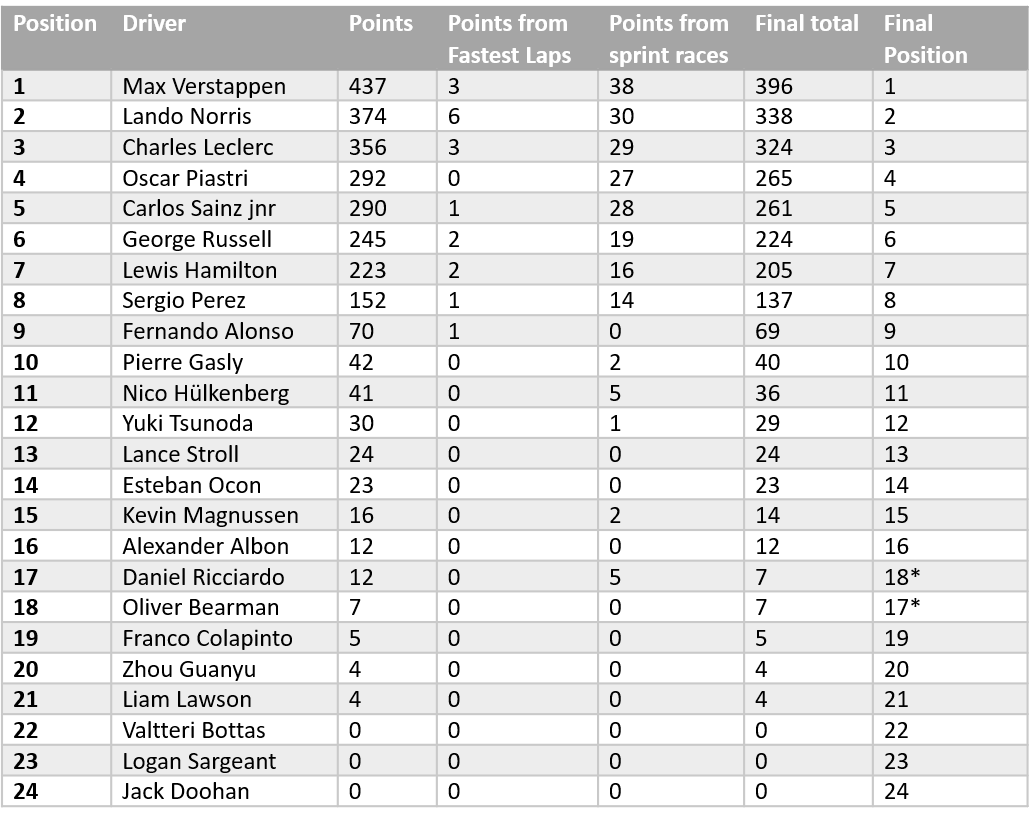
Drivers' championship with and without the sprint and fastest lap points Overall results of the drivers from 2024 without fastest lap or sprint race points.  Oliver Bearman and Daniel Ricciardo have asterisks next to their names because they swap position. Bearman moves ahead of Ricciardo on countback (one 7th position versus a best of 8th) 

Giving points to almost half the field 6 times a year changes the position of 1 of the 24 drivers. 

Over 3 years with sprint races, 7/68 drivers results have been changed. 

What have we learned? 
• The pattern that the 1 point for fastest lap is too small to affect anything continued. 
• The sprint races don’t do anything to disturb the existing order, and only strengthen the points totals of the good teams, creating further separation between them and the weaker teams. The top 3 teams got ~ 50 sprint points each, the bottom 3 got 6. 
• Deeply amused that McLaren and Ferrari had the same number of sprint points. 
• The order of the drivers is unusually muddled up. Normally it’s very two by two by two. In 2024, not so much. 

For an awful lot more effort, expense and wear and tear, the sprint races do very little to the overall standings. Which strengthens my feeling that they’re pointless.

Wednesday, 1 April 2026

Formula 1 2026 - Japanese Grand Prix

Qualifying: 

In things that are not important yet, but will be important by the end of the season - Norris already on 3rd and final battery. Even if they can resurrect his second battery, that's too close to maxing out the allowed number of batteries for comfort. 

How much of Max Verstappen's sour grapes about this set of regulations, "I am retiring if we don't change" and so on is due to being beaten by the RB Juniors? 

Pre-race: Radio got slightly more hijinks than usual because of the delay due to repairs following one of the support races. 

Jack Black has noticeably better PR training than Chris Pratt, and sounded like he might have head of F1 before Jennie Gow spoke to him. 

Damon Hill talking about Murray Walker commentating over his victory is adorable. 

However, I disapprove of them whitewashing why the Japanese Grand Prix had to move out of monsoon season. "So we are in sakura season" indeed. 

The race itself: 

See McLaren, if you give him a car that works, Piastri goes fast. 

I did have a full-blown mini-conniption about Bearman's leg; his limping looked like mine when I broke my leg. So glad that it turned out only to be severe bruising. 

I don't think the accident is evidence that the new regulations are too dangerous, just that there is room for improvement. It's not like there aren't crashes with every set of regulations. 

Also, how much of that crash was due to tyres that weren't warm? 

Alice Powell gave a really good explanation around kneepads, and their painful necessity and why some drivers still don't wear them. 

The incident really changed the shape of the rest of the race. I acknowledge the race became duller after the safety car but there was racing up and down the grid and through most of the race, unlike last year's race, which, as someone described it, "could have been an email". Therefore I am still on team "I like the new regulations".