Showing posts with label cycling. Show all posts

Wednesday, 30 July 2025

Withdrawals from the 2025 Tour de France

Sadly, this year, I haven't been able to watch any of the Tour. 

However, I did find the time to do the withdrawal stats. 

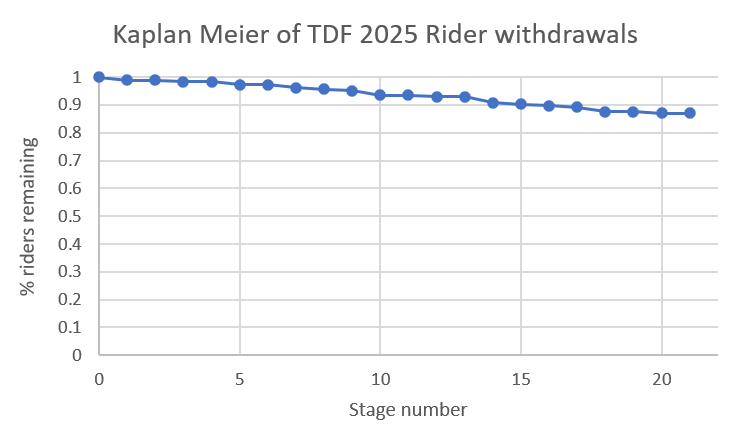
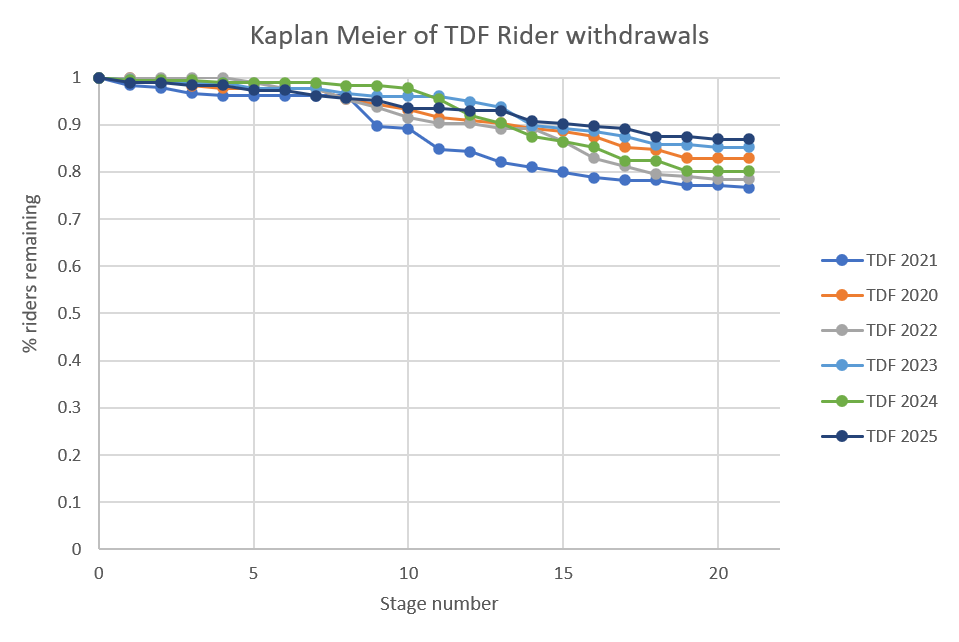
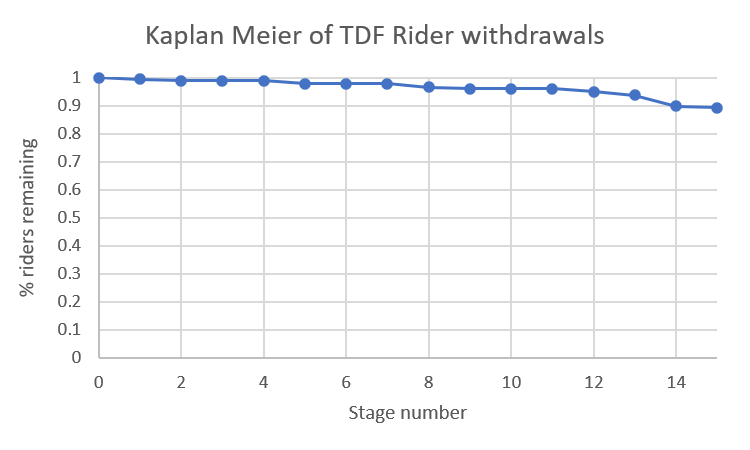
Looking at the Kaplan Meier chart: Kaplan Meier chart of withdrawals in the 2025 Tour de France.  The line of withdrawals in blue is a very shallow slope, with a drop from 1 to 0.9 over 15 stages.  It then drops to 0.875 by stage 20 and stays there till the end at stage 21. While I was compiling the chart, I did start to wonder whether this was an exceptionally kind year in terms of attrition (if you're not Jasper Philipsen or Filippo Ganna). I will try and borrow a copy of Prism to get the numbers but the comparison itself makes it clear that there was less attrition than normal but not by much. The Kaplan Meier line for the 2025 Tour de France compared to previous races going back to 2020.  2025 (dark blue line) is the one with the fewest withdrawals, finishing with 0.875 still in (87.5%), 2023 (light blue) is the next highest at about 0.85, then 2020 (orange) at about 0.83, then 2024 (green) at 0.80, 2022 (grey) at about 0.78 then 2021 (mid blue) is the lowest at 0.76 

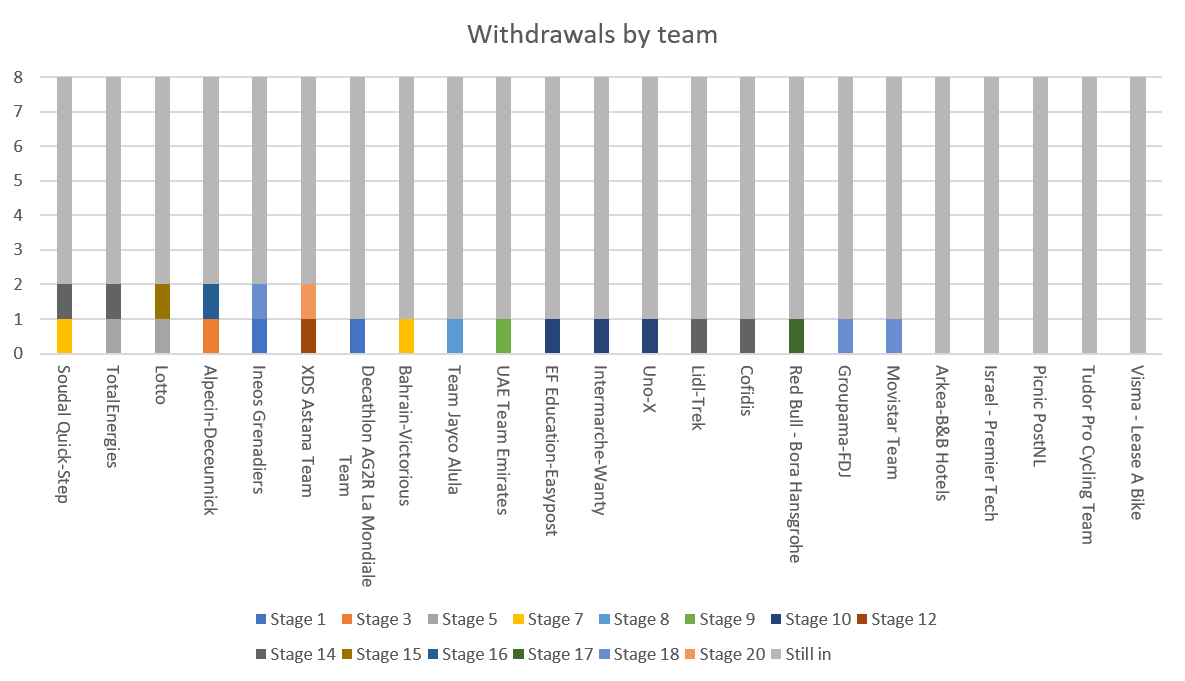
I don't know whether that's because the first "week" this year was 10 days long, because the 14th of July fell on a Monday (very necessary Casablanca clip here - https://youtu.be/HM-E2H1ChJM?si=Sadu7MugvhdwDhXC). Withdrawals by team, the teams are ranked from left to right by how many riders withdrew.  The team with the most withdrawn riders is at the left.  Fuller details in the text below. 

23 teams took part in the race. The withdrawals seem reasonably balanced. 

6 teams had 2 riders withdraw - Soudal QuickStep, Total Energies, Lotto, Alpecin-Deceunnick, Ineos Grenadiers and XDS Astana. 
5 teams had no one withdraw - Arkea - B&B Hotels, Israel Premier Tech, Picnic Post NL, Tudor and Visma - Lease A Bike. 

(I know it's because sponsorship is hard to find, but do the team names need to be that long). 

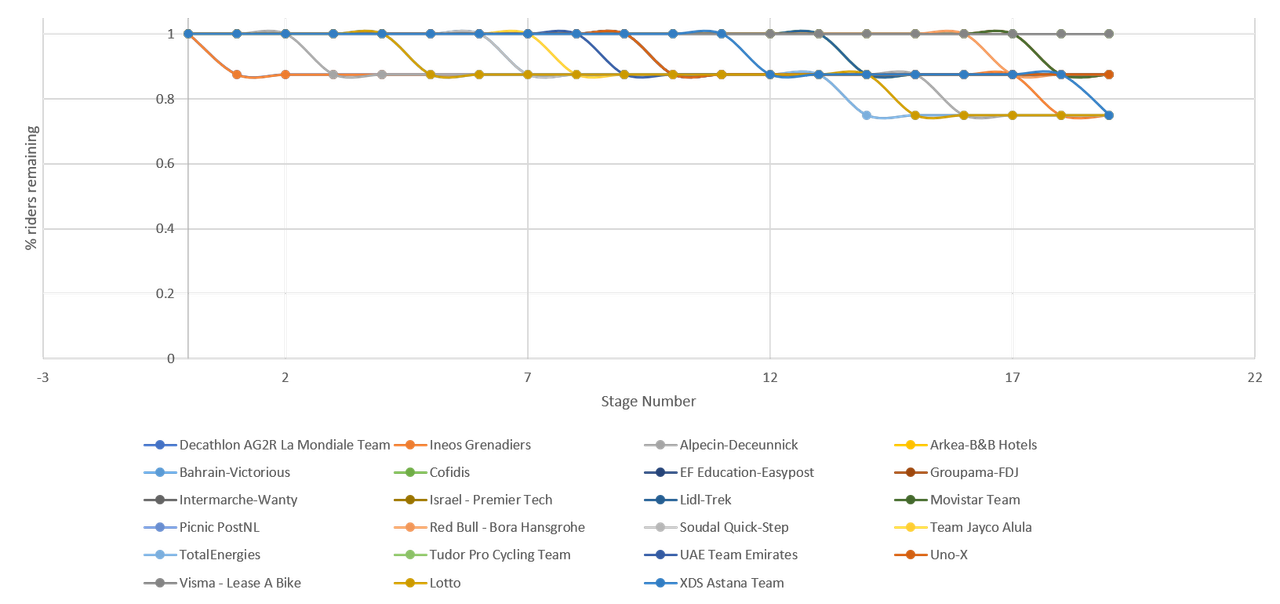
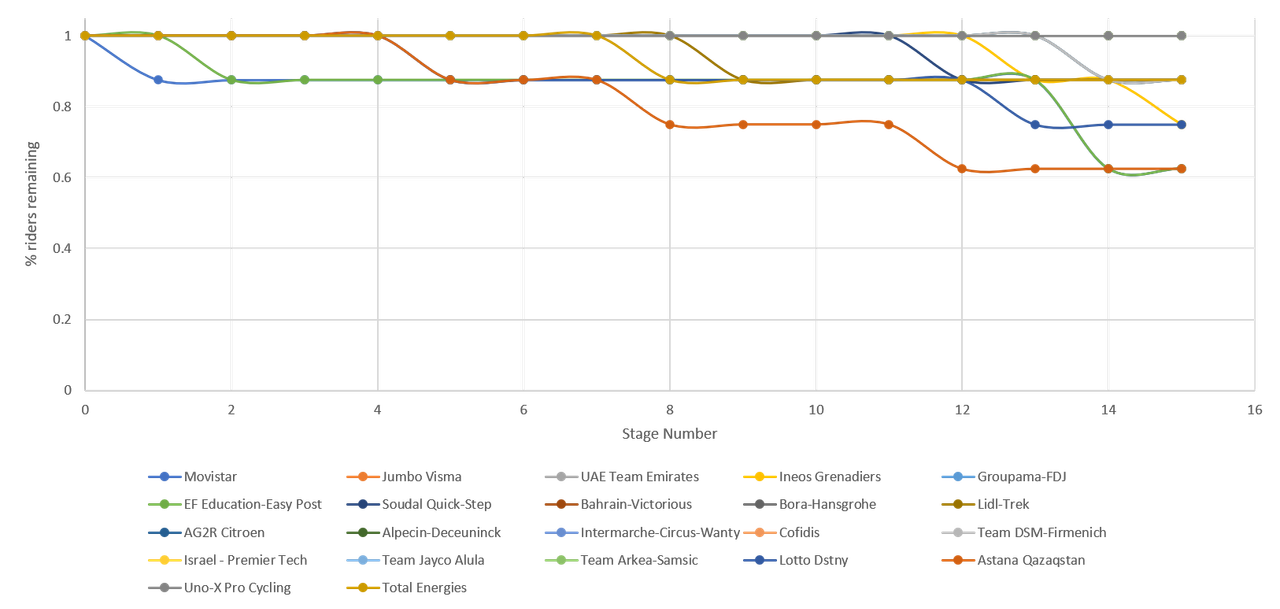
Because they withdrawals are evenly spread, in the Kaplan Meier diagram split by teams, there's no sudden drops. It looks very like a plait. Kaplan Meier chart divided by teams.  Because a team loses a rider every now and again, it looks like the lines for the different teams are forming a plait. 
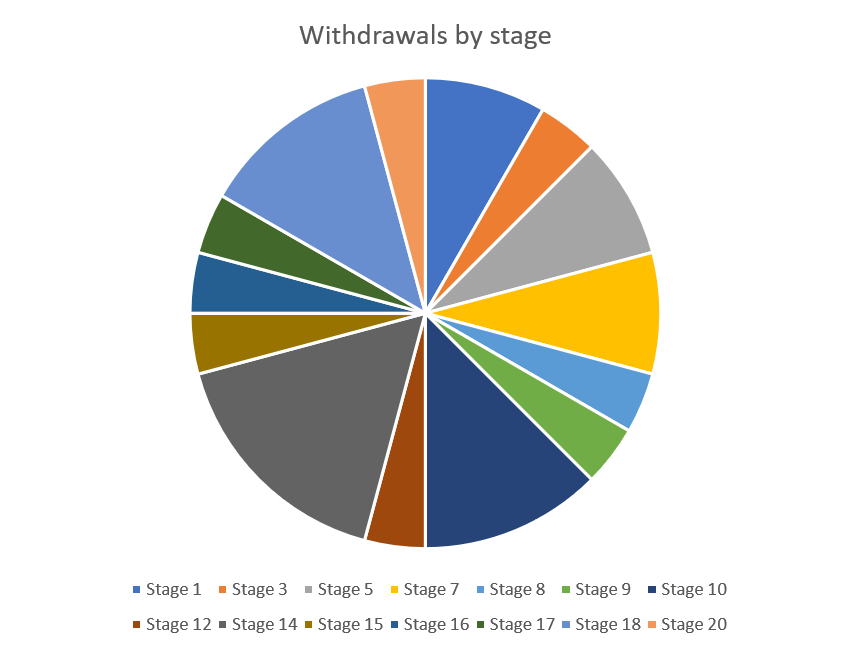
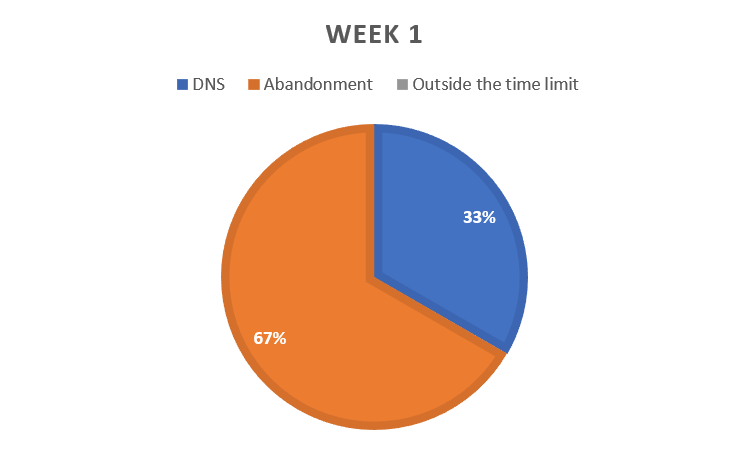
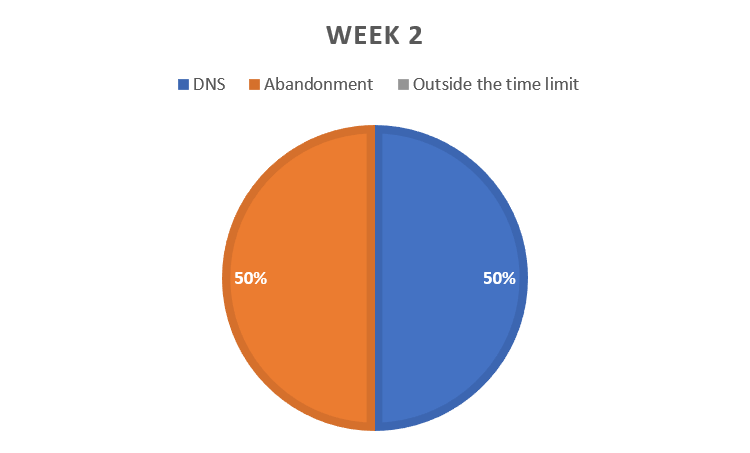
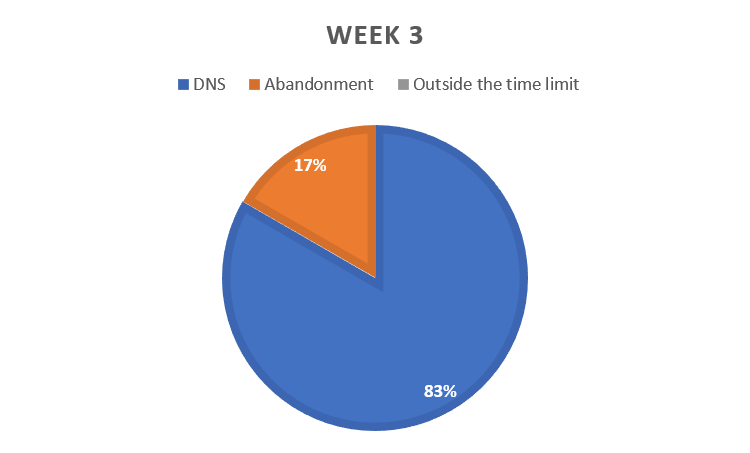
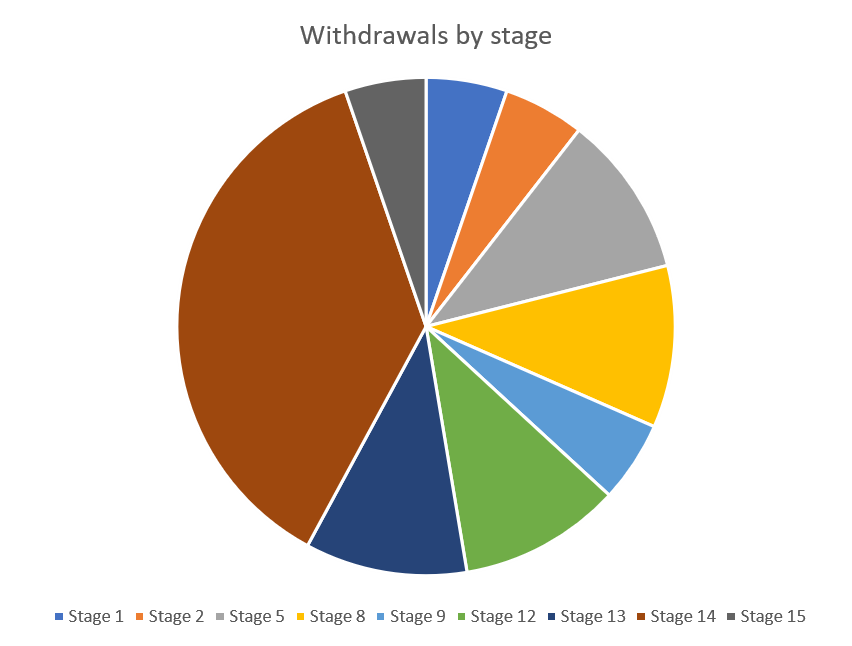
Further evidence of it being an unusually non-attritional race, despite them having a stage with a sprint finish up the Ventoux - https://velo.outsideonline.com/road/road-racing/tour-de-france/highlights-tour-de-france-stage-16-2025, is that no one stage stands out as having more withdrawals. Pie chart of withdrawals by stage, ordered by stage number.  Although stage 14, dark grey, had the most withdrawals with 4, it does not stand out from the stages around it.  Normally one or two stages stand out as having had lots of withdrawals. Looking at withdrawals by type by week: Pie chart showing withdrawals by type in week 1.  67% were mid-stage abandonments (in orange), 33% were did not start the stage withdrawals (blue).  There were no over the time limit withdrawals. Pie chart showing withdrawals by type in week 2.  There is a 50/50 split in types of withdrawals.  50% are mid-stage abandonments (in orange), 50% were did not start the stage withdrawals (blue).  There were no over the time limit withdrawals. Pie chart showing withdrawals by type in week 3.  17% are mid-stage abandonments (in orange), 83% were did not start the stage withdrawals (blue).  There were no over the time limit withdrawals. Ignoring that week 1 was 10 days ... the really interesting things are: 
1 - No over the time limit withdrawals at all 
2 - The pattern is almost symmetrical 

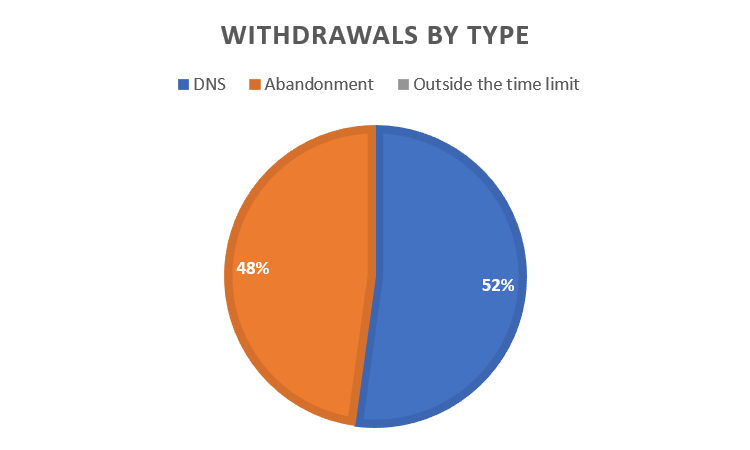
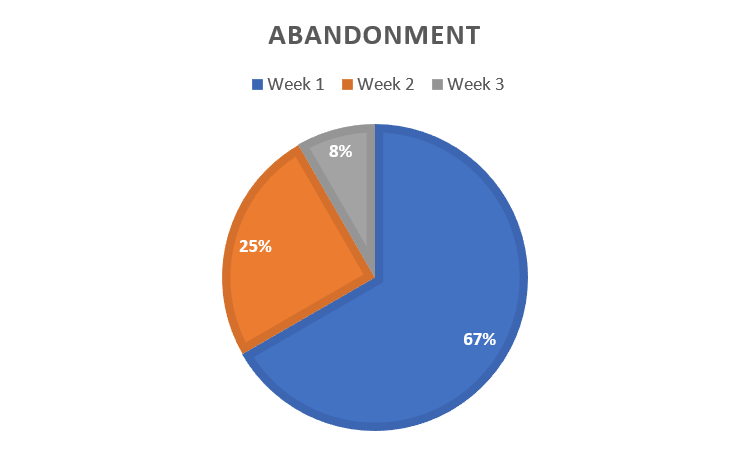
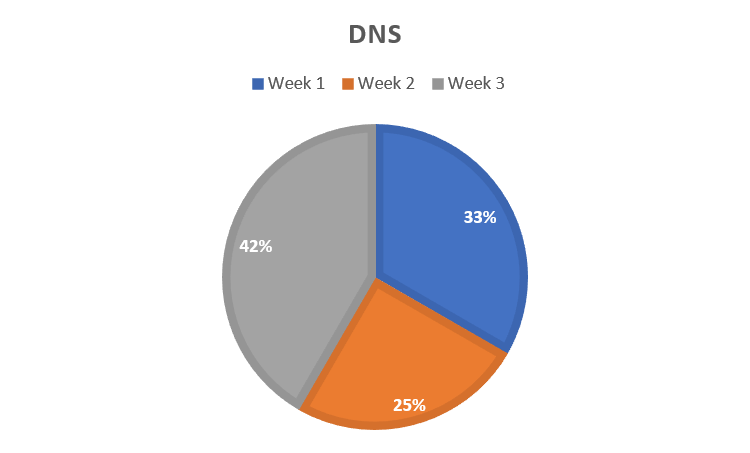
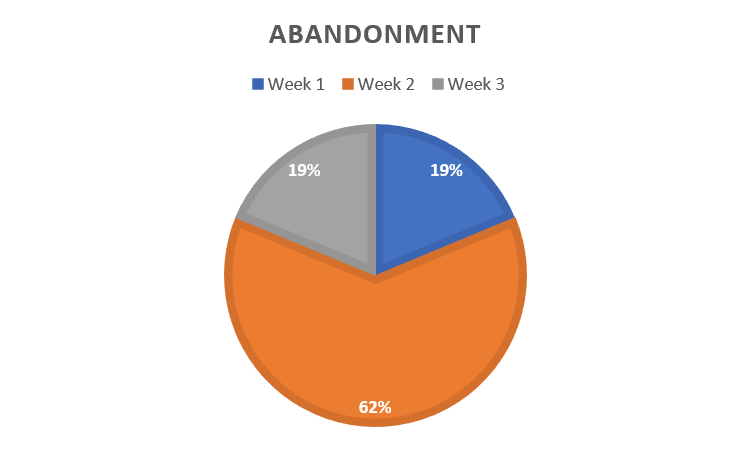
The number of withdrawals by type is pretty even, 48% were mid-stage abandonments, 52% were did not starts. Pie chart of withdrawals by type.   48% are mid-stage abandonments (in orange), 52% were did not start the stage withdrawals (blue). Pie chart of when the abandonment withdrawals occurred, 67% occurred in week 1 (blue), 25% in week 2 (orange), 8% in week 3 (grey). Pie chart of when the did not start withdrawals occurred, 33% occurred in week 1 (blue), 25% in week 2 (orange), 42% in week 3 (grey). Since Did Not Start withdrawals are mostly "help, the damage has caught up with me" withdrawals, that pattern makes sense.

Saturday, 3 May 2025

Withdrawals in the Women's Tour de France 2024

For those who don't know, maths is not my subject. I enjoy statistics and it's the only thing that stopped me failing A-Level maths, because it makes sense. 

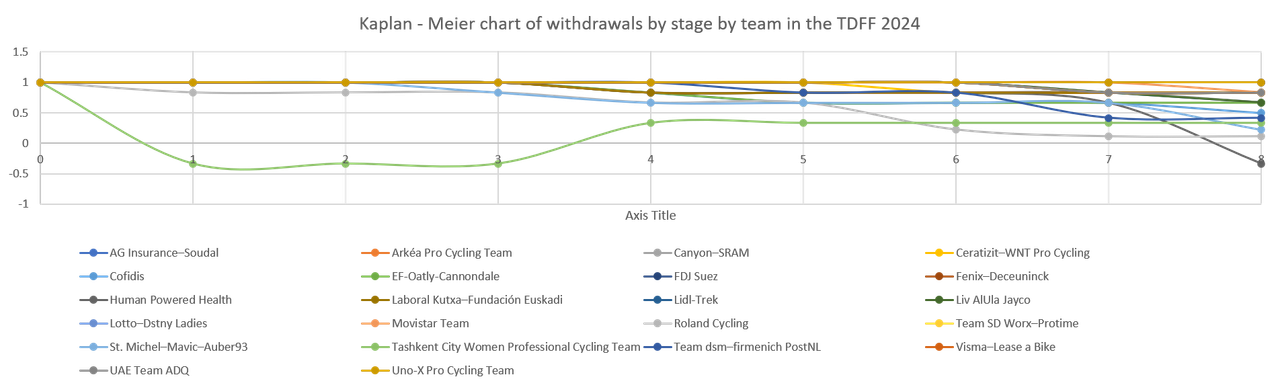
So when so many members of the Tashkent City Women Professional Cycling Team and the Human Powered Health Team withdrew in different stages of the race that the lines in the Kaplan Meier graphs go into the negative, the maths part of my brain is screaming because you can't have negative survival rates, and the statistician in me says either those teams were awful or something appalling happened. Kaplan Meier survival curves split by teams.  Two lines go negative.  One is an oakleaf green which stands for Tashkent City Women Professional Cycling Team.  It goes into the negative at stage 1, then flips again into the positive at stage 4.  The brown line that flips into the negative at stage 8 is the Human Powered Health team. When the green line for Tashkent then goes positive again because the amount of riders they lost in another stage versus the amount that remained, I become reasonably convinced of my "awful or appalling happened" thesis. 

It turns out there's something more interesting going on with the Tashkent City Women Professional Cycling Team. 

They are a Continental Tour team who gamed the system to get a women's Tour de France invite, because that was their aim (https://www.rouleur.cc/blogs/the-rouleur-journal/200-euro-salaries-inexperienced-youngsters-and-gaming-the-system-tashkent-city-justify-their-place-at-the-tour-de-france-femmes). And that's before we point out that most of them were teenagers, in a sport that acknowledges it's hard to finish the race that young (https://www.cyclingnews.com/news/people-can-think-what-they-want-tashkent-city-women-respond-to-criticism-after-four-riders-abandon-tour-de-france-femmes/

I'd also like to raise a toast to Yanina Kuskova, the one Tashkent City rider to finish. She's now riding for Euskadi. 

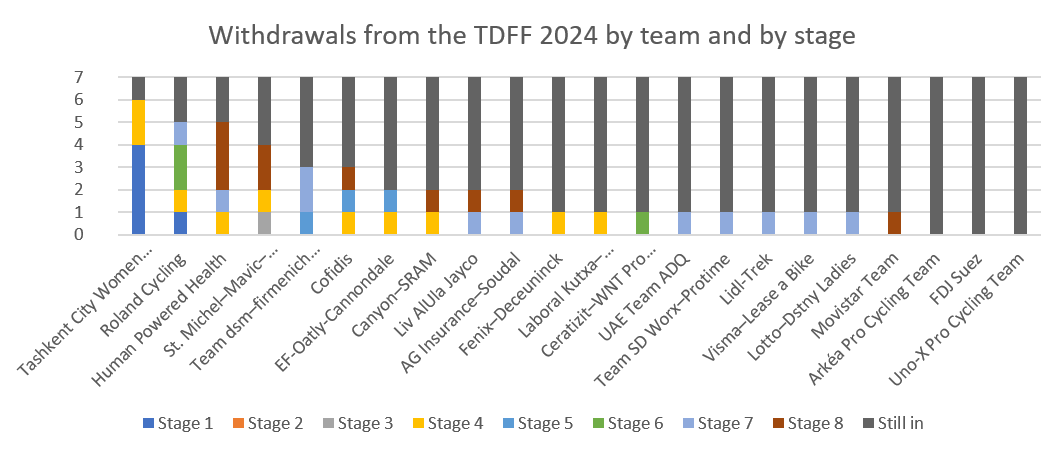
This race did seem to have a lot of withdrawals. Bar chart of withdrawals in the 2024 TDFF.  Tashkent City finished with only 1 rider.  Arkea, FDJ Suez and Uno-X all finished with all their riders. 

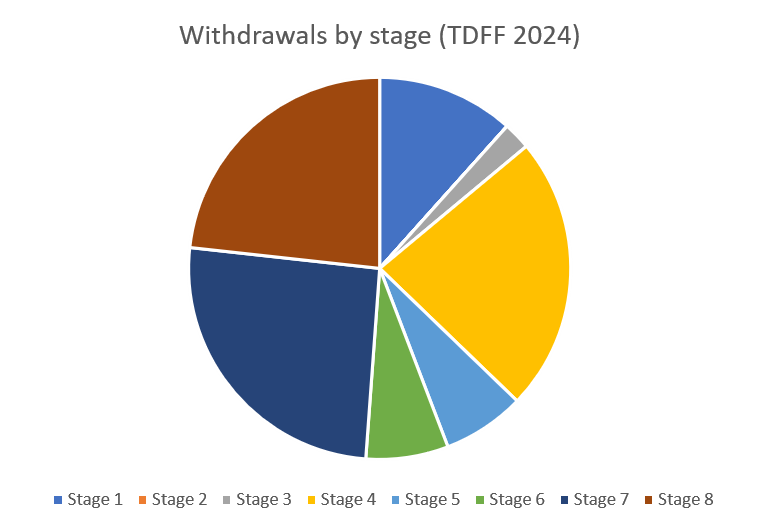
It appears that stages 4, 7 and 8 were diabolical. Pie chart.  Three stages, 4, 7 and 8, contain three quarters of the withdrawals. 
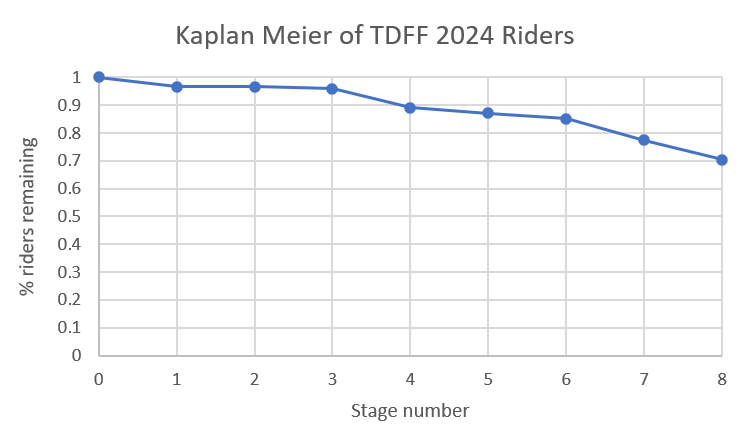
The all-rider Kaplan Meier chart also bears this out. Kaplan Meier chart of all withdrawals from the TDFF 2024.  It drops to 0.975 after one stage, and stays that way till stage 3, then drops to 0.9 by stage 4.  It continues to drop, but more slowly, to 0.85 at stage 6.  It then drops to 0.77 at stage 7 and 0.7 at stage 8. Over the years I've been doing this for both the men's and women's Tour de France, this is is the lowest percentage of finishers. 


Stage 7 was again general evil, building up to the Alpe d'Huez. 

 Stage 8 was the Alpe d'Huez itself. Meet the Alpe - https://en.wikipedia.org/wiki/Alpe_d%27Huez#Cycle_racing 

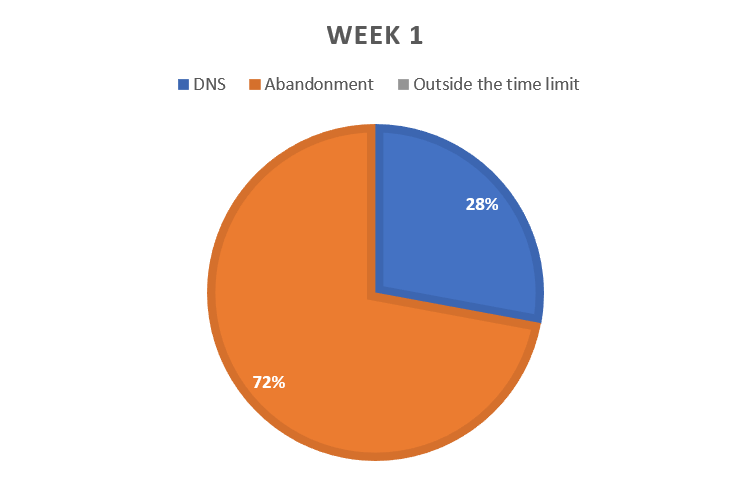
Interestingly, despite that, none of the withdrawals were due to racers finishing outside the time limit, they were either mid-stage abandons, or did not start the stage withdrawals. Pie chart of withdrawals by type.  Orange, withdrawals due to mid-stage abandonments, are 72% of all withdrawals, while did not start the stage abandonments were 28% of all withdrawals.

Monday, 28 April 2025

Withdrawals in the Women's Tour de France 2023

I warned you all a lot of this year's posts are me catching up on last year's. I'm hoping to have this post and the equivalent for the Women's Tour de France 2024 up shortly. 

In the figures, the race is called the TDFF for Tour de France Feminine to save space. 

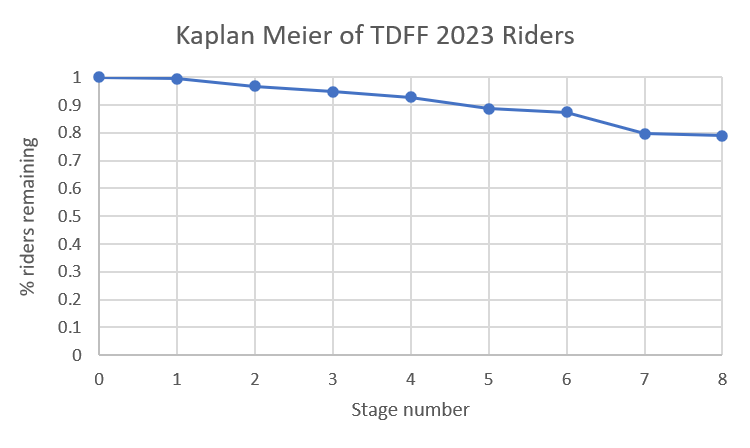
From the figures I usually make, the first thing that stood out was that you could see stage 7 happening to the peloton. Kaplan Meier chart of withdrawals from the TDFF 2023.  It starts at 1, reduces slightly by the end of stage 1, to about 0.975 by the end of stage 2, about 0.95 by the end of stage 3, about 0.925 by the end of stage 4, just under 0.9 by the end of stage 5, then 0.875 by the end of stage 6, followed by a sudden drop to 0.8 by the end of stage 7, and it pretty much stays there by the end of stage 8. 
A quick search gave me the answer to "what happenened?". The Tourmalet happened. For those who don't follow cycling, please meet the Col du Tourmalet - https://en.wikipedia.org/wiki/Col_du_Tourmalet 


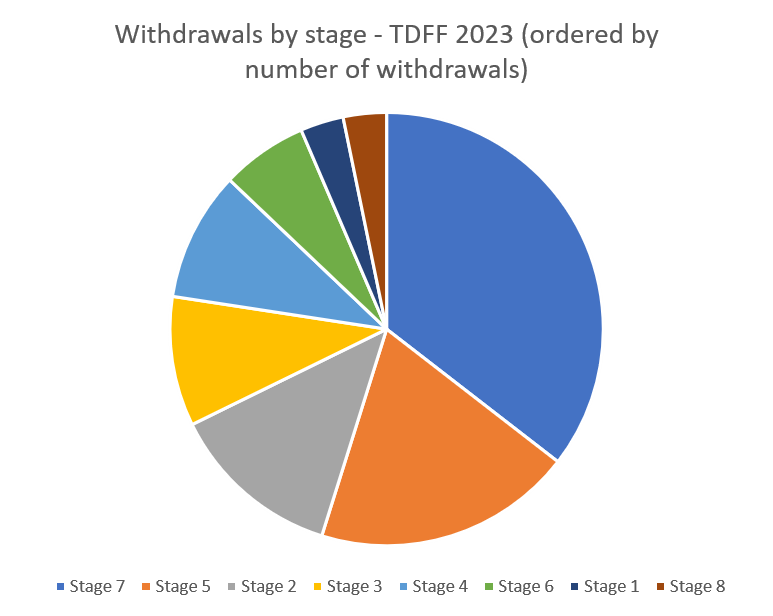
The Tourmalet effect is also seen in the pie chart of withdrawals by stage, with stage 7 (11 withdrawals) having more withdrawals than the next two stages with the most withdrawals combined (stage 5 = 6, stage 2 = 4). Pie chart of withdrawals by stage.  The largest slice of the pie, in mid-blue is for stage 7 with 11 withdrawals. 

For the men's 2023 Tour de France, the breakdown of the withdrawals was 38% did not start the stage (DNS) withdrawals and 62% mid-stage abandonments (https://fulltimesportsfan.wordpress.com/2023/11/18/withdrawals-in-week-3-of-the-2023-tour-de-france-an-overall-round-up-and-confirmation-that-the-olympics-didnt-cause-more-withdrawals/). 

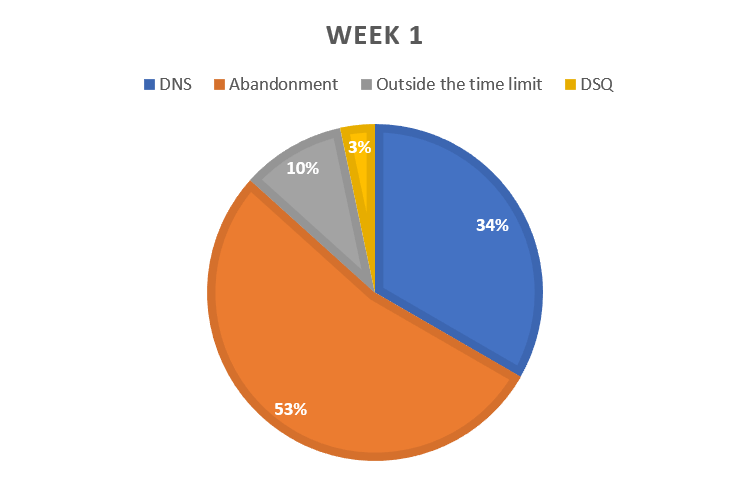
There were no withdrawals due to being outside the time limit (OTL). This is a very different pattern to what was seen in the women's Tour de France 2023. Pie chart of types of withdrawal in the 2023 TDFF.  Blue is did not start the stage withdrawals, at 34%, orange is mid-stage abandonments at 53%, then 10% are outside the time limit (OTL).  The one disqualification, in yellow, is 3% of the total withdrawals. 

The percentage of did not starts is almost exactly the same (38% in the men's vs 34% in the women's), so the over the time limit withdrawals in the women's seem come from the pool that were mid-stage abandons in the men. 

On the other hand, the 2023 men's Tour de France was unusual in not having any OTL withdrawals. 

The one disqualification was Lotta Henttala, who was disqualified for holding onto her team car to get a tow. Interestingly, Demi Vollering, the eventual winner had 20 second added on to her time the day before for excessive drafting (following a team car to reduce wind drag) but I'm going to presume the commissaires's argument is drafting is different from holding. 

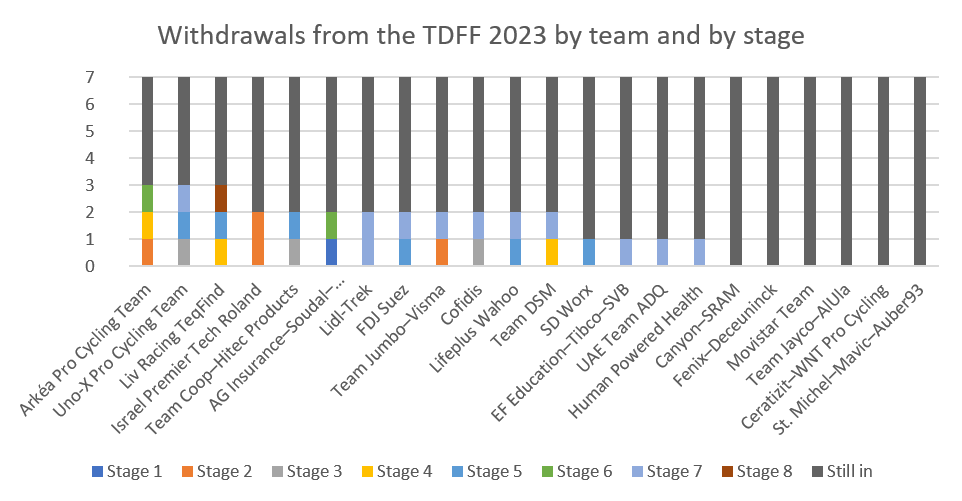
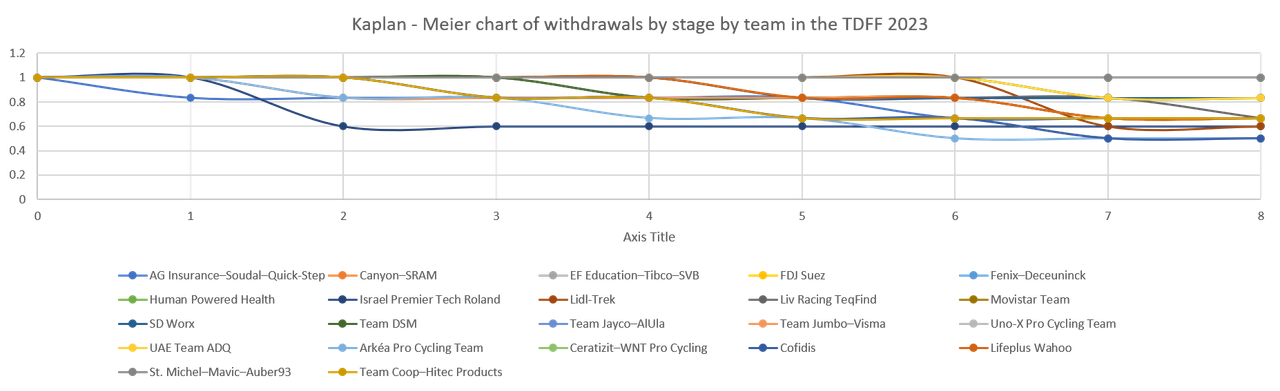
You can see the stages, particularly stage 7, happening to the teams in the bar chart of when teams lost riders. Bar chart showing when teams lost riders.  Although a couple of teams lost 3 riders (Arkea Pro Cycling team, Uno-X Pro Cycling team, Liv Racing TeqFind), no team reduced to half or less. Due to the number of teams, the Kaplan Meier chart divided by team is a mess. Kaplan Meier chart.  Due to the number of teams no clear shape is visible.  You can sort of see stage 2 happening to Israel Premier Tech, and the whole Tour happening to Arkea, but that is about it. 

L is trying to encourage me to have actual conclusions to these posts, but the problem is that there isn't enough data to have a conclusion.

Friday, 25 April 2025

Cycling - Does racing the week before predict outcome in the women's Tour de France

When I posted about the 2023 Tour de France withdrawals (https://fulltimesportsfan.wordpress.com/2023/11/18/withdrawals-in-week-3-of-the-2023-tour-de-france-an-overall-round-up-and-confirmation-that-the-olympics-didnt-cause-more-withdrawals/), friend R wondered whether the fact that the teams on the women's tour had fewer resources for recuperation etc might affect which racers completed the Tour de France.

Using the stats from Procycling Stats (https://www.procyclingstats.com/), I wanted to see if there was anything in that theory.

Attempt one - if it is a "recovery problem", I'd expect the riders who raced the week before to be less likely to finish the Tour de France Feminine (TDFF).

 Raced within 1 week of the TDFFDid not race within one week of the TDFF 
Completed the TDFF  32 91
Did not complete the TDFF 7 24

Putting those numbers in a 2 x 2 Chi-Squared table suggested that there was no statistically significant difference as to whether racers finished or did not finish the Tour de France Feminine depending on whether or not they raced the week before.

Okay, so I thought, maybe those were only smaller races.  Maybe a bigger race would take it out of the racers more.  So, was there any difference in whether or not a racer finished the Tour de France Feminine based on whether they'd raced the Giro d'Italia Donne?

 Raced the Giro Did not race the Giro 
Completed the TDFF 34 89
Did not complete the TDFF 9 22

Again, using a 2 x 2 Chi-Squared table suggested that there was no statistically significant difference.

The big thing that surprised me was how small the crossover was between people who raced in the Giro Donne and the TDFF.  I would have expected there to have been more.

Final theory was, hey, maybe cumulative damage would affect this.  So, of the 43 riders who did both races, did finishing the Giro Donne have any effect?

 Finished the GiroDid not finish the Giro
Completed the TDFF  31
Did not complete the TDFF 7 2

Sadly for L's hopes that I will make strong conclusions to my posts, nope, there was no statistical significance there either.

So what are we seeing - if there is any factor that affects likelihood of finishing the Tour de France Feminine, it is not having raced the week before, it's not having competed in the grand tour before it, and it is not completing the grand tour before it.

Further investigations would be whether this extends to the men's Tour de France too, given the greater overlap in competitors between the grand tours.

Saturday, 22 February 2025

Withdrawals from the 2024 Tour de France

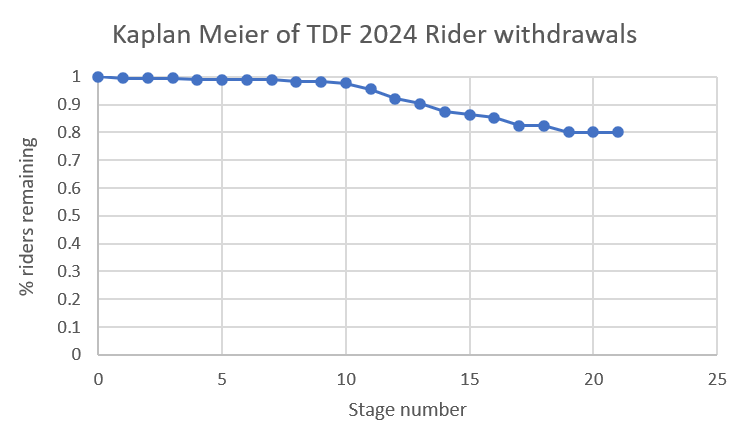
I was going to say that there were relatively few withdrawals, and then stage 12 happened (https://www.rouleur.cc/blogs/the-rouleur-journal/from-covid-to-crashes-how-stage-12-of-the-tour-de-france). From a viz perspective, it's interesting because you can see stage 11 and 12 happening to the peleton in the picture. Kaplan Meier diagram of all the riders in the peleton.  The line is flat until stage 11, then becomes a diagonal downward slope (about 3 percent per day) until day 17, then it flattens out again until day 21 (the last day/stage). 

Or, you can't half tell which week had the mountain stages. 

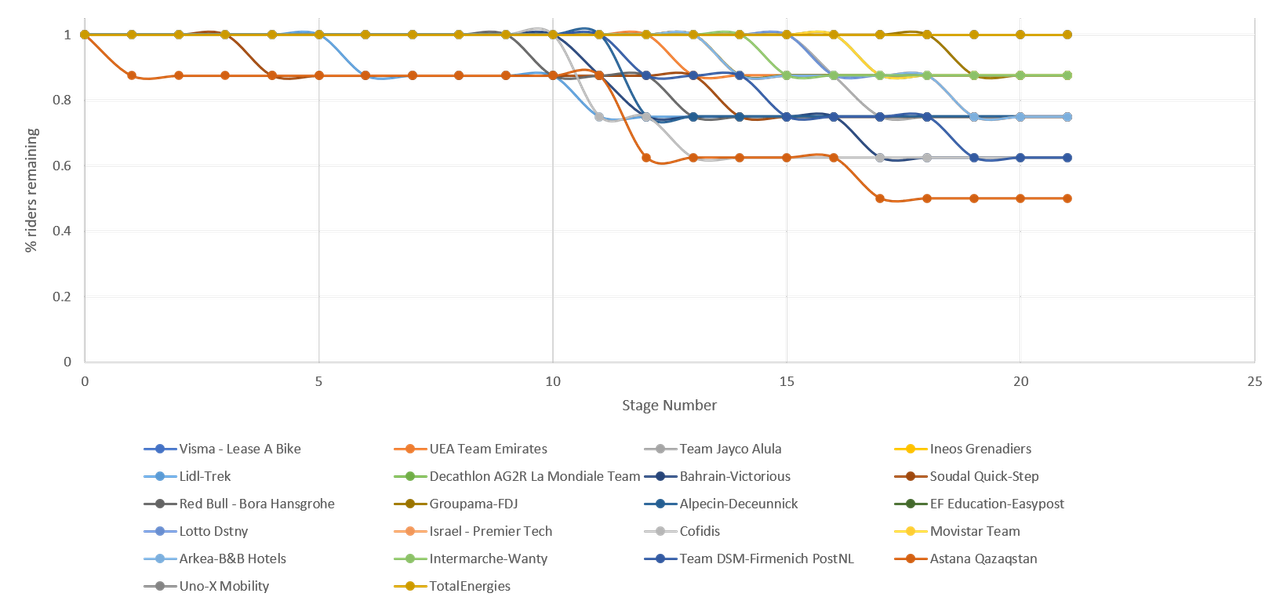
You can also see the race happening to Astana (the red-orange line) in the Kaplan Meier split out by teams. Kaplan Meier curve split out by teams.  It is very busy.  The red-orange line is Astana because I still have no way of using proper team colours.  Their line starts to drop earlier and by the end, only half of their team remains.  Other teams also drop but more slowly or not to the same extent. 

The next visualisation is a pie chart of withdrawals by stage. Pie chart showing withdrawals by stage.  Stage 12 (pale green) had the most with 6, but was closely followed by stage 14 (brown-red) and 17 (mid-blue) who had 4 withdrawals and stage 11 (light blue) and 19 (dark green) with 3 each. 

The interesting thing is that while normally there's maybe 2 or 3 stages that stand out for having a lot of withdrawals, in 2024, there were no real standout "evil" stages. 

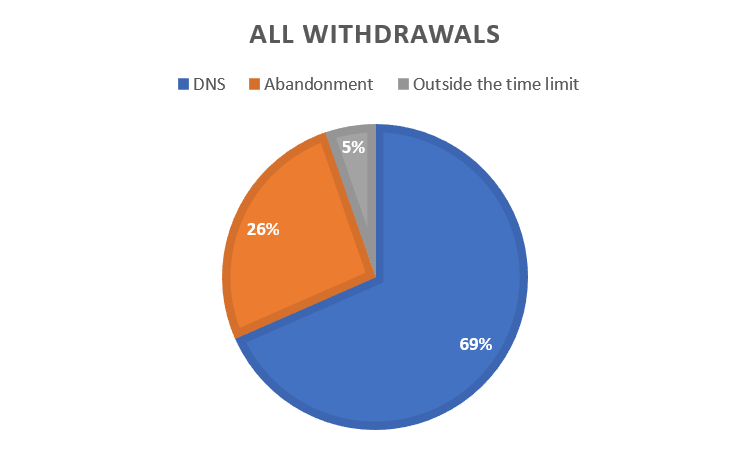
All withdrawals Pie chart of all withdrawals.  Did not start the stage withdrawals, in blue, are 69% of all withdrawals.  Mid-stage abandonments, in orange, are 26% of all withdrawals.  Over the time limit withdrawals, in grey, are 5% of all withdrawals. 

Did not start the stage withdrawals are most of the withdrawals, which is possibly because it takes over night for the riders to realise they are too injured to continue. Adrenaline is a terrible thing.

Withdrawals by week by type 

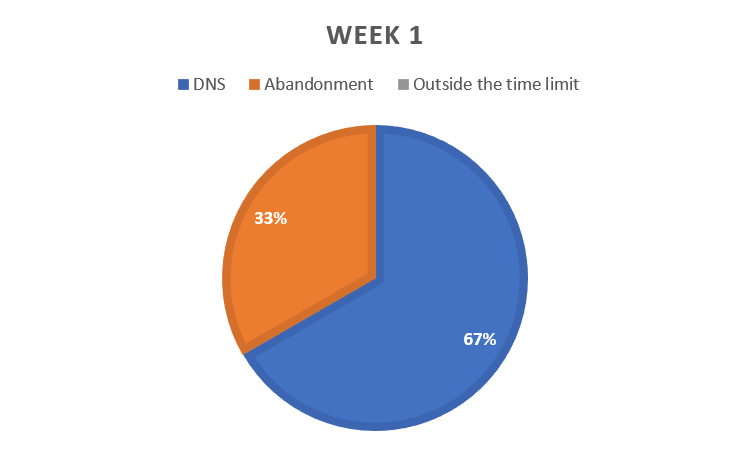
Week 1's withdrawals were all either Did Not Starts or mid-stage Abandonments Pie chart showing the week 1 withdrawals.  Blue, did not start the stage, withdrawals were 67% of all withdrawals in week 1, while orange, mid-stage abandonments were 33%. 

Week 2 featured Did Not Starts, mid-stage Abandonments and some Outside the Time Limit withdrawals. Pie chart showing the week 2 withdrawals.  Blue, did not start the stage, withdrawals were 33% of all withdrawals in week 2, while orange, mid-stage abandonments were 43% and grey, over the time limit withdrawals were 24%. 
Week 3 also features all three kinds of withdrawals. Pie chart showing the week 3 withdrawals.  Blue, did not start the stage, withdrawals were 55% of all withdrawals in week 3, while orange, mid-stage abandonments were 36% and grey, over the time limit withdrawals were 9%. 
Withdrawals by type by week Pie chart of mid-stage abandonments by week.  Week 1, in blue, had 7% of all the mid-stage abandons,  week 2, in orange, had 64% of them and week 3, in grey, had 29% of them. Pie chart of did not start the stage withdrawals by week.  Week 1, in blue, had 13% of all the DNS withdrawals,  week 2, in orange, had 47% of them and week 3, in grey, had 40% of them. Pie chart of all the over the timelimit withdrawals by week.  Week 1 had none, week 2, in orange, had 83% of them and week 3, in grey, had 17% of them. 
That's another set of charts that shows most of the mountain stages were in week 2, because those are the stages where people are most likely to be over the time limit. 

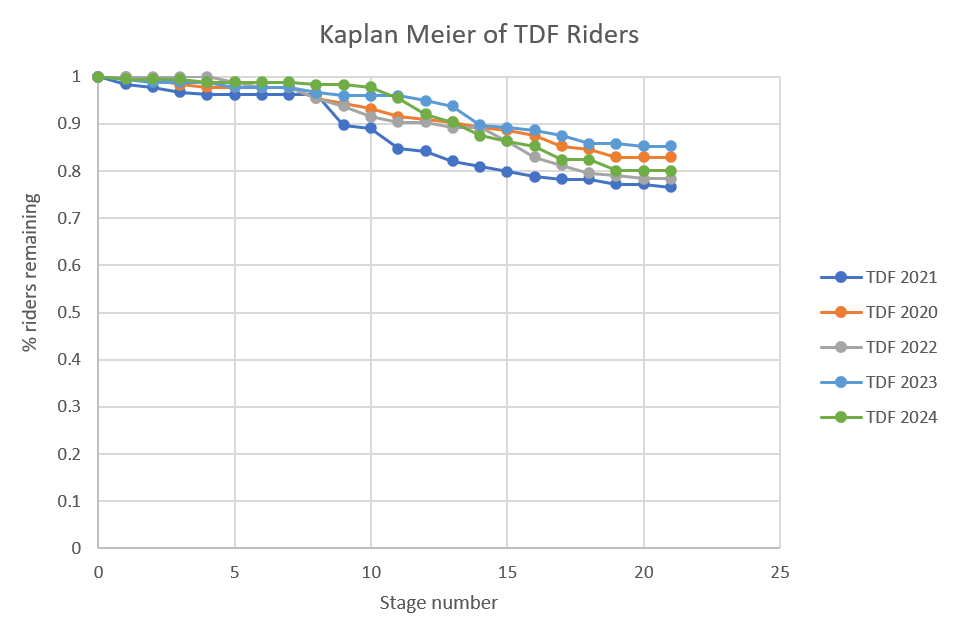
This series was originally intended to see if more riders withdraw in Olympics years (and showed that they don't - https://fulltimesportsfan.wordpress.com/2023/11/18/withdrawals-in-week-3-of-the-2023-tour-de-france-an-overall-round-up-and-confirmation-that-the-olympics-didnt-cause-more-withdrawals/), it's interesting to see that there are two groups of races when you compare the withdrawal Kaplan Meier charts since 2020, and two curve shapes. Kaplan Meier diagrams of all 5 races, 2020, 2021, 2022, 2023 and 2024.  2021 has a different curve shape to the others.  The end points of 2021 and 2020 are at similar points, while 2022, 2023 and 2024 also match. 

I can maybe explain 2021's shape being different, although the end point isn't significantly different, because of the COVID withdrawals. 2021 was also the last year before the riders reduced in number, which might explain the two clumps. It's easier for a wounded but not out rider to hide in a pack, whether that pack is his own team, or a larger groupetto.

Saturday, 18 November 2023

Withdrawals in Week 3 of the 2023 Tour de France, an overall round up and confirmation that the Olympics didn't cause more withdrawals

We've reached that stage of the year where people desperately try to tidy up the things they didn't quite get around to finishing. 

I have a better excuse than usual for not posting these, because I was flying off to the US when the racers were flying up the Champs-Élysées, and then I got distracted by the Women's World Cup (https://fulltimesportsfan.wordpress.com/2023/08/03/womens-world-cup-2023-last-16-network-diagrams/) when I got back. It's a particular shame because I had finished writing up my notes, and just needed the last day of racing to finish off the diagrams. 

The last week of the race featured Pogacar cracking, which somewhat overshadowed an Austrian winning the queen stage!!!!! (https://www.bbc.co.uk/sport/cycling/66248827

It also featured poor Simon Geschke having to literally race the broom wagon on stage 17 (https://twitter.com/GcnRacing/status/1681730004223180812). Although he won, and bless the broom wagon driver for cheering him on, he had to withdraw in the middle of stage 18.  (Yes, in the Tour de France, the elimination line is not something high tech and digital, it's a man in a van, and I'm sorry this is part of why I love cycling.)

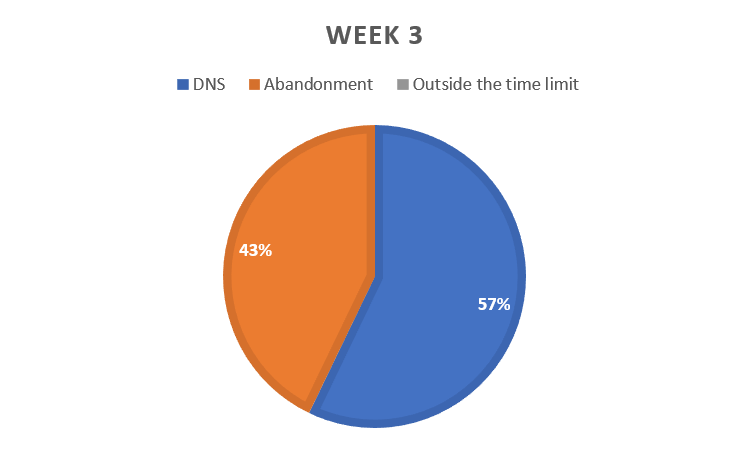
Overall, week 3 withdrawals were pretty evenly split between DNS and mid-stage abandonments. Week-3-withdrawals 
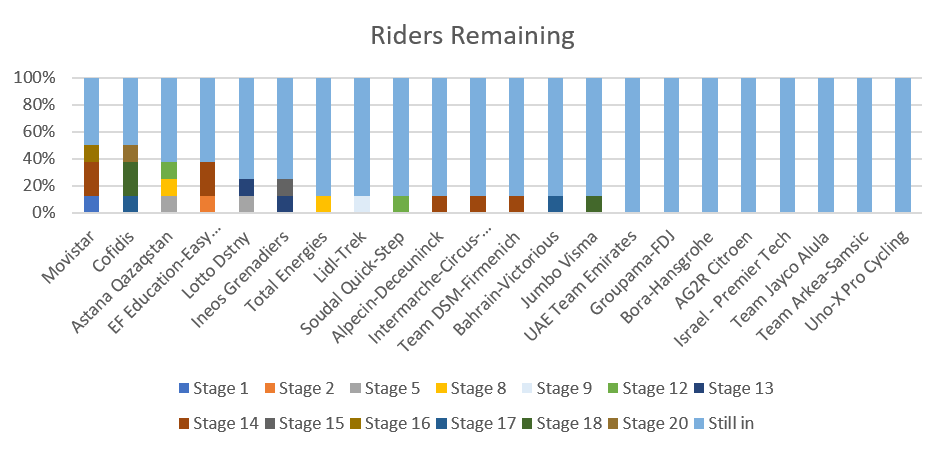
 When did teams lose riders? Riders-Remaining Cofidis and Movistar both lost half of their riders, while UAE, FDJ, Bora-Hansgrohe, AG2R, Israel Premier Tech, Jayco, Arkea and Uno-X didn't lose a single rider. 

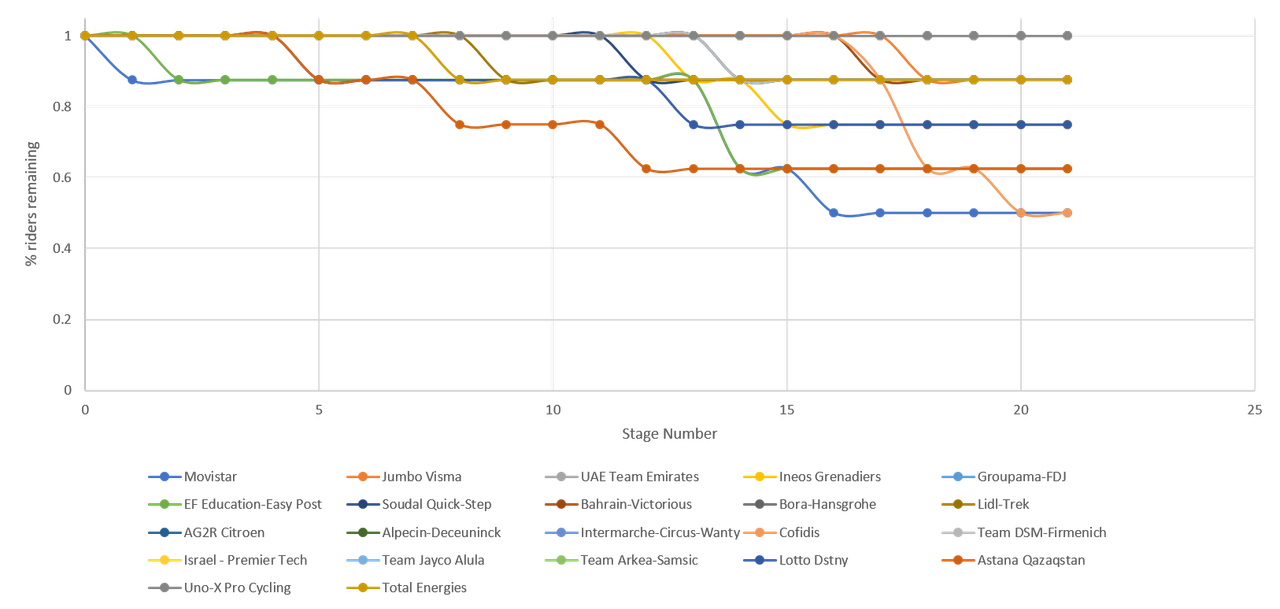
You can actually see stage 14 happening to EF Education and stages 16 and 17 happening to Cofidis in the Kaplan Meier diagram broken down by teams. Kaplan-Meier-by-team EF's green unfortunately covers up the same thing happening to Movistar. 

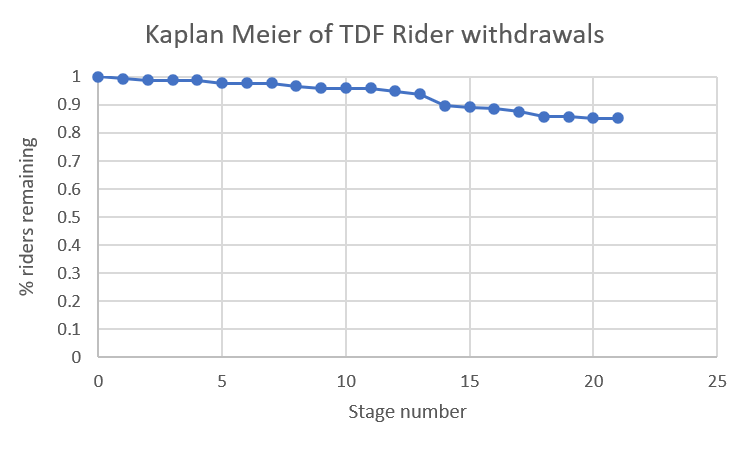
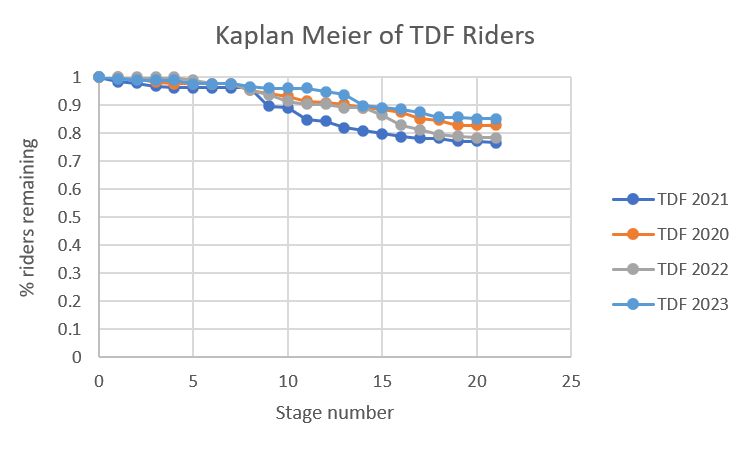
The overall Kaplan Meier diagram of withdrawals looked like this: Kaplan-Meier-overall Comparing the withdrawals to the 2020, 2021 and 2022 Tours de France, it looks like this: Kaplan-Meier-compared-to-other-years 2021 and 2022 have very similar shapes, while 2023 looks more like 2020. 

I briefly had access to PRISM, so I ran the data through that too. 

PRISM version:TDF-2020-2023 That figure made me feel good because my home-brew version looks very similar to it, so I don't think I'm going too wrong with my methodology. 

The main reason I wanted to run it through PRISM is because it provides statistical analysis of Kaplan Meier diagrams. By eye (https://fulltimesportsfan.wordpress.com/2022/05/18/for-guts-or-for-glory-was-the-2021-tour-de-france-attrition-rate-influenced-by-the-upcoming-olympics/) it already looked like the Olympics in 2021 didn't have an effect on the withdrawal rate and PRISM confirmed that view by saying there was no statistical difference in the withdrawals in the different years. 

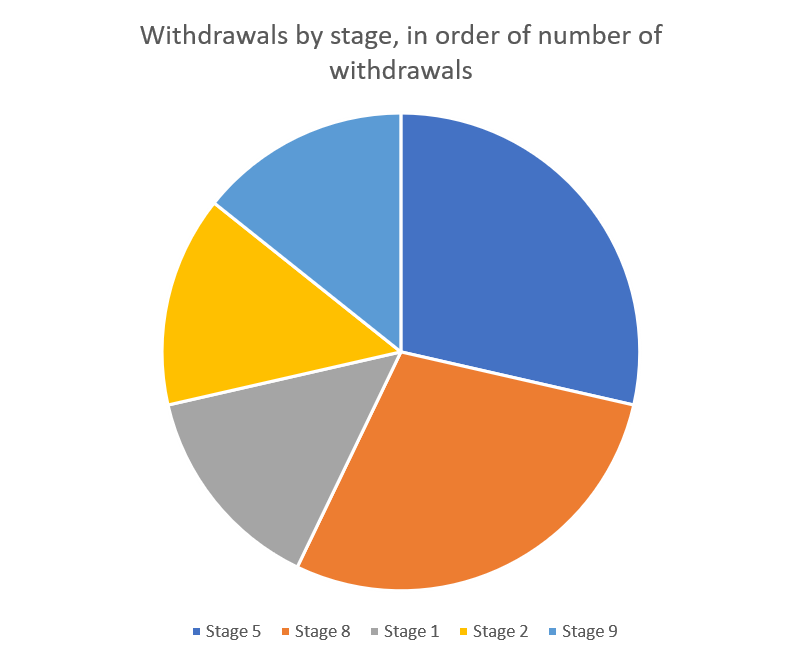
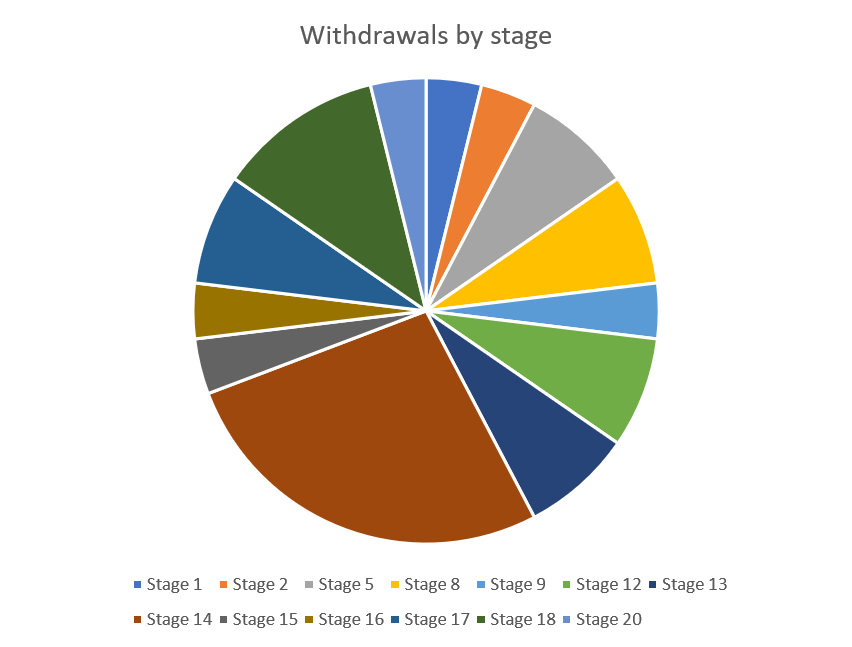
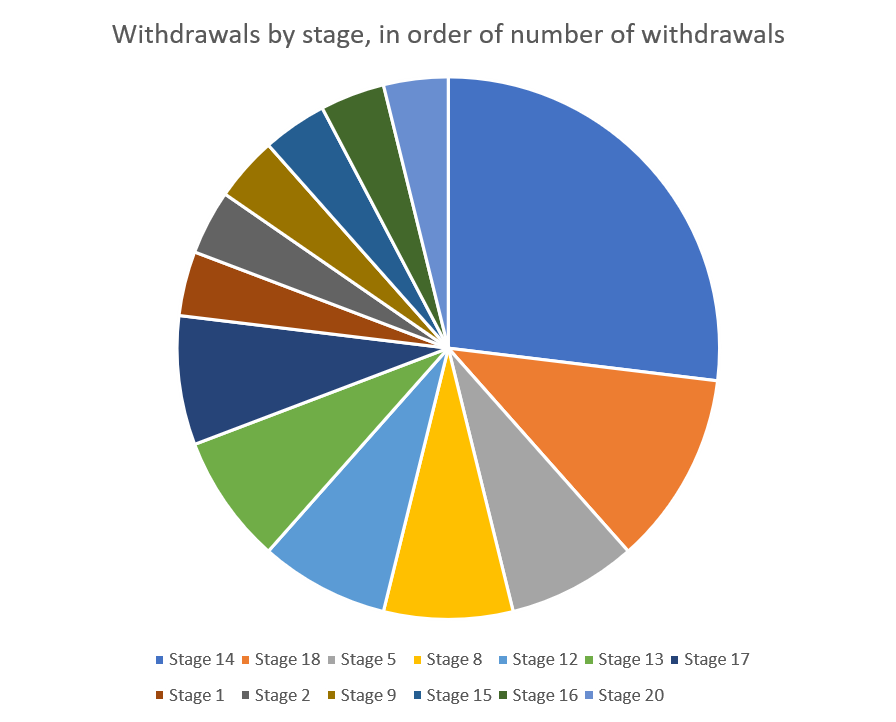
Withdrawals by stage: Withdrawal-by-stage-in-order-of-stage Withdrawal-by-stage-in-order-of-number-of-withdrawals Stage 14 was the stage with the most withdrawals by a long way. To refresh your memory, it was a combination of a slippy road, a turn and ill-fortune that took down a swath of riders (https://www.eurosport.co.uk/cycling/tour-de-france/2023/tour-de-france-neutralised-after-extraordinarily-nasty-moment-on-stage-14-involving-almost-all-teams_vid1951457/video.shtml

The really interesting thing was that there were no over the time limit withdrawals. All-withdrawals 

I don't know if this is because there isn't as big a difference between the top riders and those at the bottom, that the stages were shorter so it reduces the risk, or whether people were seeing sense after accidents and withdrawing there and then, but it's an interesting fact. 

Looking at the abandonments in more detail: 

Week 2 was the worst for withdrawals with almost half of all withdrawals occurring then, with week 1 and 3 being as bad as each other: All-withdrawals-by-week This is because of mid-stage abandonments, because relatively few of the DNS withdrawals were in week 2. DNS-per-week Abandonments-per-week Things I will look out for next year? Whether this "no outside the time limit withdrawals" pattern happens again next year, and whether the curve shape is the same again, next year being another Olympic year. 

Related posts to look forward to this year (or at the start of next year) - the equivalent post for the women's Tour de France 2023.

Thursday, 20 July 2023

2023 Tour de France Withdrawals - Week 2

Every edition of the Tour has that one stage where there's a sudden disaster and lots of people drop out. I've seen it be hard mountain stages, where too many people are over the time limit, but not enough for the broom wagon to be cancelled, I've seen it be hard stages where there's been a bug going through the peloton, I've seen it been rain and crash. 

This year's "that one dratted stage" seems to have been stage 14, where a combo of slippy road, a turn and ill-fortune took down a swath of riders (https://www.eurosport.co.uk/cycling/tour-de-france/2023/tour-de-france-neutralised-after-extraordinarily-nasty-moment-on-stage-14-involving-almost-all-teams_vid1951457/video.shtml) 

[I'm not sure who that Intermarche-Circus-Wanty rider is, probably Adrien Petit, but that's possibly the actual face of "damn it all" made flesh.] 

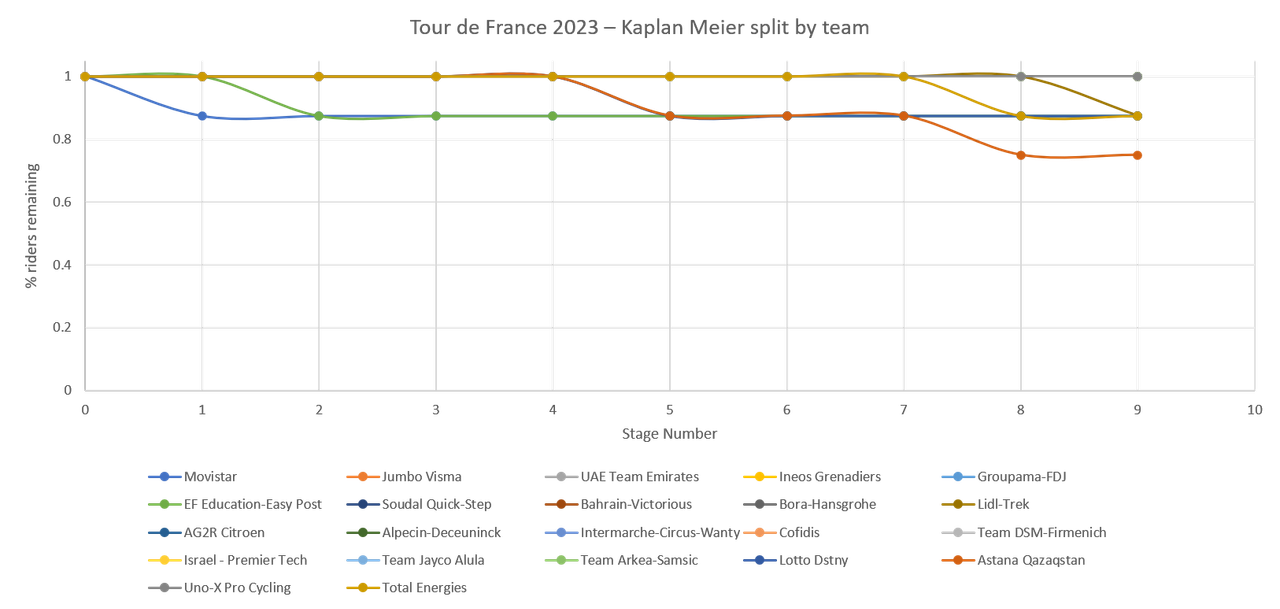
Stage 14 really stands out in the pie chart of withdrawals by stage.  Withdrawals-by-stage-end-of-week-2 And you can see the inflection it causes in the Kaplan Meier diagram  Kaplan-Meier-Week-2 The Kaplan-Meier split out by teams makes it clear that life continues to happen to Astana and EF Education-Easy Post Kaplan-Meier-teams-week-2 

All of last week's withdrawals were either did not start the day following previous crashes (or general wear and tear) or mid-stage abandons due to aforementioned crashes. Type-of-withdrawals-week-2 Interestingly, that means there still hasn't been an over-the-time limit withdrawal. 

In the yellow jersey standings at the start of the third week there was so little in it that people started to talk about 1989. I know people enjoy talking about that edition. 

I've mostly just been enjoying Kwiatkowski and Izagirre winning stages, and desperately trying not to jinx a certain rider who is still in. (If I avoid jinxing him, I will explain who it is) 

The final post in this series will be delayed by a week for reasons, but I hope to add an extra special diagram to make up for the delay.

Monday, 10 July 2023

2023 Tour de France Withdrawals - Week 1

The withdrawals so far in the 2023 Tour de France have come in three groups: 
1 - The crash that lead to Mas and Carapaz's withdrawals - https://www.bbc.co.uk/sport/cycling/66076741 

2 - The crash that wiped out Guarnieri and Luis Leon Sanchez - https://www.cyclingnews.com/news/tour-de-france-crashes-blight-motor-circuit-finale-to-stage-4/ 

3 - Stage 8's two crashes that lead to Cavendish's broken collarbone and Cras's withdrawal - https://www.cyclingnews.com/news/cras-blames-spectator-for-tour-de-france-crash-which-saw-simon-yates-mikel-landa-lose-time/ 

Quinn Simmons is the first "general wear and tear" withdrawal this year (https://www.cyclingnews.com/news/quinn-simmons-abandons-the-tour-de-france-ahead-of-stage-9/). I expect them to start mounting.

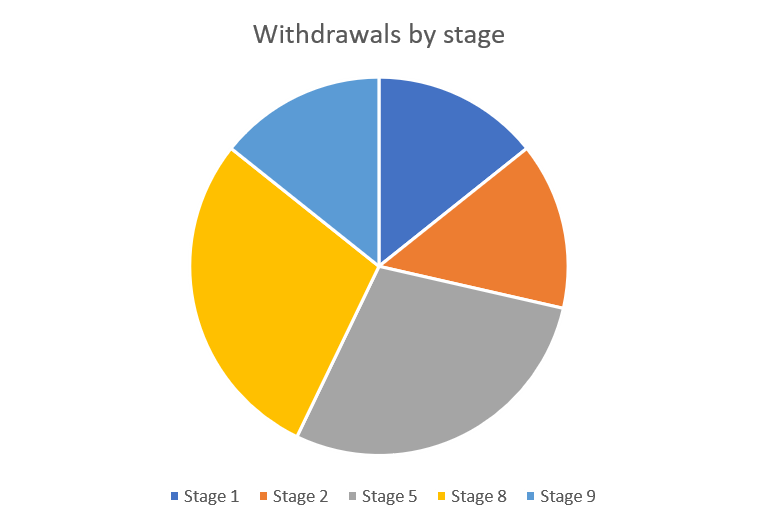
Looking at withdrawals by stage:    Week-1-withdrawals-by-stage Week-1-withdrawals-by-stage-by-number-of-withdrawals 
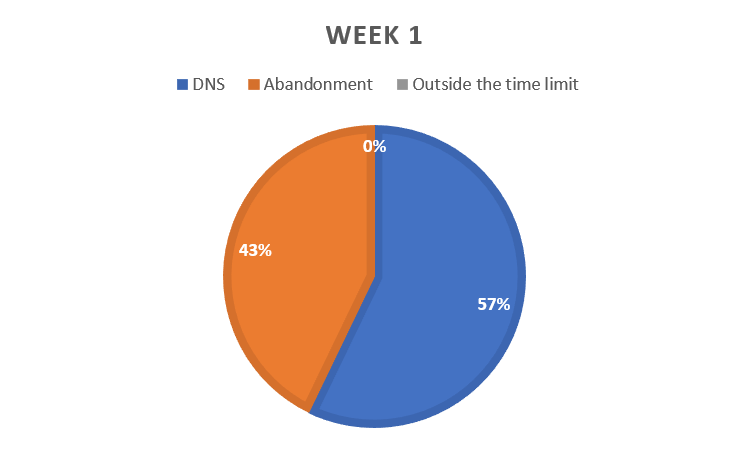
All the withdrawals have been mid-stage abandonments or did not start the next day due to previous crashes, there have been no riders who have missed time limit cut-offs. Week-1-type-of-withdrawal This is despite the first week containing an unexpectedly large amount of climbing and difficult stages compared to usual (https://twitter.com/eltiodeldato/status/1674387305618894848 and https://twitter.com/eltiodeldato/status/1674713858722676736 demonstrate this well). 
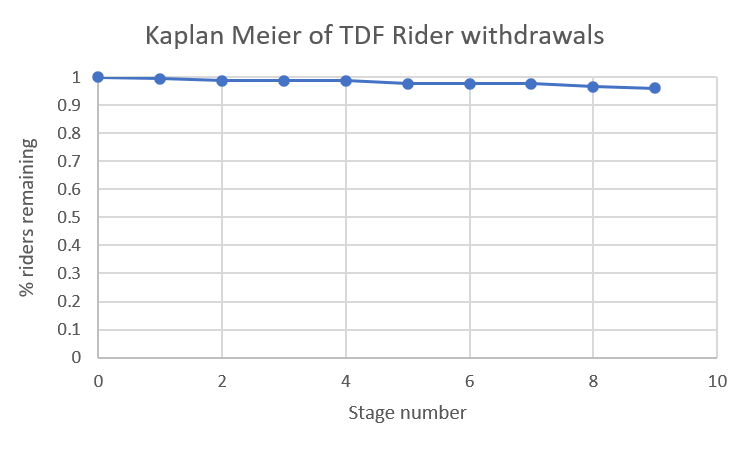
Because there's relatively few withdrawals, the Kaplan Meier chart is pretty flat, although the Kaplan Meier split by teams makes it quite clear that the Tour has happened to Astana. Week-1-Kaplan-Meier Week-1-Kaplan-Meier-by-team 
Talking about Astana, one thing this week has highlighted is the paucity of cycling knowledge in the people writing about road cycling in the big media sources. 

The UK press coverage, in non-specialist outlets, entirely understandably, was all about Mark Cavendish. 

Cue, when Leon Sanchez had to withdraw, many inches of print about how this was terrible for Cav's sprint train. 

... 

... 

Yeah, that Luis Leon Sanchez. 
As a vital component of a sprint train. 
... 

Dear general sports journalists who cover cycling once a year, either stick to the facts or if you want to add opinion, throw some money at the excellent cycling journalists available and get them to write you something. Because really, sometimes, what you write, makes you sound like morons. 

Now, I know a sensible team, if they had a sprinter who could break one of "the records" but needed a sprint train, would put together a sprint train, and dedicate the team to that. But it's Astana, and who *ever* accused Astana of being sensible*. Of course they've frankensteined a team together to try to go for sprint victories and have a GC contender, plus Lutsenko for climbing stage wins. 

I can't help but feel I am a jinx on Cavendish because news of the crash happened just as I opened my phone to check how the Tour was doing on Saturday. 

L is putting it down to a Belgian conspiracy, but he's had more than one twelve-hour shift this week, so we will forgive him melodramatic conspiracy theories. 

I love that Vinokourov has immediately gone with "if Cavendish wants to stay, we will have him" (https://www.bbc.co.uk/sport/cycling/66147017). Because he knows how that feels and because he has style**. 

All this, and I've not said anything about Pogacar vs Vingegaard, which is bubbling along nicely. 

In the grand tradition of "you can't win a Grand Tour in the first week, but you can lose it", neither of them have lost it, and it could get very interesting in the next two weeks. 

* Said with love, affection and exasperation. Astana have been my team since they were created, because wither Vinokourov goes, so do I. 

** He lies, cheats and connives, but he does it with style.