Thursday, 24 September 2026

Are the scrutineers picking on my driver? - Update after the Italian Grand Prix

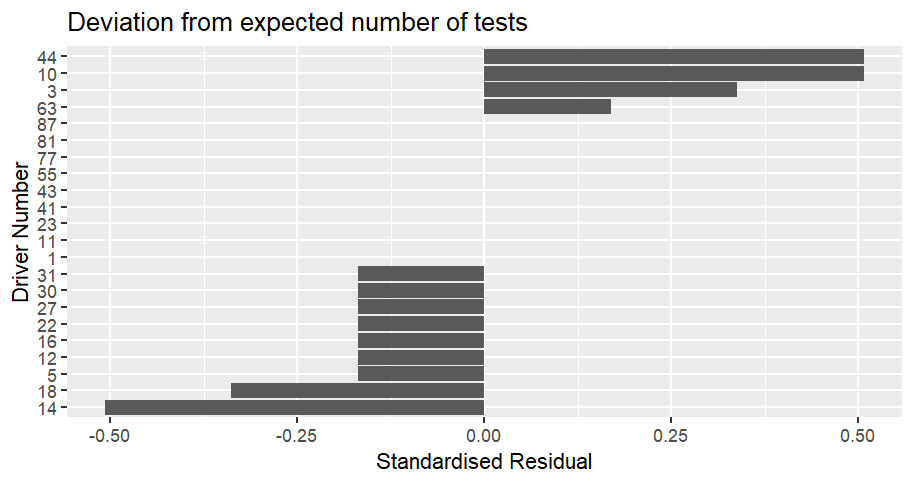
The scrutineering data for the Italian Grand Prix is straightforward. Bar chart showing how often cars were scrutinized compared to the expected number at the Italian Grand Prix.  The values are displayed as a standardised residual.  Car 10 (Gasly) and 44 (Hamilton) were the most over-scrutinized compared to expected, with a value of 0.51, followed by car 3 (Verstappen) with a value of 0.36 and 63 (Russell) with a value of 0.17.  Car 14 (Alonso) the most under-scrutinized compared to expected with a value of -0.51, followed by car 18 (Stroll) with a value of -0.34, then there are 7 cars on -0.169.  8 cars were tested exactly as much as expected. Somehow, despite being the first car out, Leclerc isn't the least tested. 

The χ² for the race is 1.38, so any differences aren't statistically significant. 

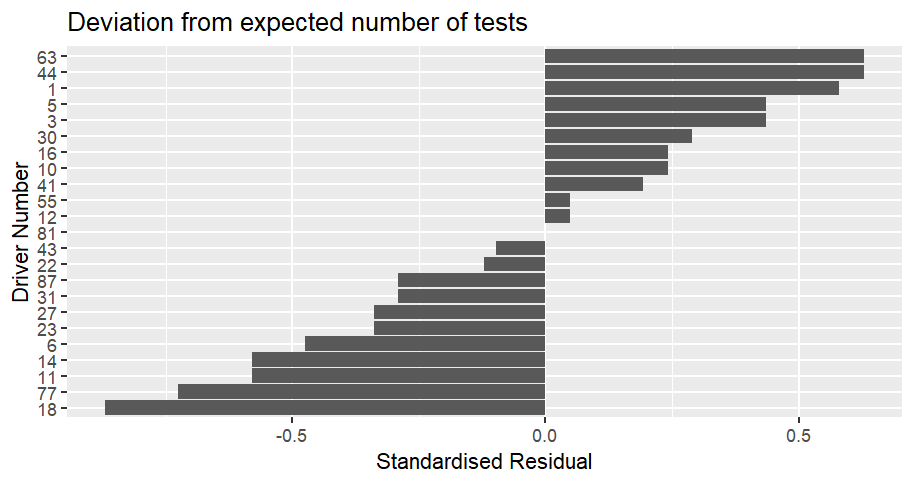
For the season to date, it looks like this: Bar chart showing how often cars were scrutinized compared to the expected number up to the Italian Grand Prix.  The values are displayed as a standardised residual.  Cars 44 (Hamilton) and 63 (Russell) were the most over-scrutinized compared to expected, with a value of 0.63, followed by car 1 (Norris) with a value of 0.58.  Car 18 (Stroll) was the most under-scrutinized compared to expected with a value of -0.87, followed by car 77 (Bottas) with a value of -0.73, then car 14 (Alonso) and car 11 (Perez) on -0.58.  Only car 81 (Piastri) has been tested exactly as much as expected. 

The "tested less than expected" cars are definitely further from expected than the "over-tested" cars. I think that's because the Aston Martin and Cadillac teams have remained what we will politely call "not good", while the rest of the teams have come closer together in terms of results. 

The χ² for the season up to the end of the Italian Grand Prix is 4.32 so any differences aren't statistically significant, but the number is still increasing.

Wednesday, 16 September 2026

Formula 1 2026 - Spanish Grand Prix

The Madrid Circuit: Of course, if Barcelona has one, Madrid has to have one. Grand Prix in Spain are getting almost as plentiful as they are in the MotoGP.

But the race it reminded me of was Valencia (thanks to L, different L to usual, for helping me twig that it was Valencia I couldn't remember). And the reason it reminded me of Valencia was because Madrid was yet another street circuit where nothing happens.

(So little happened at Valencia that someone literally had to remind me those Grand Prix existed)

I think we just have to be honest about street circuits. If a circuit doesn't have a fair few spots where two and a half cars can get through there will be no overtaking. Circuits that are designed around normal roads will not have that. So if it's a street circuit, there will be no overtaking.

So stop adding more street circuits to the calendar!!!!

Ahem!

I was also amused and slightly charmed by how confused Ted Kravitz was by the existence of mega-sized conference centres like the one in Madrid. Possibly because some of my colleagues have actually been to the one in Madrid and I spend probably too much time in them with work.

The race itself:

The start was exciting, with me going "eep!", "oop!" and similar noises. Then it settled down. The track being that tight meant that any time anyone went for anything, that was the noise I made. But it also meant that almost no one went for anything because disaster was too close.

For once I can't really complain about Ferrari's strategy because they made the most of an opportunity. That curses and pins and voodoo dolls didn't cause another red flag or safety car wasn't their fault. Neither could McLaren be faulted for the unfortunate timing of the virtual safety car with regard to Norris. Mercedes's strategy for Russell was their own fault.

Sainz jnr was heavily hit by the home-town race curse.

It was a bit of a nothing race overall, but what else is expected from a street circuit?

Wednesday, 9 September 2026

Formula 1 2026 - Italian Grand Prix

I would like to pretend I had something more reasonable to say but ... I hate being a Ferrari fan. Why are they always like this?

I don't, in any way, blame either driver for the first corner - that's racing. I blame the team for not coming up with a working strategy for the one remaining car.

The racing was fun while it lasted, but I trust this has finally ended any belief George Russell has that there is driver equality at Mercedes.

Friday, 4 September 2026

Are the scrutineers picking on my driver? - Update after the Dutch Grand Prix

For the purposes of this series, the main thing for the Dutch GP was Hadjar missing it due to injury. Lawson moved up to Red Bull, and Tsunoda was temporarily back in whatever Toro Rosso are called this year (I think it's Racing Bulls, I can't keep up with the constant name changes). 

I didn't think it would affect the actual race data, because hey, that was still just 22 drivers. 

Dutch GP race data itself: Bar chart showing how often cars were scrutinized compared to the expected number at the Dutch Grand Prix.  The values are displayed as a standardised residual.  Car 63 (Russell) was the most over-scrutinized compared to expected, with a value of 0.70, followed by cars 27 (Hulkenberg) and 41 (Lindblad) with a value of 0.35.  Cars 18 (Stroll), 31 (Ocon), 77 (Bottas) and 87 (Bearman) are the most under-scrutinized compared to expected with a value of -0.35.  8 cars were tested exactly as much as expected. Russell was the most scrutinized compared to expected, followed by Hulkenberg and Lindblad, with Stroll, Ocon, Bottas and Bearman the least scrutinized. 
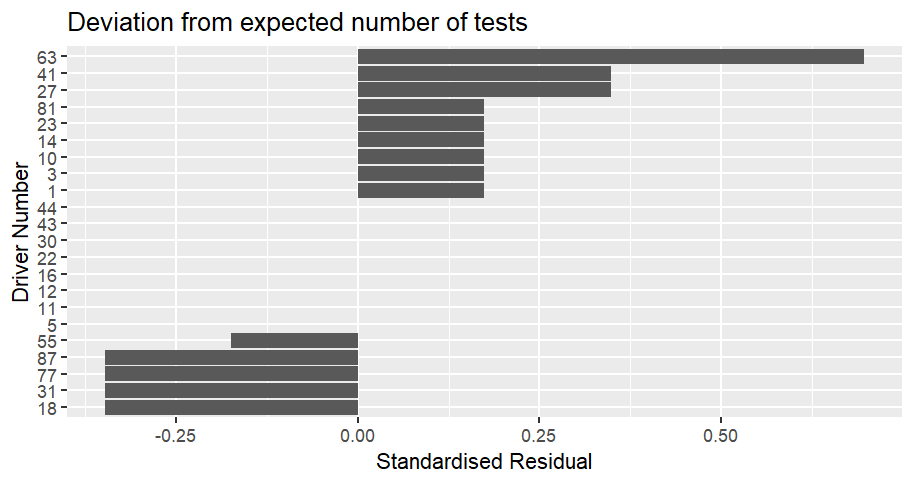
What I don't understand is why Verstappen isn't on the under-scrutinized list given he was out before the end of the first lap, before Bearman who is on that list. 

Most peculiar. 

Any differences weren't statistically significant, with a χ² of 1.38. 

The thing I thought the Hadjar swap out-Tsunoda swap in would affect was the season-to-date ranking. But what I forgot was that, because it's observed vs expected, Tsunoda will still get a value for the one (or more depending on Hadjar's wrist) grand prix he participated in. 

The thing it changes is the χ² critical value, because Tsunoda's appearance increases the degrees of freedom in the data from 21 to 22. The critical χ² value goes up from 32.671 to 33.924. 

The season to date chart looks like this: Bar chart showing how often cars were scrutinized compared to the expected number for the season to date up to the Dutch Grand Prix.  The values are displayed as a standardised residual.  Cars 1 (Norris) and 63 (Russell) are the most over-scrutinized compared to expected, with a value of 0.61, followed by cars 5 (Bortoleto) and 44 (Hamilton) with a value of 0.50, followed by cars 3 (Verstappen) and 30 (Lawson) with a value of 0.35.  Car 18 is the most under-scrutinized compared to expected with a value of -0.81, followed by car 77 (Bottas) on -0.76 and car 11 (Perez) on -0.61.  2 cars were tested exactly as much as expected, 22 (Tsunoda) and 81 (Piastri). 
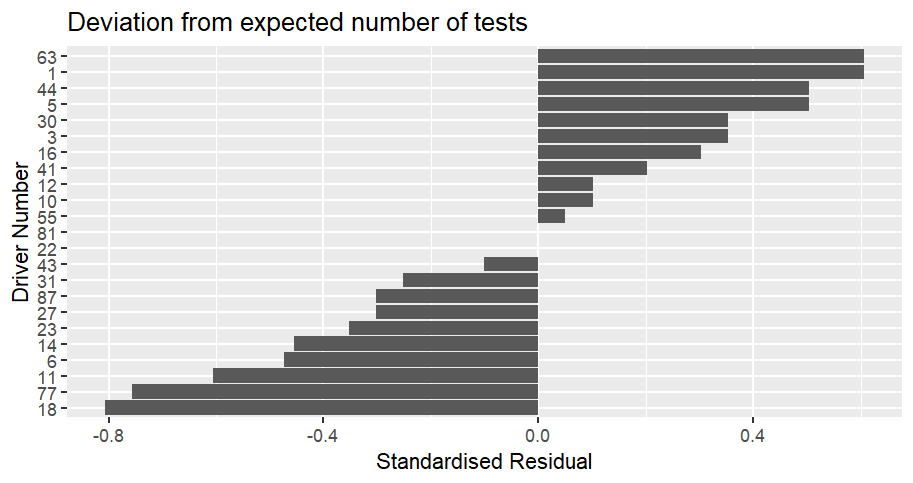
At the top, Bortoleto still stands out as not being like the other cars up there. 

At the bottom, it's still the cars that don't finish a lot, with Stroll and the two Cadillacs down there. 

Tsunoda's car has been tested exactly as much as expected after 1 race, and so has Piastri's after 12 races. 

The χ² value continues to go up, it's now 4.03, still nowhere near significant but rising. I think the cars being tested less than expected are the stronger contributors because their standardised residuals have larger values. 

We also didn't have a random check of a top 10 finisher, so the evidence is really piling up that that is a truly random check that only occurs sometimes and the early-season pattern was just a quirk of the numbers.