Friday, 23 October 2026

Formula 1 2026 - Singapore Grand Prix

I try and post these in a timely fashion (editorial comment: too late) but it's really hard to do that when there's so much else going on with the Rugby League World Cup, especially when the race I need to write up is a particularly boring Singapore Grand Prix. 

Possibly the most interesting thing about it was the ridiculous lengths Bottas went to just to get there - cycling from Kuala Lumpur to Singapore 

We also had a rehash of Ferrari's strategic nonsense. By lap 12, Ferrari were up to plan C. Truly, I love my team. I also find it amusing that people kick Ferrari when they use team orders and when they don't. They can't win (in the philosophical as well as sporting sense). 

If McLaren could do pitstops, they'd be dangerous. 

The radio issues meaning GP had to resort to "knock once for yes, twice for no" to communicate with Max Verstappen. That might be one way to spice up the racing, make them do it without radio. 

He is a sarcastic Toto! Although seriously, I don't even want to imagine how many times this season Antonelli has had track limit warnings. 

I am hopeful that the US Grand Prix will be more interesting.

Wednesday, 21 October 2026

Rugby League World Cup 2026 - A small data visualisation project about the England Men's team

England Match 1: 
Because of poor decisions by International Rugby League I couldn't watch the match anywhere so was listening to it on the radio. Truly, Robbie Hunter-Paul is an international treasure. 

Not entirely sure why the English press were saying it was a shock, other than them never giving Tonga the credit they are due. If they'd said the first Tongan try was a shock, that would be true, it was against the run of play but after that it was a lot more even. 

I'm a Saints fan, spiritually, I prefer what McDermott was trying to get this England team to do rather than the kind of rugby Shaun Wane had them playing. 

On the other hand, Wane looked at the players he had and played them in a system that worked to their strengths. If you're going for quick and clever, why are you not playing Mikey Lewis (never mind Jake Connor who didn't even get picked)? George Williams and Harry Smith have their uses, but quick and clever isn't it. 

I don't blame McDermott for some of the errors because the England players appeared to develop poor decision making skills every time they got into the Tongan 20 meters, but there was some oomph lacking. I don't know if McDermott's made that choice because he doesn't think this front row can bring the biff, and they're big units but they don't scare me the way say Burgesses plural, or Elliott Whitehead or James Graham did. (Challenge, go a whole thing without mentioning Jamie Graham, glorious failure). So fine, you aren't doing wham bam rugby, you're running the ball instead, but then you have to involve the wingers, especially if one of them is Dom Young. And that seemed to be missing. 

So England now have to rely on beating France and Lebanon and hoping the other results go their way. I'm going to be really upset about either England or PNG not making it, I fear. 

Data visualisation project: 

Much like the last World Cup, I'm doing a small data visualisation project to see if I can spot patterns in player selections and how the team performs. 

One game doesn't give much data, but here is what I have so far. 

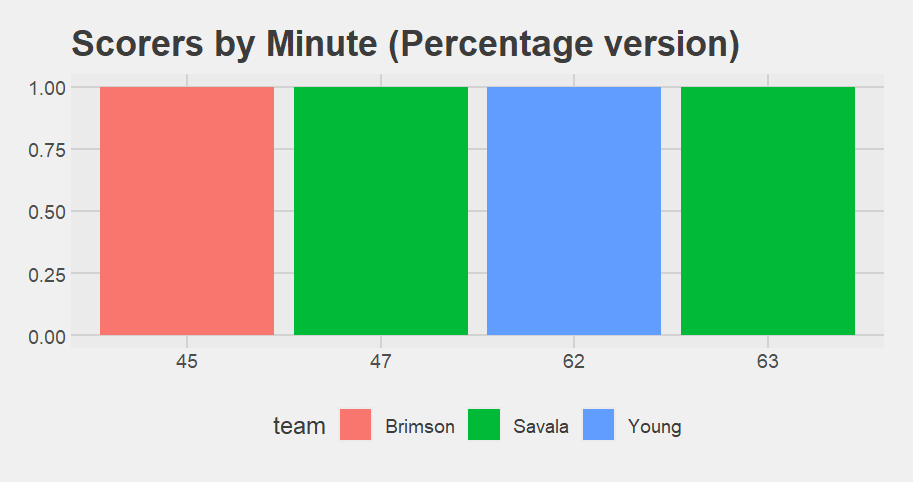
England's point-scorers by name and time Bar chart of who scores for England and when.  There are 4 point scoring moments, at 45, 47, 62 and 63 minutes.  The bars at 47 and 63 are coloured green and indicate the conversions scored by Savala. Very little there other than Savala is the chosen kicker. 
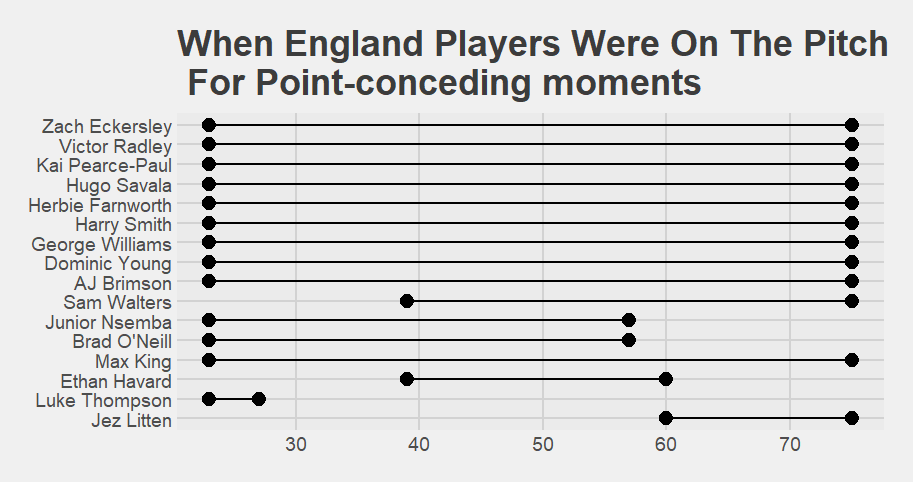
Because there were only two tries for England, the chart of which players are on the pitch when England score is uninformative. The one for "who is on the pitch when England concede" looks like this. Line chart showing which England players were on the pitch when they conceded.  The lines do not overlap for the players substituted on and off which is why there are some gaps. You can see Thompson and Havard coming on and off, and Jez Litten being given the last 20 minutes. 
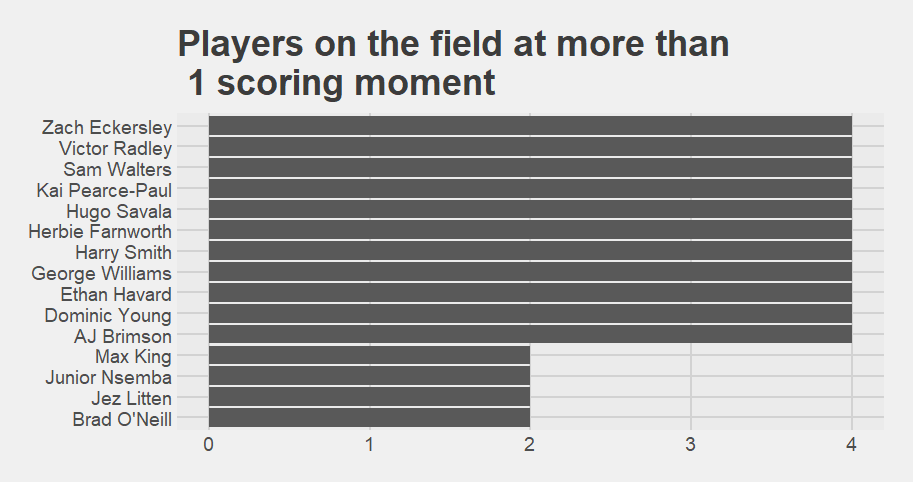
The two equivalent bar charts for which players were present for point-scoring and point-conceding moments are below. Bar chart for players on the pitch when England scored in game 1.  Eckersley, Radley, Walters, Pearce-Paul, Savala, Farnworth, Smith, Williams, Havard, Young and Brimson were present for all 4, King, Nsemba, Litten and ONeill (sorry still cannot do html with apostrophes) were present for 2. You can see who were rolled on as subs, King, Nsemba, Litten and O'Neill. According to nrl.com King and Nsemba swapped on for each other, and obviously Litten and O'Neill are a straight swap. 
The bar chart of who was on for point-concessions is more interesting. Bar chart for players on the pitch when England conceded in game 1.  Eckersley, Radley, Pearce-Paul, Savala, Farnworth, Smith, Williams, Young and Brimson were present for all 11, Walters, Nsemba and ONeill (sorry still cannot do html with apostrophes) were present for 8, King and Havard for 6, Thompson and Litten for 3 and Ben Currie for 1. 
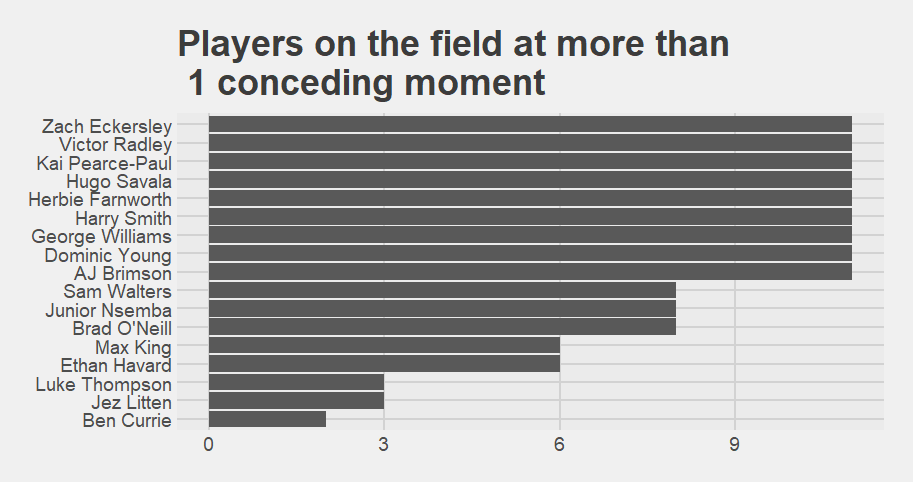
The larger number of events reflects both the result and the number of 2-point penalties Tonga scored. In the chart you can see the backs who didn't get subbed off, and the forwards who were. 

The two matrix charts of who was together when England scored and conceded are below. There's not yet enough data for the equivalent network graphs. Matrix of which players were together when England scored.  Because England only had 4 point-scoring moments so the chart is simple, with the players who were together for all 4 points in purple and the ones present for fewer (2) in orange.  The one exception is Max King who is in very pale yellow where he crosses over with Nsemba and ONeill suggesting they didn't play together as often. Because England only had 4 point-scoring moments so the chart is simple, with the players who were together for all 4 points in purple and the ones present for fewer in orange. The one exception is Max King, who is in very pale yellow where he crosses over with Nsemba and O'Neill, suggesting they didn't play together as often when England scored. It makes sense for Nsemba because he was subbed on for him, and O'Neill got subbed off for Litten at around the same time.
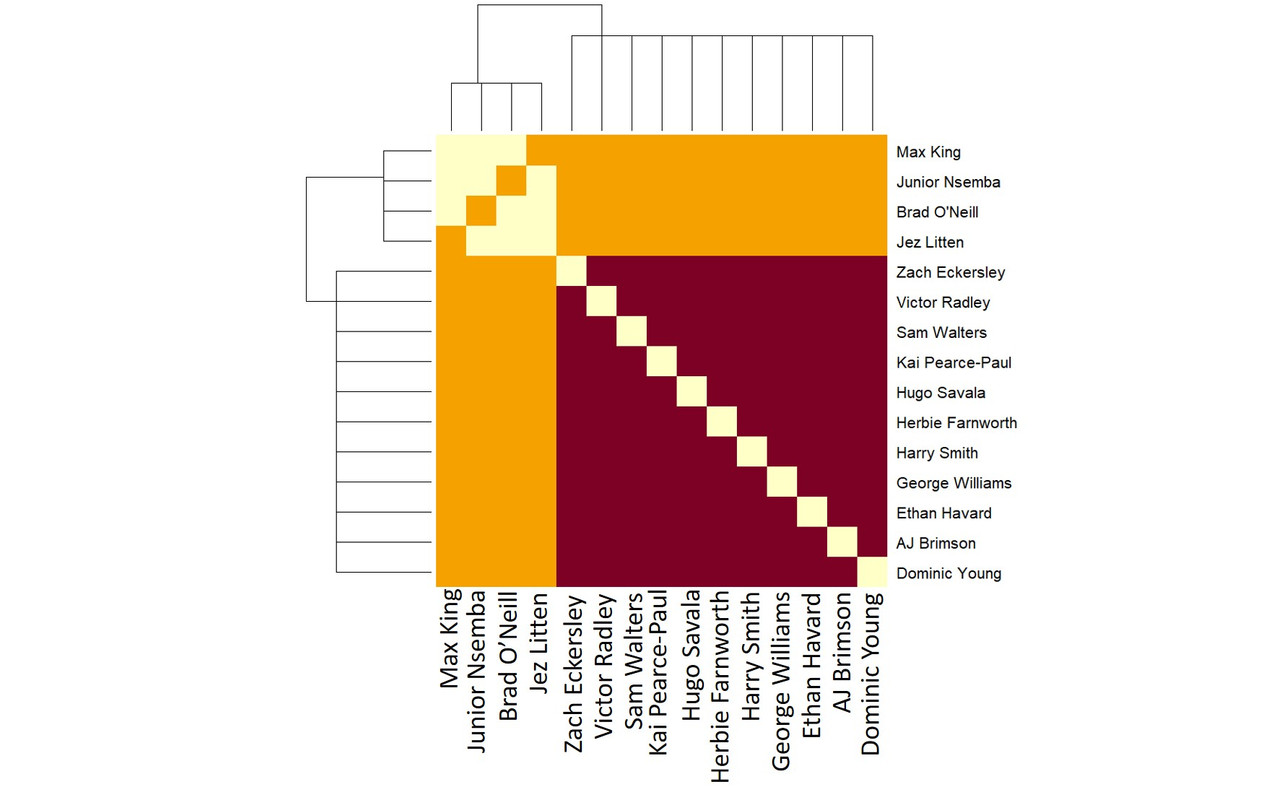
Then there's the chart for when England conceded:Matrix of which players were together when England conceded.  This is a more complicated chart.  Of interest is that you have the darkest, most often together, section, then a lighter orange section, followed by the second darkest section of a deeper orange.  This suggests that those players (ONeill, Walters, Nsemba) are together often when England concede but are subbed off so are not there with the main purple section. Then you have the paler less often on the pitch when England concede group.  Ben Currie has the palest average line because he only came on at minute 68. There's a distinct split between the dark purple, the players most often together when England concede, section, and the second darkest (the darker orange). The latter includes O'Neill, Walters and Nsemba, who were substituted on and off rather than remaining with the main group throughout. Ben Currie has the palest line because he only came on at minute 68. 
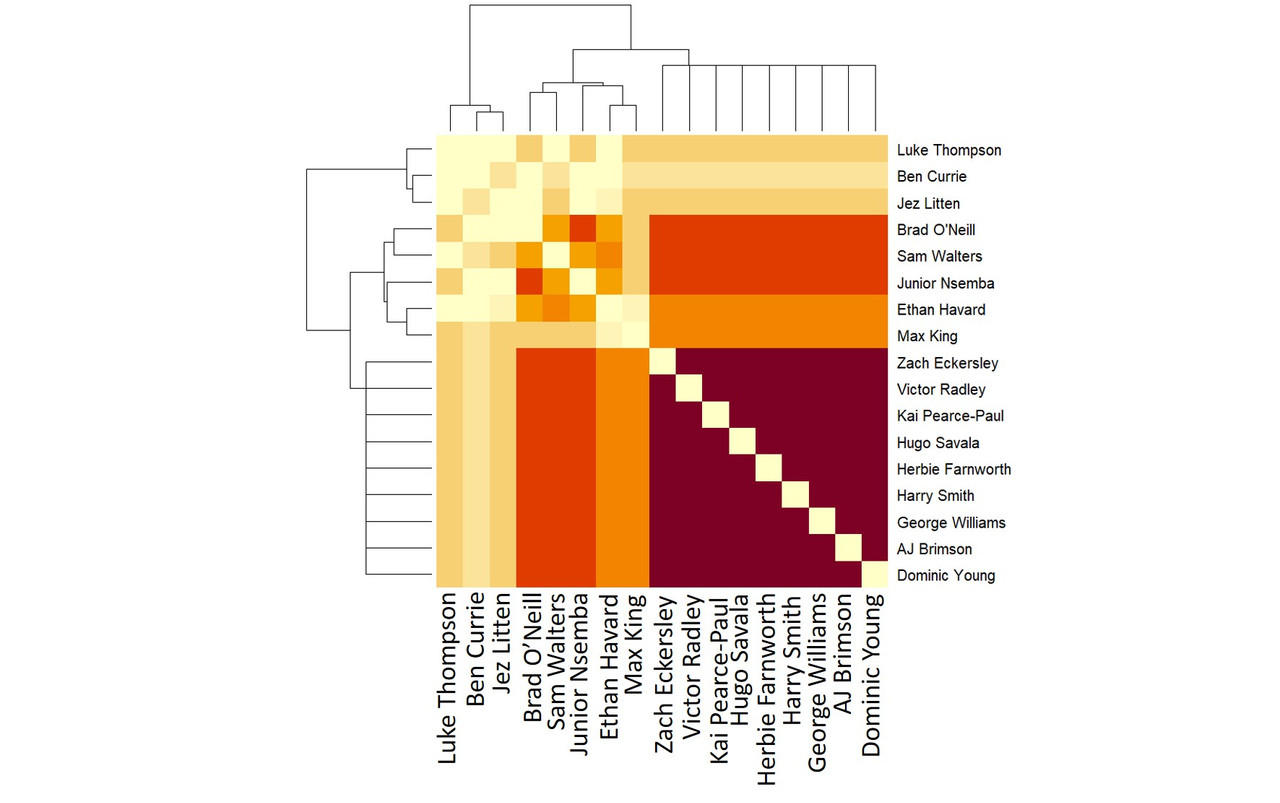
Harvard and Walters were the players present for relatively fewer point-conceding moments, being in the darkest purple section for scoring but not for conceding (yes, I know I'm being nice about Wigan players. Yes, it feels wrong). 

It'll be interesting to see what patterns develop over time.

Sunday, 18 October 2026

Rugby League World Cup 2026 - Women's Group Stage Network Diagrams

Here are the network diagrams for the group stages for the Women's Rugby League World Cup 2026. 

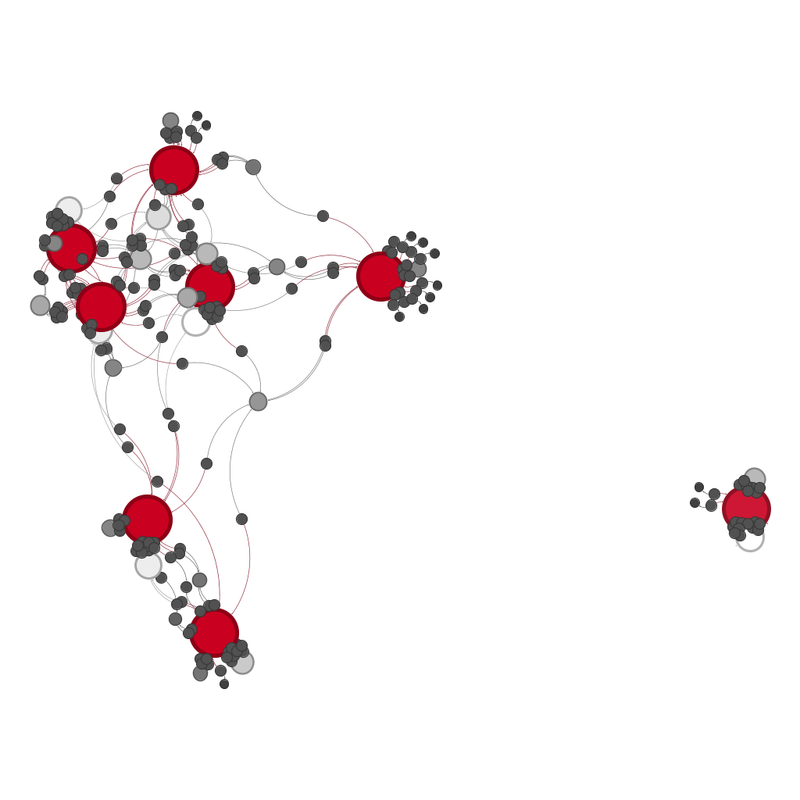
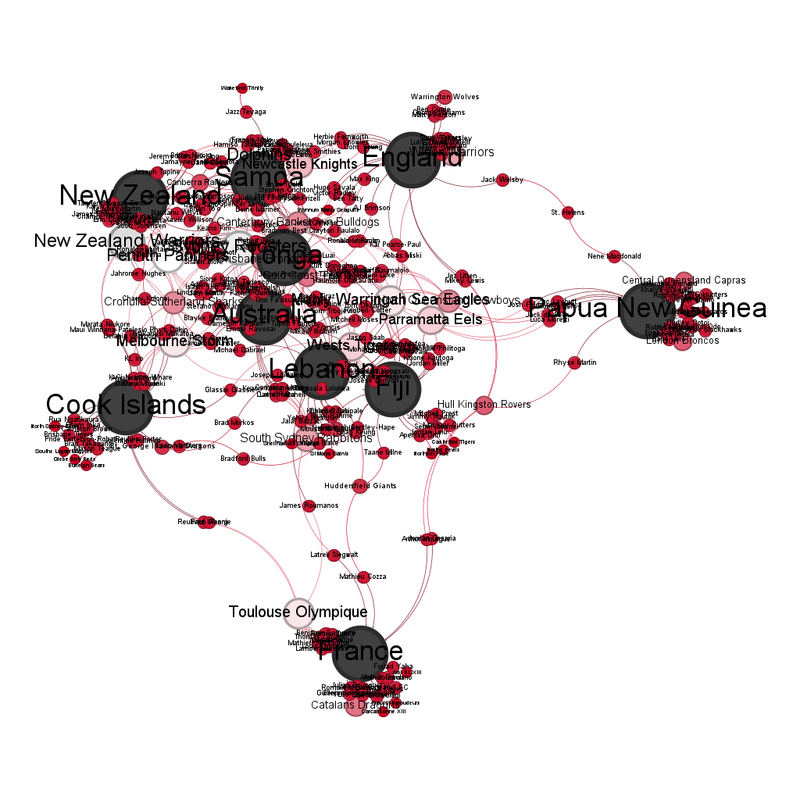
First, let's look at the non-labelled version of the diagram. Network graph of the links between the teams at the 2026 World Cup.  The larger redder circles are the ones with the most links.  The national teams are in red.  Of the eight teams, one is completely isolated on the right and has no links to the other 7 teams.  Of the remaining teams, two are in the bottom of the graph, and the remaining 5 are clustered together at the top. 
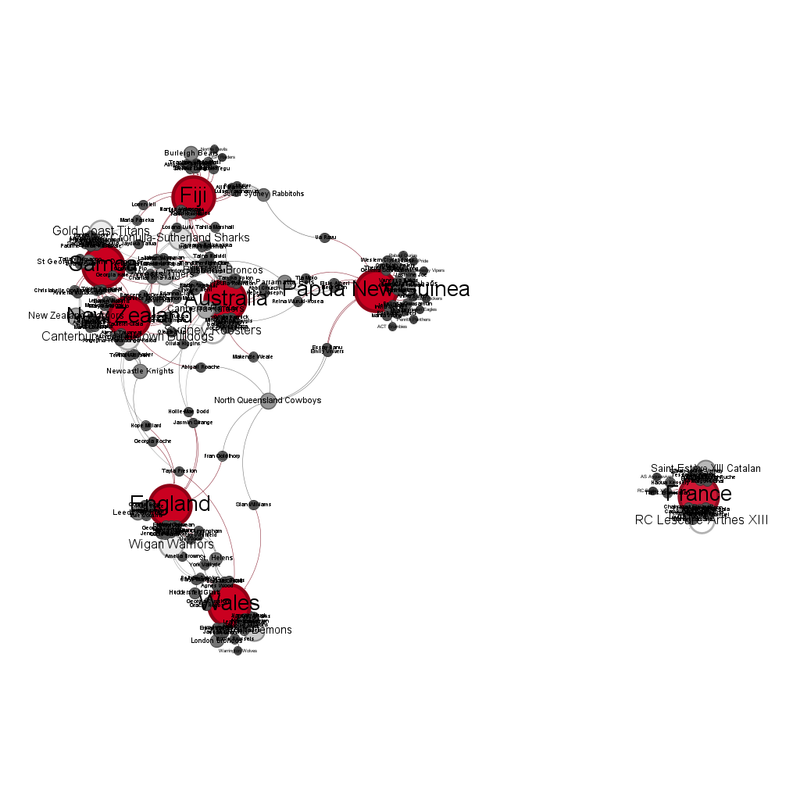
Which teams are which? Network graph of the links between the teams at the 2026 World Cup.  The larger redder  circles are the ones with the most links.  The national teams are in red.  Of the eight teams, one is completely isolated on the right, France, and has no links to the other 7 teams.  Of the remaining teams, two are in the bottom of the graph (Wales and England), and the remaining 5 are clustered together at the top. France are completely on their own which doesn't bode well for them. 

The other two teams sticking out at the bottom are England and Wales, which also doesn't bode brilliantly. 

Of that top cluster of 5 teams, Fiji, Samoa, New Zealand, Australia and Papua New Guinea, Papua New Guinea are the team sticking out slightly to the right. 

The other thing I've noticed is that while, in the equivalent men's diagram there is a mixture of club teams that the players are from, in the women's most of the national teams have one club team that most players are from (Papua New Guinea are the only team where that's not really the case). 

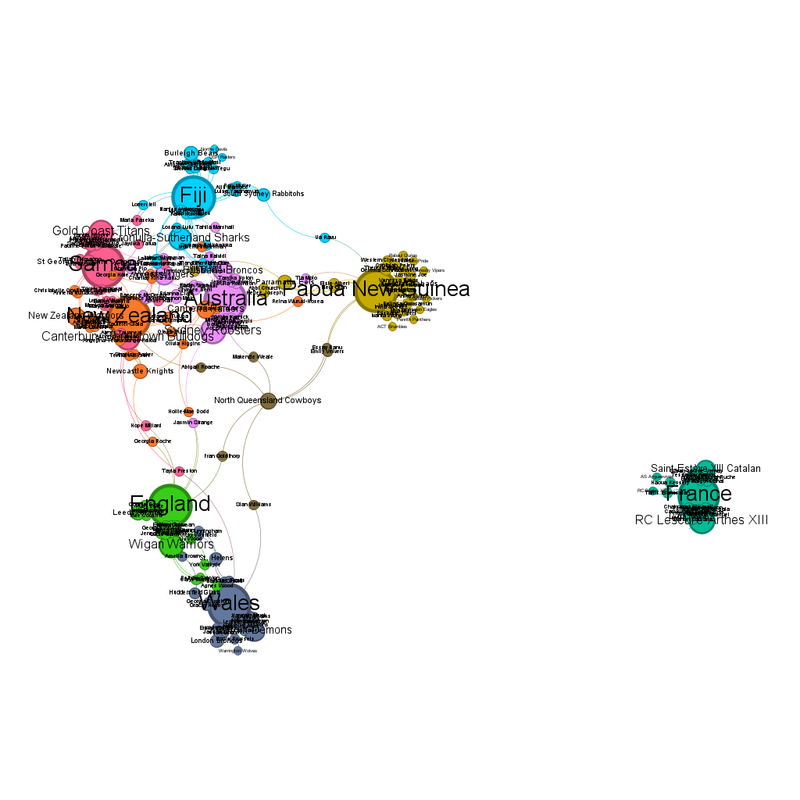
The community view also does something fun. Community view of the above diagrams.  Normally, community views have fewer groups than the number of teams.  This one has an extra one, North Queensland Cowboys. 
Normally, there's the same number of communities in this view as national teams, or maybe fewer when the teams are deeply enmeshed due to links through club teams. This time, the North Queensland Cowboys are an extra community, I think because they link 5 of the national teams. 

Because of France being separate, it's really hard to identify the central team, particularly the central national team because of the way they are clustered. Central club team is probably Sydney Roosters. 

The Roosters are also the club team with the most representatives, alongside RC Lescure-Arthes XIII, with 12. They are followed by Gold Coast Titans, Wigan Warriors and Canterbury-Bankstown Bulldogs on 11, and Cronulla-Sutherland Sharks on 10.

Wednesday, 14 October 2026

Rugby League World Cup 2026 - Men's Group Stage Network Diagrams

If you would like a nice, in-depth and reasonable preview of the World Cup, may I recommend this from the Maroon Observer. 

Here I am all about pretty pictures and bemoaning there only being 2 Saints players at the World Cup and one of those spent most of the season injured. 

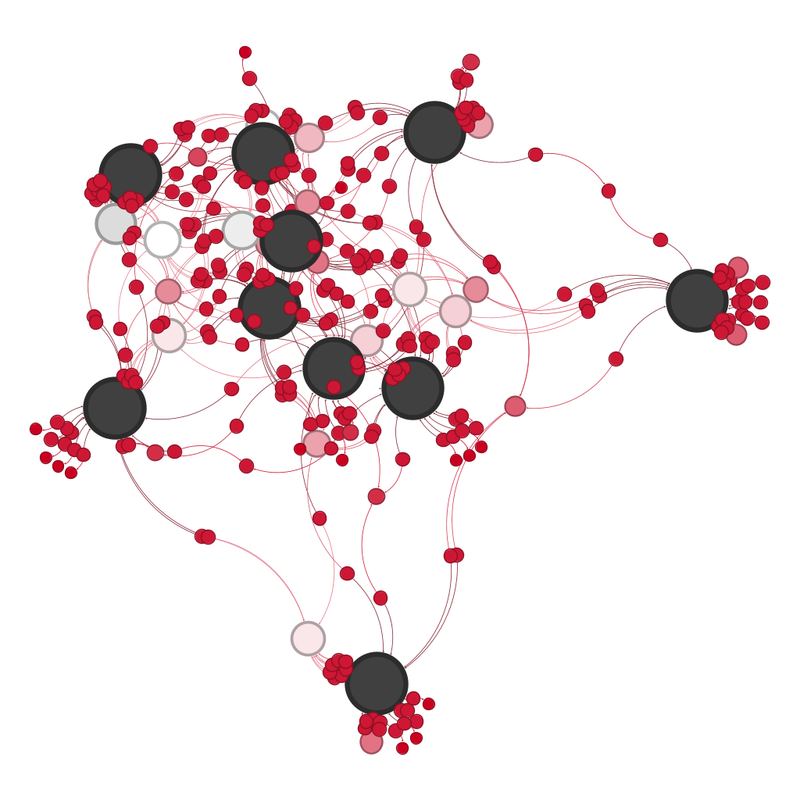
What do the network diagrams look like? Network graph of the links between the teams at the 2026 World Cup.  The larger darker  circles are the ones with the most links.  The national teams are in dark grey.  Two of them stick out.  They will be identified in the next image.  The remaining eight are pretty much in a square in the top left hand corner. The labelled diagram.  The two teams that stick out are Papua New Guinea top right and France at the bottom centre. 

The two teams that are sticking out are Papua New Guinea and France. Teams stick out if their players play for clubs who don't have a lot of other participants playing for other national teams. If the previous pattern that sticking out = weaker remains true, this means Tonga have been stuffed over by the draw and have a harder route to qualify for the semifinals. They would need to beat one of Samoa or England to qualify, while England and Samoa only have to beat Papua New Guinea and France. No diss on Papua New Guinea intended, because I really want them to do well. 

I think Papua New Guinea are pulled out because so many of their players play for London Broncos who don't have any other representatives while the Cook Islands players are spread over more club teams so the weight of any individual team doesn't pull them out in the same way. 

The club team with the most representatives are the New Zealand Warriors and the Sydney Roosters who both have 13. They are followed by the mysteriously un-city-ied Dolphins and Penrith Panthers on 12, and Manly Warringah Sea Eagles, Melbourne Storm and Toulouse Olympique on 11. 

Because 8 of the teams are clustered together, Fiji are the team in the geometric centre of the graph, while Tonga and Australia are probably the "gravitational" centre. 

Hull Kingston Rovers and South Sydney Rabbitohs are the club teams closest to the physical centre. 

The other thing that strikes me is a suspicion that the NRL must be relatively evenly matched because the Australian squad aren't dominated by one club team, unlike the way say France are by Toulouse Olympique. (Until the first match, I promise not to comment on the excessive number of Wigan players in the England squad. Brian McDermott, you'd better have a good reason for not starting Jez Litten.) 

The one upside to there only being ten teams is that it's relatively quick to make the diagrams so I hope to have the women's and, data permitting, the wheelchair teams graphs ready shortly.

Monday, 12 October 2026

Formula 1 2026 - The Bahrain Grand Prix in Malaysia

Because F1 2026 makes very little sense. (Although I love that we're back at Sepang. It may be the only track I like because of how pretty the grandstands are.)

Due to the delay between the formation lap nonsense and the actual start, the BBC only have from the second start onwards on BBC Sounds so I have had to resort to watching the Channel 4 highlight show. (I prefer the radio coverage, whole post on why coming soon.)

You know it's going to be one of *those* races when people go off on the formation lap. I frequently make jokes about having seen x, y or z before but I have never seen half the field prevented from functioning by computer failure before. "Starting procedure suspended," indeed.

And then people off in formation lap 2.

I did enjoy the BBC commentators chortling over the work the FIA had to do to ignore its own rules.

Bloody heck at Piastri nearly hitting Albon in the pitlane. It seemed to be Albon's day for it because I am really not sure Stroll should have been released from his pitstop like that.

George Russell only has bad luck.

The gaps between cars, even after the track became dry, were very small, and, because it's a race track, built for racing, there were overtakes. It's almost like they should race in places designed for it, not around regular roads.

Saturday, 3 October 2026

Formula 1 2026 - Azerbaijan Grand Prix

It turns out me not watching races doesn't always equal a Ferrari win (busy looking at the Bayeux tapestry, report eventually).

Baku historically has either had an interesting qualifying or an interesting race. Qualifying was exciting, so I wasn't expecting much from the race. I was right not to. I was fascinated that the press all went with "Baku Chaos Bonanza", which is a very blogger take, but this race wasn't, except the Red Bull psychodrama. (And no, BBC, Max did not sound calm.)

BBC suggesting that driver to driver comms would be interesting. Probably, but also more beep than word. It would also end in thumping - see also, Norris and Colapinto in this race. I would also like to bless Mark Priestley for saying "Albon = alright" was the most important thing after his accident.

The other odd thing was the soft tyres lasting longer than the medium. Even on a track with little wear, that is odd. Were the sudden rash of incidents around lap 30 - the Norris spin and the Albon crash - due to tyres wearing out because people were waiting for a safety car and just stayed on their first set of tyres too long?