Here I am all about pretty pictures and bemoaning there only being 2 Saints players at the World Cup and one of those spent most of the season injured.
What do the network diagrams look like?
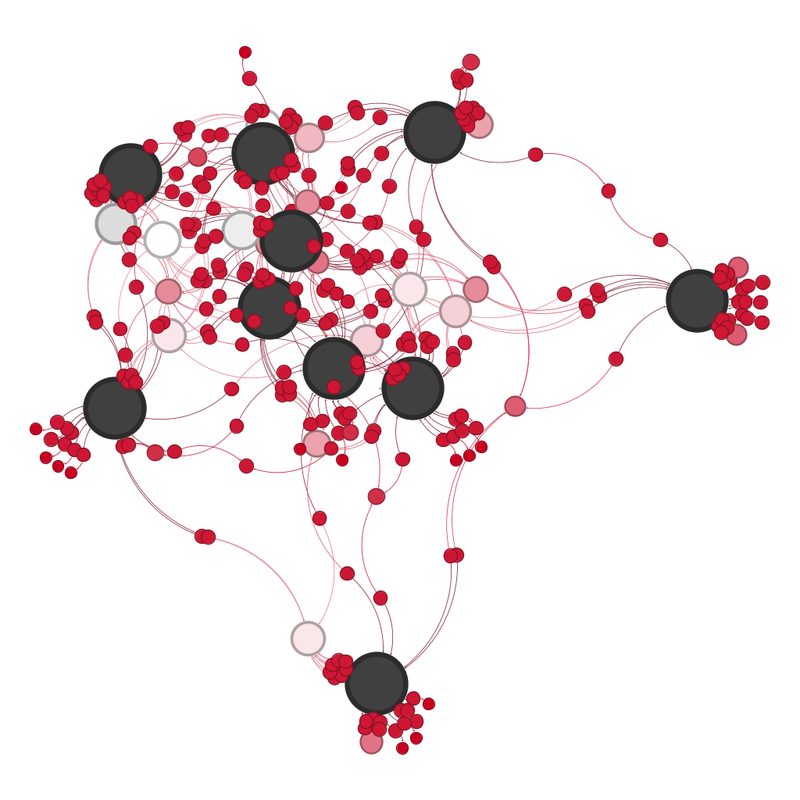
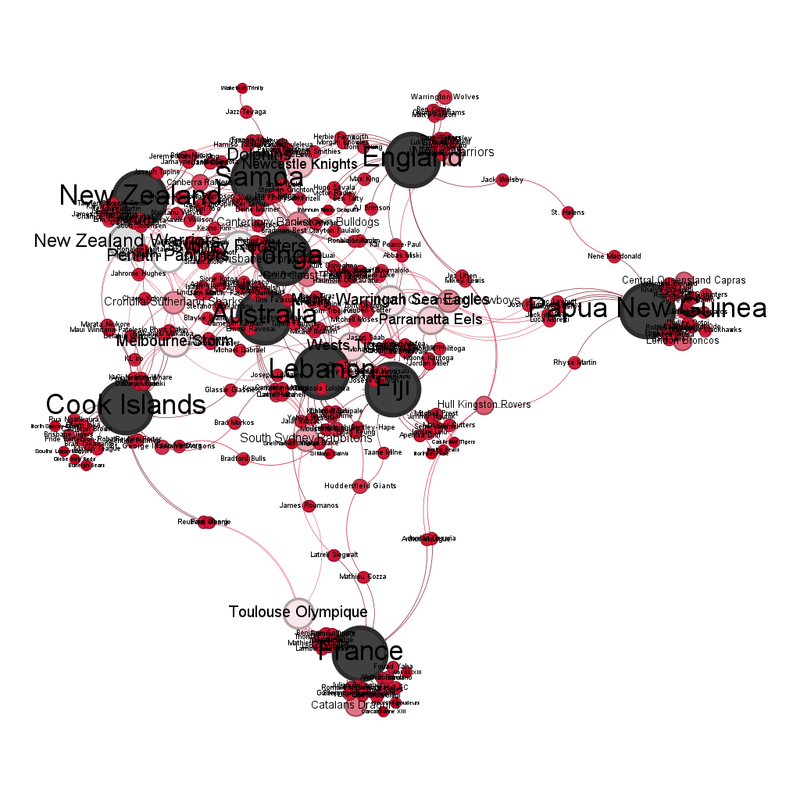
The two teams that are sticking out are Papua New Guinea and France. Teams stick out if their players play for clubs who don't have a lot of other participants playing for other national teams. If the previous pattern that sticking out = weaker remains true, this means Tonga have been stuffed over by the draw and have a harder route to qualify for the semifinals. They would need to beat one of Samoa or England to qualify, while England and Samoa only have to beat Papua New Guinea and France. No diss on Papua New Guinea intended, because I really want them to do well.
I think Papua New Guinea are pulled out because so many of their players play for London Broncos who don't have any other representatives while the Cook Islands players are spread over more club teams so the weight of any individual team doesn't pull them out in the same way.
The club team with the most representatives are the New Zealand Warriors and the Sydney Roosters who both have 13. They are followed by the mysteriously un-city-ied Dolphins and Penrith Panthers on 12, and Manly Warringah Sea Eagles, Melbourne Storm and Toulouse Olympique on 11.
Because 8 of the teams are clustered together, Fiji are the team in the geometric centre of the graph, while Tonga and Australia are probably the "gravitational" centre.
Hull Kingston Rovers and South Sydney Rabbitohs are the club teams closest to the physical centre.
The other thing that strikes me is a suspicion that the NRL must be relatively evenly matched because the Australian squad aren't dominated by one club team, unlike the way say France are by Toulouse Olympique. (Until the first match, I promise not to comment on the excessive number of Wigan players in the England squad. Brian McDermott, you'd better have a good reason for not starting Jez Litten.)
The one upside to there only being ten teams is that it's relatively quick to make the diagrams so I hope to have the women's and, data permitting, the wheelchair teams graphs ready shortly.

No comments:
Post a Comment