My first observation of the scrutineering at the Chinese Grand Prix is that different things are checked at different Grands Prix.
That makes some sort of sense.
F1 engineers are a bunch of overgrown schoolboys and girls looking for a way to get around the rules. If you always checked the same things, they'd make sure those things were legal and that everything else wasn't. But, at the same time, there is no way to check everything on every F1 car every race. So always checking most important things and varying which of the other things you check makes sense.
On the other hand, some of the differences don't make sense.
An example is that, after the Australian Grand Prix, one of the top 10 finishers (car 63 - George Russell) was chosen for "more extensive physical checks".
After the Chinese Grand Prix, no car was similarly chosen.
I don't think it was number of finishers, Australia had 16, China had 15. Possibly >15 is the cut off?
It's something I'll keep an eye on as the season progresses.
Below is a bar chart of the number of checks compared to expectation (measured using standard residuals).
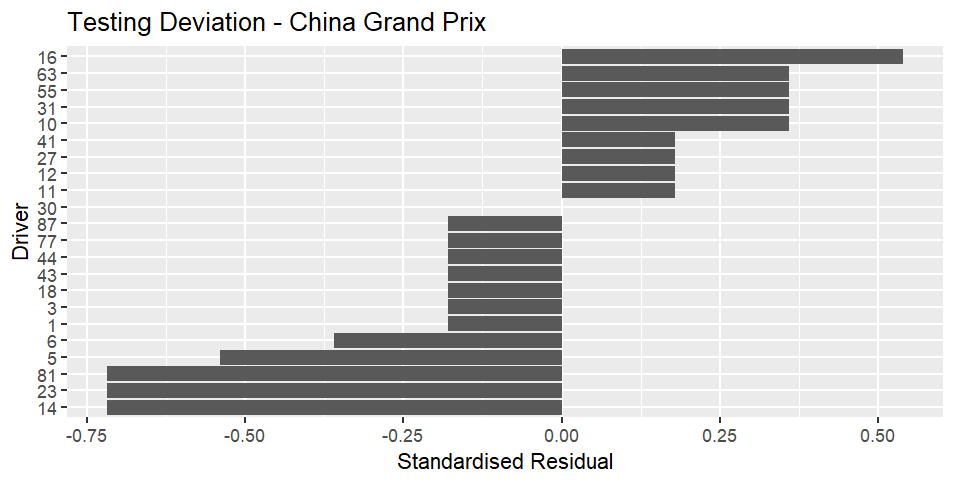
The most tested driver is Leclerc, while Piastri, Albon and Alonso are the least tested.
None of the differences from expected are statistically significant.
Most of the under-tested drivers are those that either did not start or had to retire from the race which supports the theory that under-testing is related to not completing the race.
The season up to the end of the Chinese Grand Prix:
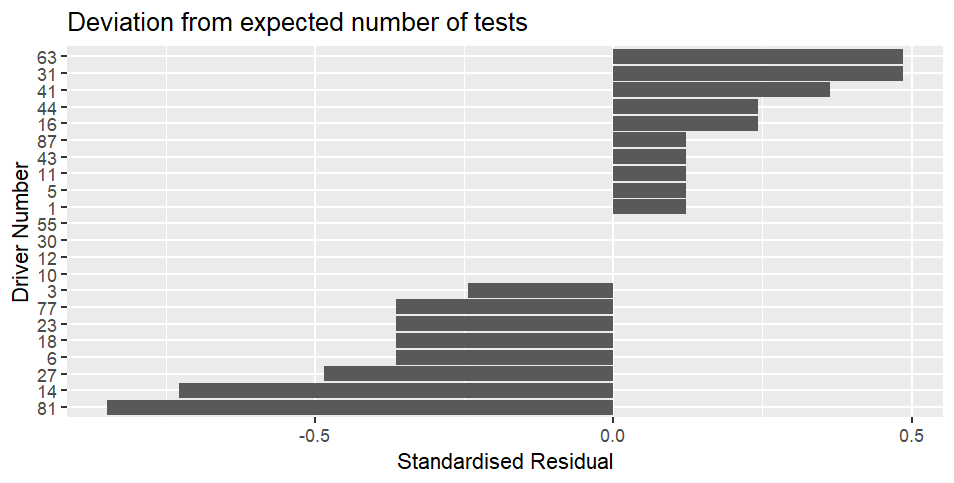
Piastri (car 81) being the most under-tested supports my theory that the under-testing is due to not finishing and is exacerbated by him not even starting those races.
George Russell (car 63) being one of the most over-tested I can explain because of how well he and Mercedes have done. Ocon (car 31) being equally over-tested, I can't explain, because Haas haven't performed as well as Mercedes and Ocon isn't the top-performing Haas driver.
The number of drivers that have been tested exactly the number of expected time, now 4 rather than the 2 after the Australian Grand Prix, also makes sense if, as hypothesised, the number of tests will converge towards expected as the season continues.

No comments:
Post a Comment